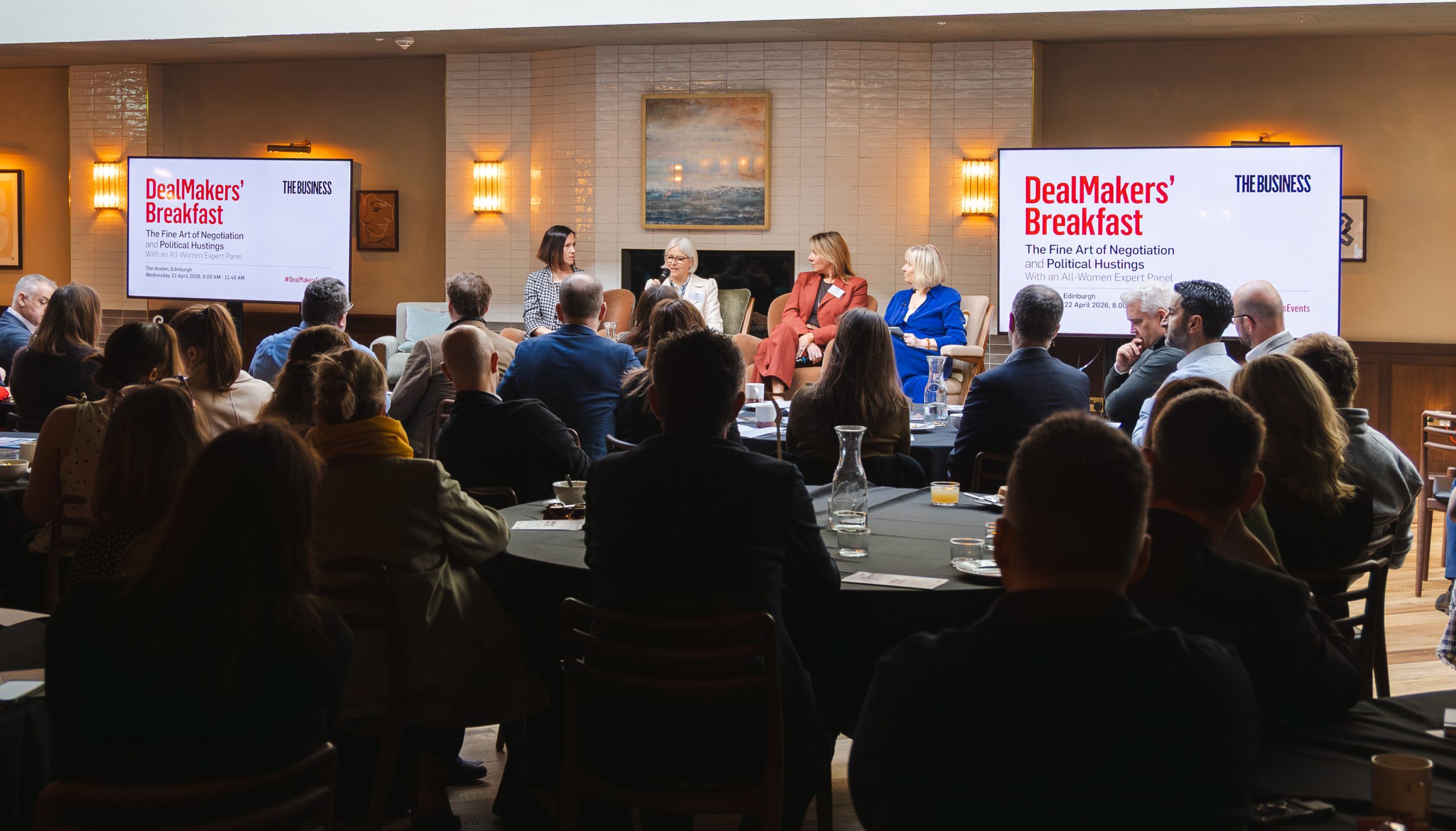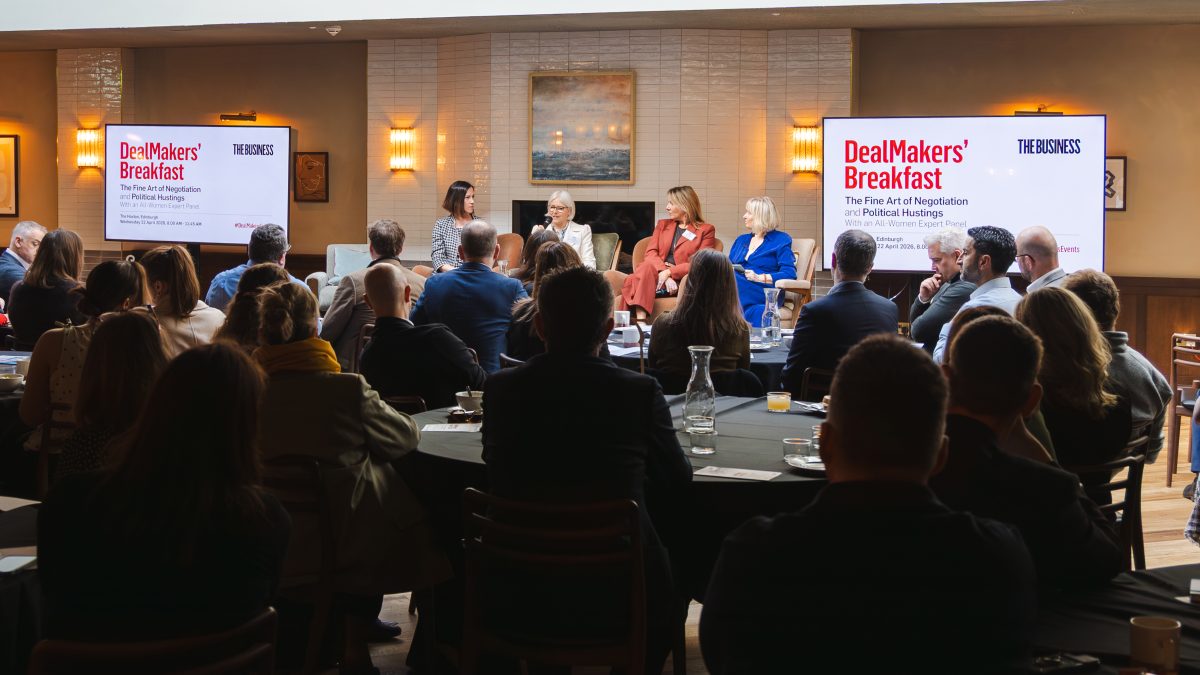

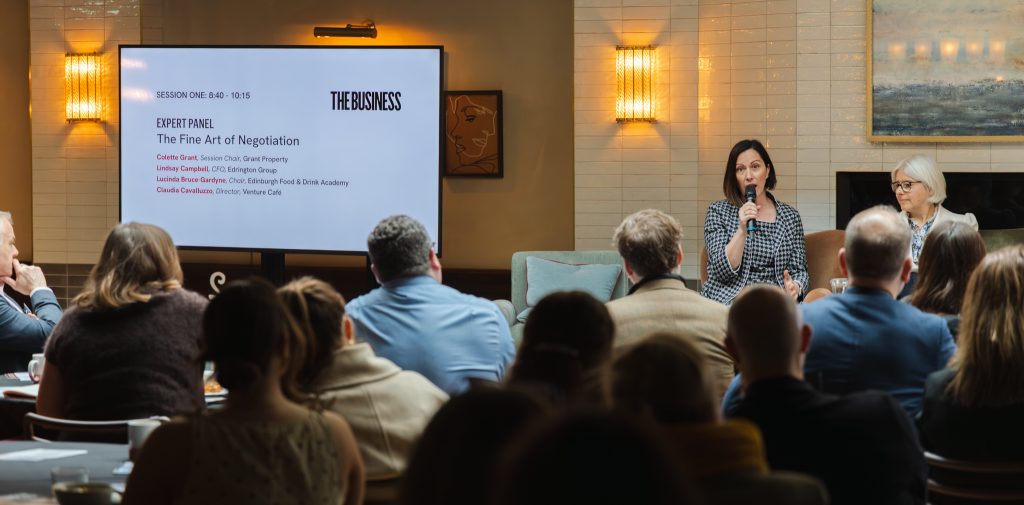
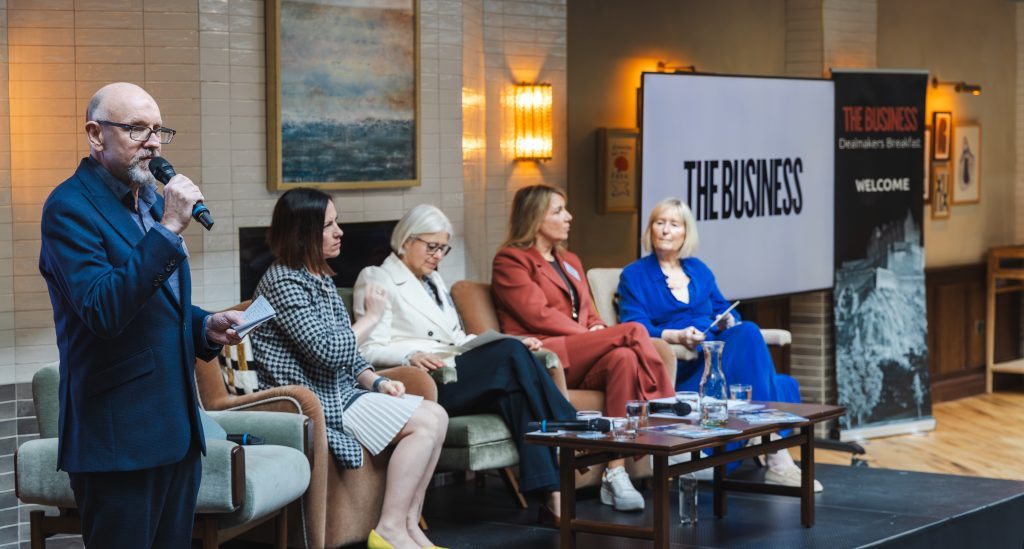
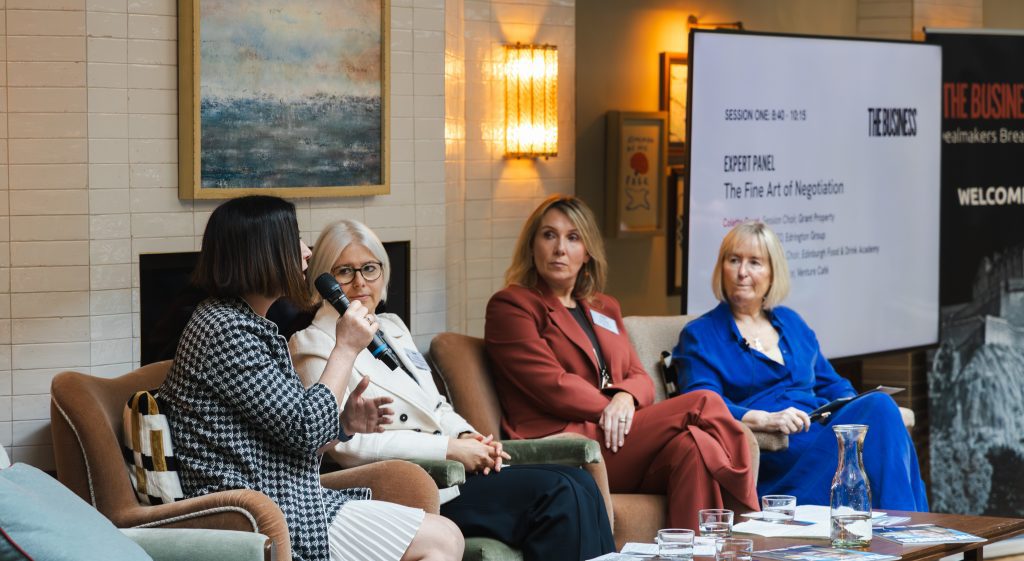
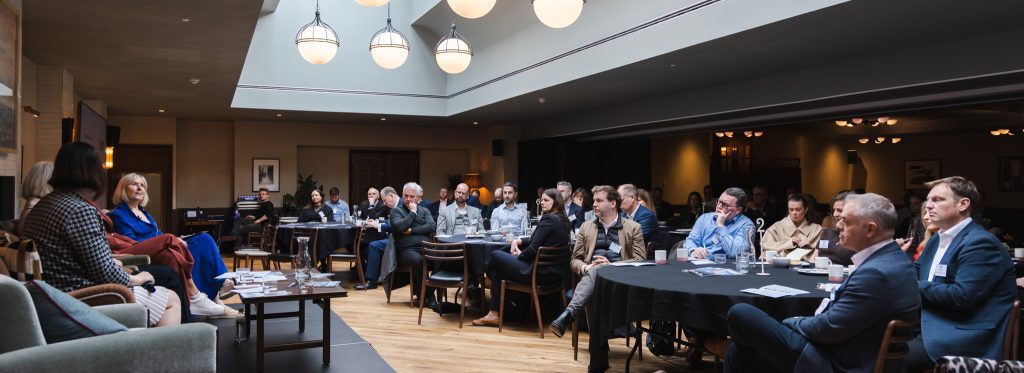
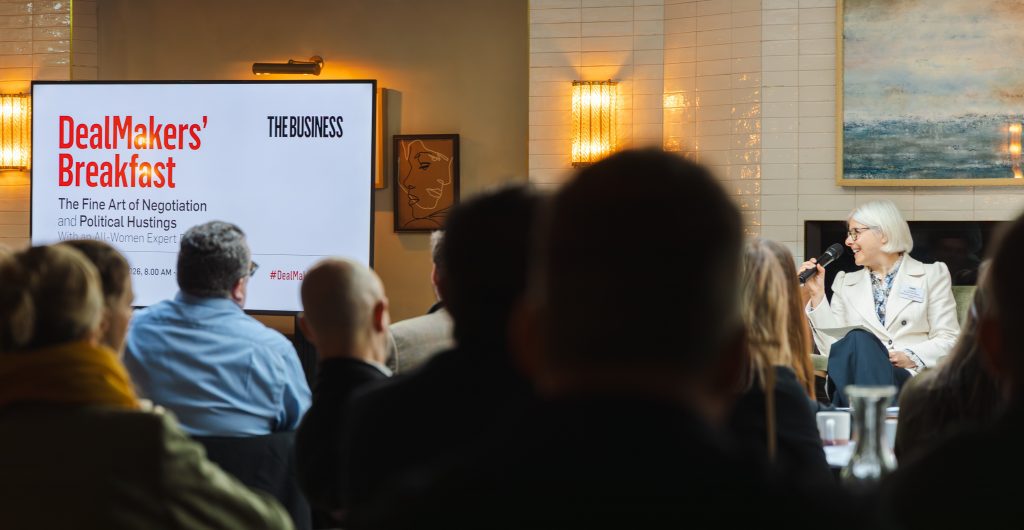
The Business Dealmakers’ Breakfast panel at the Hoxton in Edinburgh on Wednesday 22 April, chaired by Colette Grant, with Lindsay Campbell, Lucinda Bruce-Gardyne and Claudia Cavalluzzo, offered an array of ‘Expert Insights’.
Negotiation, as Colette Grant observed when opening The Business’ panel discussion on the Fine Art of Negotiation, is something we all do every single day in life.
From conversations with colleagues and clients to the running monologue we hold with ourselves in our head about whether to push forward or hold back, it is woven into every corner of professional and personal life.
“Everything in life is a negotiation: with ourselves, which I think is probably one of the biggest things. Shall we, shan’t we, what will they think, what will that be? It’s all going on in our head and nobody else even knows about it.”
The panel that gathered to explore that theme brought together four exceptional business women, each shaped by different routes through the world of deals, investment and enterprise. It was an eclectic session which truly sparkling.
INTRODUCING THE PANEL
Colette Grant is a serial entrepreneur and former chair of the Saltire Foundation, whose experience spans property investment, entrepreneurial mentoring and the kind of resilient, hard-won wisdom that only comes from having navigated a business through the full spectrum of fortune.
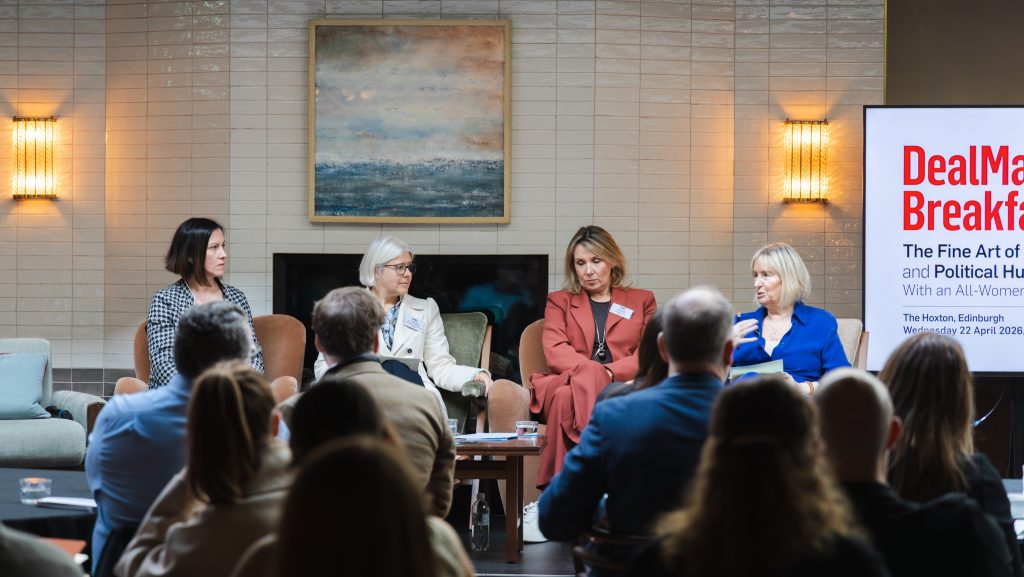
Lindsay Campbell is a Scottish chartered accountant whose career has wound through large global plcs, owner-managed businesses, management buyouts and some of Scotland’s most iconic whisky brands, most recently as a senior figure at Edrington, home of The Macallan.
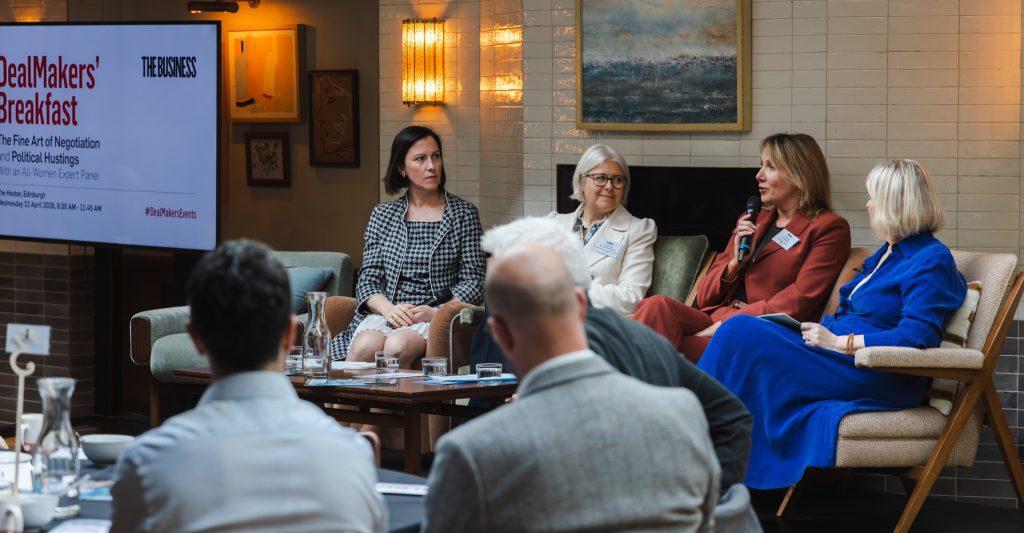
Lucinda Bruce-Gardyne founded Genius Foods in 2009, the UK’s first fresh gluten-free food brand, scaling it from her kitchen in Edinburgh to a global operation run out of Bathgate, before going on to chair Scotland Food and Drink and, most recently, acquiring the Edinburgh Food and Drink Academy.
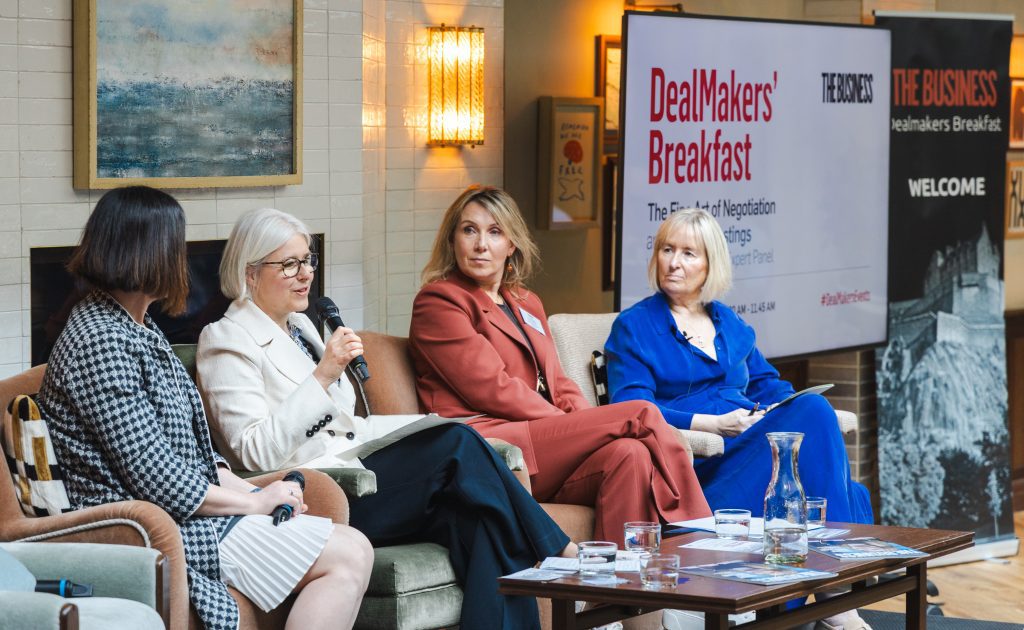
Claudia Cavalluzzo is an Italian scientist-turned-entrepreneur, now Director of Venture Café Edinburgh, who came to Scotland via a love of molecules, a PhD in organic chemistry and a transformative stint at Babson College, one of the world’s leading entrepreneurship schools.
Between them, these four women have sat on both sides of the negotiating table: as founders pitching to investors, as executives doing cross-border corporate deals, as investors evaluating early-stage startups, and as mentors watching others navigate moments of high-stakes uncertainty. Their conversation, moderated with characteristic energy and candour by Colette Grant, ranged from the mechanics of preparation and listening to the deeper questions of trust, authenticity and how to hold your nerve when the pressure is on.
KEY SKILLS FOR SUCCESS IN NEGOTIATION
Lindsay Campbell opened with what she described as three pillars: preparation, listening and flexibility. But it was her emphasis on preparation — specifically on clarity about what she called ‘non-negotiables’ which set a tone for everything that followed.
“You get so caught up in the deal and the excitement of it that you aren’t really clear about the things that are your non-negotiables.”
A transaction in which her side had a paramount concern around legal certainty, while the other party was focused almost entirely on commercial terms. When it became clear that the core issue was being consistently sidestepped, her team took the difficult decision to drop the deal.
“We stepped away, managed to get an agreement on that, and then we stepped forward again and we could be much more flexible in terms of some of the commercial terms.”
On listening to the discussion, Campbell was also emphatic. It is not simply a matter of politeness or patience; it is a strategic tool that yields information you would never otherwise gather.
“A lot of the time you go in there thinking, what do I want, what’s important to me? And actually, what’s really important as you go in there, you’re also listening, because you’ll begin to realise where are some of the points that people are willing to give on.”
Sometimes it's not the loud voice you need to be listening to, but it's maybe somebody else [...]
- Lindsay Campbell
She added a nuance that rang out across the room: the most valuable intelligence in any negotiation rarely comes from the loudest voice.
“Sometimes it’s not the loud voice you need to be listening to, but it’s maybe somebody else, because you can see they’re a slightly different, they’re part of the decision-making process, and they will probably give you an awful lot more.”
Her third pillar, flexibility, was illustrated by an earnout negotiation in which careful listening revealed that the other party placed a significantly higher value on the earnout element than her side did. That gap in perception, once identified, created the room to manoeuvre.
“Their perception of the value in the earnout was certainly more than what we thought the potential was. And therefore, that allowed us to say, actually, we don’t want an earnout, but we need to adjust in terms of what we’re going to give you.”
Lucinda Bruce-Gardyne has made her fair share of deals, especially with manufacturing agreements negotiated with suppliers across three continents, licensing deals in markets she was entering for the first time, a large-scale retail listing from a standing start, and most recently a multi-investor acquisition of the cookery school in Edinburgh.
Everything was about ‘gut feel’, and the courage to trust it even when logic or excitement pushes in another direction.
“I think the most important thing I’ve learnt over many years now is gut feel. If you get a weird feeling, you can back that weird feeling away thinking, no, this is going to be great. And I think probably 99 per cent of the time it comes back and bites you in the bottom.”
Can you work with these people long term? Because when you do a deal, you're sort of married to them.
- Lucinda Bruce-Gardyne
“Even if you really, really want that deal — because in the short term it’s going to bring you some cash or it’s going to bring you an opportunity that you think is really exciting — in the end, I’m not sure that is the way to do a deal. Look at the long term. Can you work with these people long term? Because when you do a deal, you’re sort of married to them.”
But she was not advocating for pure instinct. Gut feel, in Bruce-Gardyne’s framework, must be accompanied by rigorous due diligence.
She described a process of progressive testing: examine the other party’s track record, speak to people who have worked with them, understand what they have made for others. Then, crucially, begin to probe the relationship through the term sheet itself. “What happens if? What would you do if this happens?
WHY IT’S BEST TO STAY IN NEUTRAL
Or what should we put in place to ensure that a possible challenge can be dealt with in a mutually beneficial way? And quite often when you start to test and prod, when you’ve had a slightly funny feeling about it at the beginning, you start to see what people are really made of because they’ll either be defensive or not want to discuss it, which is always a big red flag.”
She was also clear about the role of the team. No significant deal should be navigated alone.
“An important game-changing deal for your business is a team effort. It’s worth really listening to everyone in that team to decide whether or not you need to act on something you’re feeling nervous about.”
And on lawyers, of which there were several in the room, she offered a practical observation that drew knowing laughs from the audience:
“I think it’s really important to bring lawyers in a little bit later on, once you’ve really tested those big ticket items between yourselves. Because the moment lawyers enter the whole negotiation, things become all about fine detail. And that can be quite distracting and take you away from those really big things that you really care about.”
The best advice I ever had was: get more neutral.
- Colette Grant
Colette Grant, reflecting on her own experience, added a principle she had picked up in a particularly difficult negotiation: the importance of neutrality.
“The best advice I ever had was: get more neutral. Being over-excited is actually as bad as being under-whelmed or fearful. Some of the negotiations I’ve had to do aren’t really for a great outcome, they’re just saving our lives. So being more neutral and trusting yourself is huge.”
Claudia Cavalluzzo has spent years working at the intersection of science, entrepreneurship and investment — first running the Converge competition for early-stage academic spinouts, then as COO of MI:RNA therapeutics company, and now as a micro-investor and connector-in-chief at Venture Café Edinburgh.
Her perspective on trust was grounded, warm and rooted in a clear-eyed understanding of what investors are actually buying.
“Trust is something that is absolutely key to every deal — investment, negotiation, partnership, employment, relationship. And it’s something that takes time.”
That, she acknowledged, creates a genuine challenge in a world of short meetings and first impressions. The answer, she argued, lies in two things: demonstrating competence and being genuinely human.
AUTHENTICITY IS HARD TO FAKE
“As an entrepreneur, you will be the person who knows your business the most. You will know what the pain points are, you will know the technology that underpins it. By showing that and your competencies, you earn that respect that will get the investor really interested and maybe give you a chance.”
Authenticity is harder to fake and impossible to sustain if it is faked at all.
You can get people to like you, but eventually it will come down to who you really are.
- Claudia Cavalluzzo
Cavalluzzo was direct about the risks of performing a version of yourself in high-stakes situations. She pointed to the Theranos case, involving Elizabeth Holmes and Ramesh Balwani, who were involved in an elaborate fraud over blood testing which was uncovered in 2015, as a stark cautionary tale:
“There was an idea and people trusted this individual, but she wasn’t really being authentic. You can get people to like you, but eventually it will come down to who you really are.”
For early-stage investors in particular, she said, the person across the table is as important as the idea.
“Yes, investors are buying in the opportunity, perhaps even the technology, but what they’re really buying into is you as a person. Are you the person who can ride all the waves, all the manufacturing disasters, all the negotiations? Can you bring people on board? Can you be resilient? And you might not have those skills yet — but if you have the aptitudes and if you have that authenticity and that courage to ask for help and not just pretend that you know everything, I really think you can bring people on that journey with you.”
She ended with a piece of practical advice that cut through everything: warm introductions are not optional, they are essential.
An investor at a recent event had mentioned receiving around a thousand pitch decks a year, with an average reading time per deck of 35 seconds.
“You can have the best AI-designed pitch, but it’s not going to cut through. The warm introduction might just lend you that chat.”
She concluded: “Build your network. Never, ever stop building your network.”
CULTURAL VERSUS CORPORATE DYNAMIC
Lindsay Campbell has conducted deals in Japan, China, the United States and across Europe. She was careful to caveat her observations as generalisations.
But the patterns she described were vivid and practically useful. In Asian cultures, she noted, hierarchy operates at a deep structural level that can catch the unprepared negotiator badly off-guard.
“You think you will have agreed things, and you maybe will have agreed it with the individuals who are in that room. But what I didn’t realise initially was actually they have to take that back up a hierarchy, and it needs to come back to you. And probably when it comes back, you won’t have agreed what you thought you’d agreed.”
Her key recommendations for cross-cultural negotiation are patience, humility and a refusal to show frustration.
“If you get frustrated and how you interact with people goes slightly the wrong way, that can stop a deal happening or certainly change the dynamics of a deal. So continue to be humble and patient — it becomes really important in that culture.”
By contrast, US business culture, she said, tends to be more direct and front-loaded. “It is much more on the table up front.”
Claudia Cavalluzzo illustrated this vividly with a story about a virtual deal discussion with an American counterpart that she had misread entirely.
She had been certain, from body language and tone, that the meeting was going badly — only for the other party to end it with a brisk and positive summary of next steps.
“I was sure I could read the room. But she was so direct and to the point, she said, yeah, this sounds good, I think we could negotiate this deal, these are the three options, come back to us. I was shocked.”
The lesson she drew, echoing advice that Colette Grant had been for years.
“Do not make assumptions. Just because maybe someone has done that before, it doesn’t mean they’re going to do that again.”
Lucinda Bruce-Gardyne took the international theme further.
When Genius Foods went global, one of the most important early decisions was to hire local team members in each target market.
“It ticked all the points you’ve mentioned, the business etiquette is different, business is done differently, you don’t have the contacts, you don’t have that trust network. People don’t know you from Adam. So suddenly you’re putting an ambassador almost in front of you in country who can speak their language, who have those relationships.”
Don’t assume your product travels unchanged across borders.
“I’ll never forget when we took Genius bread to Germany. They don’t use toasters in Germany. This idea of turning up with a sliced loaf — they couldn’t care less. They want rolls, they want loaves of bread that they can cut however they want to cut.”
On the corporate versus entrepreneur dynamic, Campbell offered a frank assessment grounded. The language is different, the timescales are different, and most importantly the emotional stakes are different.
“That business is their one and only sole focus. Actually, the dynamic changes, it wouldn’t be a corporate’s one and only sole focus and it isn’t the most important thing in the world to the corporate.” She described one acquisition that had not worked out because the founder, after the sale, could not come to terms with the fact that their business was no longer the centrepiece of every decision.
“They could not see why they would ever want to change that. And therefore, unfortunately, that just didn’t quite work out in the way that we anticipated.”
A WIN-WIN DEAL THAT LASTS
Returning to Lucinda Bruce-Gardyne for a question about longevity in deal-making, the panel moved into more operational territory. She had spent years navigating manufacturing relationships. These arrangements were literally putting the survival of her brand into another company’s hands. So her checklist for doing so was both rigorous and detailed.
The key test, she said, is what happens when you start to put the commercial relationship under stress before you have signed anything. Are your prospective partners willing to invest in order to work with you properly?
“If they’re not prepared to do anything to help invest in new equipment, that’s okay, it’s just not going to work — because it has to be a partnership.”
Are they willing to give you innovation time in their facility?
“If you’re not going to be allowed the time and space to continuously improve, they’re not the right partner.” And — perhaps most revealingly — what do the working conditions on their shop floor look like? Are the execs sitting in lovely, comfortable offices while everyone working on the shop floor has a dreadful canteen and dirty loos? That tells you a lot about management.”
This was much more than the glossy side of the dealmaking.
“You need to really understand what the conditions are like for the workers in it. I think that’s really important.”
Plan beyond the honeymoon period she added.
“Then you also need to talk really openly about what happens if your product isn’t selling. What happens when you’re under stress? Because that’s when a relationship really, really tells. It’s all very nice at the beginning of the deal — it’s all very exciting. But when you enter that day-to-day phase and you’re dealing with the challenges that come up, it’s important that you can navigate those together, because that’s quite often where it all starts to fall apart.”
FINDING THE IDEAL BALANCE ON BOARD
The theme of the right board composition emerged and Bruce-Gardyne was unequivocal:
“Don’t fill your board up with one kind or expertise. Don’t fill your board up with financiers. You want people that understand the technical side of your business too, or understand your industry so that when things don’t work, they’ve got really meaningful solutions that they can bring to the table and really meaningful contacts.”
Campbell reinforced this with a story about her time as finance director with Colette at Grant Property, when the deal excitement had threatened to carry the founder into agreements that needed challenging.
“With your FD hat on, making sure you’ve got the people who can be the Rottweilers if you need them — you should have somebody who’s going to be that. It’s not all about relationships. You actually need to have some hard commercial conversations as well and not be afraid to have them.”
HOW CAN ENTREPRENEURS LAND THAT DEAL?
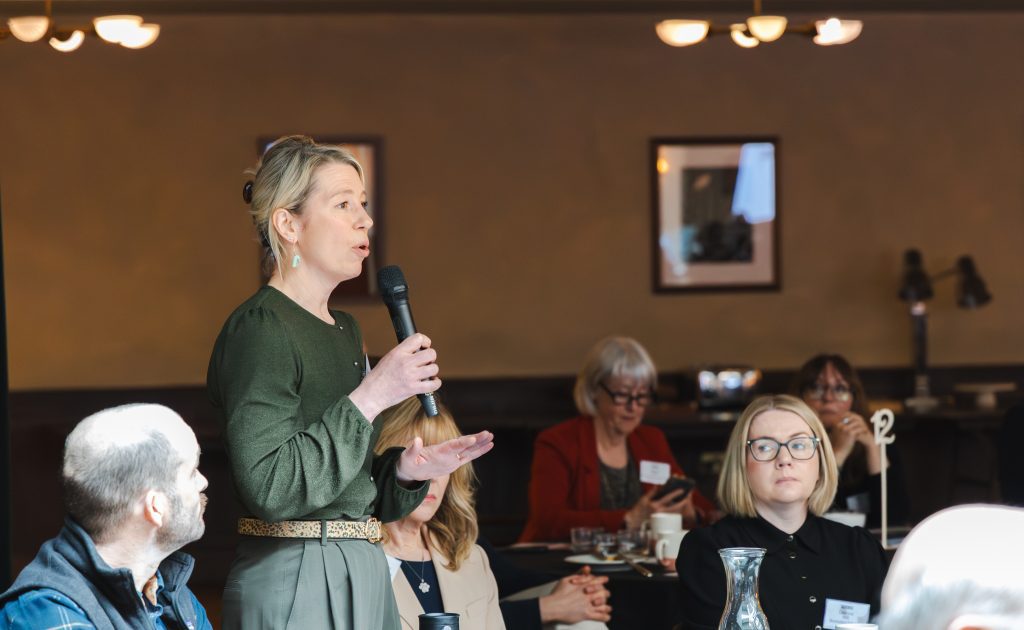
Claudia Cavalluzzo returned to one of the most consistent themes of the discussion: the asymmetry between the preparation investors and founders each do before they meet.
Most knockbacks from investors come not from the pitch itself, but from a failure of prior research.
“It could be because the investor is not investing in that kind of business model, that stage, doesn’t have similar businesses that could really help that business in question flourish. So doing the due diligence is absolutely key.”
The logic is not just practical but relational. Doing your homework is, a form of respect. “It also shows that you care about their time and you’re not wasting their time.”
She encouraged founders to talk to others who had received investment from their target investors; not just to understand the fit on paper, but to understand what the relationship actually feels like from the inside.
She returned again to the power of warm introductions, and to the extraordinary statistic about pitch decks: a 1,000 received, 35 seconds of attention per deck.
Her message was network maintenance is not an optional extra for entrepreneurs, it is foundational.
PHEW! IT’S OVER. AFTER THE DEAL IS DONE
On what it feels like when a deal closes, Campbell described the emotional cocktail as: “Relief, joy, excitement — and exhaustion.”
Bruce-Gardyne recalled the moment Genius bread was listed in 700 Tesco stores: “The gratitude of the trust that Tesco had put in me and the team to somehow figure out how the hell we were going to make enough bread from a manual process to fulfil orders from 700 stores. It was just humbling, actually — wow, people trust us enough to give us that chance.”
Cavalluzzo offered a more instinctive response. “I high-five myself. Well done me. I always have this self-doubt, and I land something big and I’m impressed with myself.”
A question about investor types prompted Bruce-Gardyne to reflect on the differences between angel investors and private equity, drawing on Genius Foods’ own funding journey.
Both types, she argued, need to believe in the brand, the values and the long-term vision — but Private Equity brings a different intensity.
“It’s a much stricter, more formal relationship. They really need to have that understanding of the technical aspects and be able to introduce you to people that can help improve those technical aspects as you scale, because they will be wanting you to scale really, really aggressively. Don’t just have private equity that just wants the glamour.”
The preferred option is the investor who allows the business to grow organically.
“Patient capital is everything. And if people say they want their money back in three years, they’re not the right people.”
SO WHAT WOULD THE PANEL DO DIFFERENTLY?
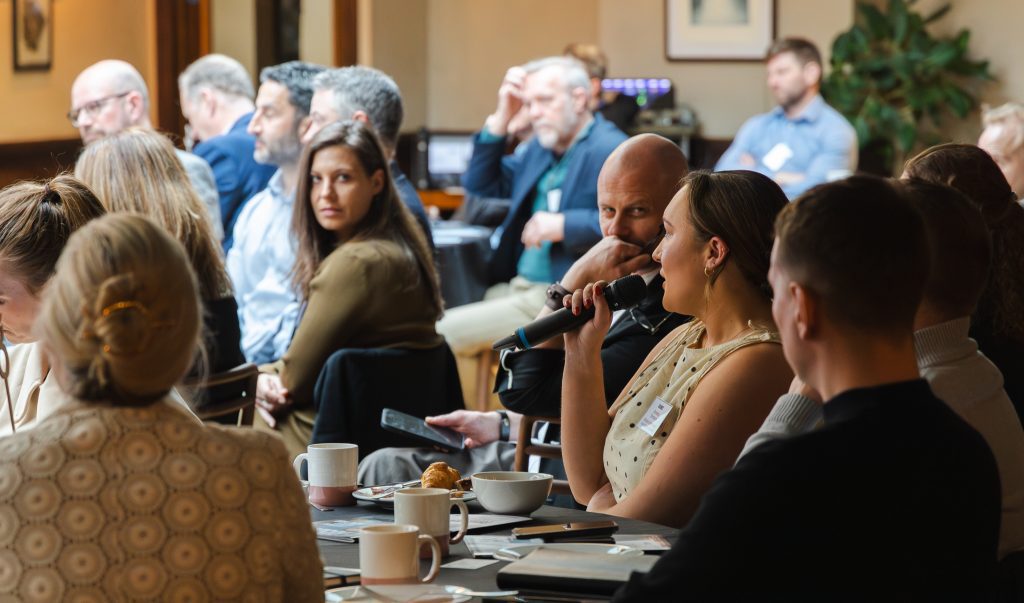
The panel’s final exchanges were asked what they would change about the deal-making process if they could, the answers were personal.
Claudia Cavalluzzo went straight to the fundamental challenge of early-stage investment: the near-impossibility of answering detailed financial questions when your business is still largely an idea.
“Investors are asking you questions that are a finger-in-the-air type of answer, like what is my cash flow going to look like in five years? How do I know?”
She called for more meaningful early-stage conversations which probe strategic thinking and clarity of purpose rather than demanding projections that nobody believes anyway.
“I don’t think there is a need for long-term predictions when nobody really believes them.”
Lindsay Campbell directed her mild impatience at the late-stage legal process, while being careful to note how important it is.
“When you get to the stage where you’re in the detail of the 300-page legal agreements, that’s the bit that I probably have an element of frustration with. And that’s more to do with me.”
Her practical solution when things get stuck in legal loops: get both parties and both sets of lawyers in the same room and refuse to leave until something is agreed. “Otherwise things can go round and round in circles.”
Lucinda Bruce-Gardyne offered her thoughts: always be learning, always stay humble, never think you are safe.
“Act as number two, even if you are number one. Never think you’re safe. Always be thinking about how you can continuously improve your business. It’s a journey, a winding journey with decisions. You’re making five or six reasonably important decisions a day in business. And so much of it does come down to gut feeling, but also the people you have on the team.”
Lindsay Campbell, reflecting on an early deal she had been involved in when she was, by her own admission, very wet behind the ears, said: “Surround yourself with great people, and be willing to take a punt. You’ve got to also just take a punt and push yourself out of the comfort zone. And accept that you’re going to make mistakes and don’t beat yourself up about it, as long as it’s not a fatal mistake.”
Colette Grant reminded the audience that the fun is in the way you get there, not when you get there.
“The fun you have along the way, even when it’s really bad, actually, is the part that I wish I had known. Because you look back and think — oh, do you remember when that was so great? And at the time, you were like, how the hell do we get out of this?”
AND A FINAL THOUGHT?
The panel each distilled the morning into an elegant aphorism.
Claudia: “Build your network. Never, ever stop building your network.”
Lindsay: “It’s not about somebody being a winner and somebody being a loser. It’s about a balance trade-off. Through that process, you’ve got a collaborative approach that recognises there are joint benefits and joint wins out of it all, because generally you’re in the relationship for the longer term.”
Lucinda: “Be really clear of your red lines. Sticking to your guns and sticking to your values and sticking to your vision when you’re building a business will work so much better for you in the long term. It takes courage to say no — but never feel that you’re taking the easy option in doing so.”
Colette: “Being yourself is always an upgrade. This is your one chance at this life. Maybe not take ourselves quite so seriously, and have fun along the way.”
So, the Fine Art of Negotiation is about building relationships and those honest conversations, something which rewards those who show up as themselves, listen well, and never stop believing make good things are possible.