
When Gordon Dewar took over, Edinburgh Airport was on a par with Glasgow. It is now way ahead and established as Scotland’s gateway to the world. How did he achieve this runway success?
As September arrives in Edinburgh, locals let out a collective sigh. The festivals are over, the last notes from concerts at Murrayfield have faded, and the city returns to something resembling normality. Tourists ebb away, commutes become more straightforward, and a familiar rhythm settles back in.
The cultural calendar may rise and fall, but at Edinburgh Airport, the city’s gateway to the world, nothing interrupts the steady business of travel.
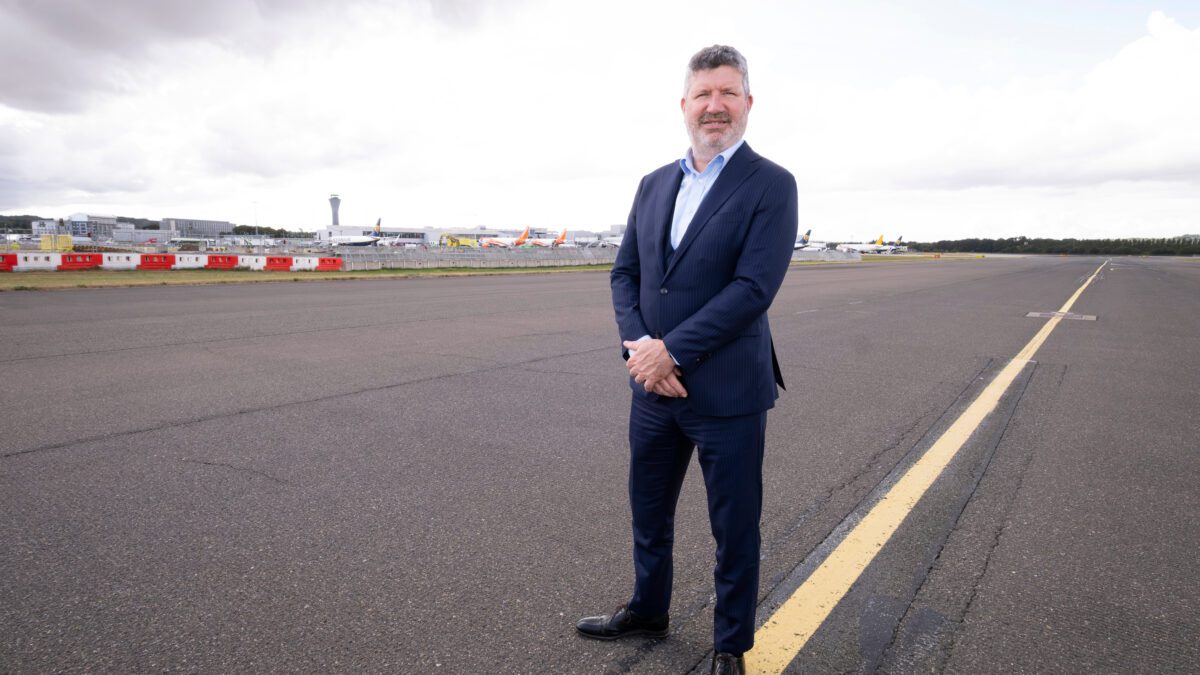
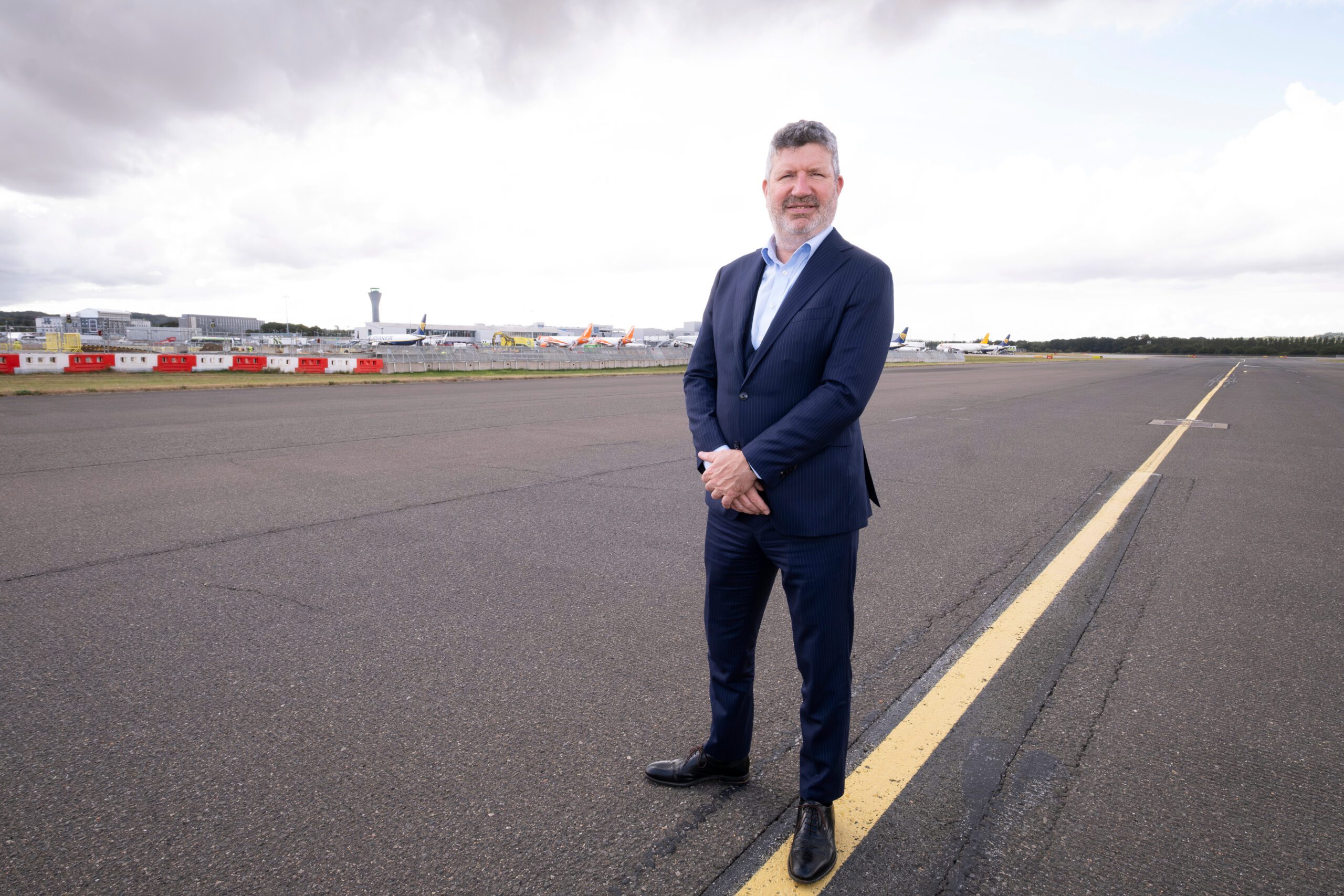
Its Chief Executive, Gordon Dewar, is dressed in a navy waistcoat and open-necked light-blue shirt, his look smart but relaxed – a fitting demeanour for someone who has spent more than a decade running Scotland’s busiest airport.
“I was born four miles from the airport, in Carrick Knowe,” he says, proud of his roots. “My father was a policeman; mother was a dinner lady.”
It is a modest starting point for someone who has presided over what many would describe as the most transformative period in the airport’s history.
After university, Dewar began his career in transport consultancy before moving into operations with FirstGroup and then Aviva. He joined the British Airports Authority (BAA) in 2007, first in Glasgow and later in Edinburgh, before spending two years in Bahrain helping to set up a new publicly-owned airport company.
Those years abroad were marked by personal tragedy, when his daughter Olivia was killed in a car accident aged just 17.
On his return to Scotland, he was approached by Global Infrastructure Partners (GIP) when it was bidding for Edinburgh Airport, and when the deal went through in 2012 he took charge.
At that time Edinburgh and Glasgow were comparable in size. “They were neck and neck, literally nine million passengers each back in 2012,” he remembers. But Edinburgh soon pulled away. Freed from BAA’s ownership and given a mandate by GIP to compete, the airport surged ahead. “Once the ownership said you’re now allowed to compete with the likes of Glasgow actively… that was a real shift.”
The results are stark. By 2019, Edinburgh was handling a record 14.7 million passengers, compared with Glasgow’s 8.8 million. Then came Covid.
“Mid-Covid, zero passengers, sometimes 12 or 13 in a day,” he recalls. “We were doing five kilometre runs on the runway because there was nothing else to do with it.” His tone turns noticeably sombre. “The hardest decision I’ve ever made in my career was when we lost about a third of our colleagues. It was horrific.”
Yet the crisis also gave him space to think differently. “Mostly, what really transformed our recovery was thinking about the relationships we wanted to preserve… it gave us an excuse to talk to people throughout.”
Those conversations with airlines, retailers and partners while planes were grounded proved decisive.
So, when the world opened up again, Edinburgh was ready. By 2023, it was back at 14.4 million passengers, almost at its pre-pandemic peak, while rivals were still catching up. And crucially, the relationships built and deals struck with airlines during the shutdown began to bear fruit.
Virgin Atlantic shifted trans-atlantic routes from Glasgow. JetBlue chose Edinburgh as its only Scottish destination. WestJet expanded services from Canada, while Emirates returned from Dubai. “Now, the only airport in Scotland that offers US direct flights is Edinburgh,” Dewar says with satisfaction.
“I’m really excited by JetBlue because we’re proving that we can compete in American destinations – in Boston, in JFK – so that was a really sweet one for us.”
The one he talks about with particular pride is in the Far East. “I guess, personally, probably the Beijing one… that’s a real feather.” For Dewar, it showed that Edinburgh could play not just on the European or transatlantic stage, but in the most competitive aviation market of all.
This progress has carried Edinburgh past the 15 million-passenger mark and put it firmly on course to handle 16 million this year.
Edinburgh’s resurgence is not just a story of passenger numbers and flight schedules. The airport is also a vast economic engine. Every traveller who passes through leaves their mark on Scotland’s economy. “It’s really easy to quantify,” Dewar says. “Every few years, we do the study, and it’s £100 per passenger, the GVA (gross value added). So, we think we’ll be £1.6bn of GVA this year.”
He is noticeably proud as he sets out the numbers, and with good reason. That figure translates into livelihoods on a remarkable scale. About 1,000 staff are directly employed by the airport itself, another 10,000 work on the campus, and many tens of thousands more are supported indirectly across tourism, logistics and the wider supply chain.
Mid-Covid, zero passengers, sometimes 12 or 13 in a day. We were doing 5km runs on the runway because there was nothing else to do with it
As a former board member of the Scottish Tourism Alliance, Dewar is acutely aware of the airport’s role in drawing visitors to the country. Direct flights from North America and Asia don’t just service Edinburgh or even the Central Belt; they ripple out to the Highlands, the Islands and Scotland’s other cities. “We’re selling not just Edinburgh Airport, we’re selling this phenomenal brand of Edinburgh, the city, and Scotland, the country,” he says.
Growth on this scale demands constant investment. Dewar reels off the numbers. “Our average spend in the past 12 years is about £40m a year. We’re going to be spending £120m a year for the foreseeable future.”
That ramp-up includes pushing the front of the airport out by 37 metres, marking one of the most significant visible changes to the airport since Dewar took over. It will follow projects such as extending the south-east pier, along with new gates to increase capacity.
But not every change has been popular. Parking charges remain a lightning rod. But Dewar is unapologetic. Animated now, he launches into a frank response to those criticisms.
“People say, ‘I don’t want to pay £6’. Then don’t. Either get the bus or, even better, there’s a free drop-off point. We keep saying this. Then people say, ‘I don’t want to walk so far’. That’s a different challenge, isn’t it?
“If you don’t want to pay £6 for the convenience, but you’re not prepared to walk for five minutes, then you value your time very highly. And I’m very delighted because you’re paying us £6 for that.”
He stresses that it is not about gouging passengers but rather charging for a convenience which puts more stress on the airport’s infrastructure. “We’ve offered an alternative because we know not everyone’s got the money. And if money’s tight, or if you’re just fundamentally opposed to giving us the money for whatever reason, there’s a free option.”
It’s part of a wider ethos of his that the user should pay. “If we made the drop-off free, someone else would have to pay for it, be it airlines, retailers or other passengers indirectly. Why should someone else subsidise?
“For example, we were criticised for putting a trolley charge on. My question is, if I don’t use a trolley, why am I paying for it? I’ve never understood this logic.”
For all the growth inside the airport fence, Dewar is frustrated that progress outside has been slower. The single access point from Eastfield Road has long been a vulnerability.
“Back in the day, it was obvious that the single road was always going to be congested at some point in the near future, as it is now,” he says. “It’s a single point of failure. If there’s a nasty road accident, we’re closed.”
The airport offered to fix the problem itself. “Reluctantly, we called up to say, look, we need it before [the council] can probably deliver it. We’ll pay for it, we’ll put it on our land, we’ll make it happen. And I expected to have both my hands bitten off. Here we are, 10 years later, I’m still having to ram it into the system.”
Council processes and planning rules got in the way. “Some of the concerns the council had were understandable. They’ve got to follow due process. Their structure plan for West Edinburgh did not include this. Therefore, you’re pitching against a wider plan, which in their view is difficult.”
After years of frustration, Dewar now sees progress. “We’ve got really close alignment with all our neighbours. Our road is a huge enabler for them, as it is for us. And I think we’re pushing into an open door now… I’m really optimistic that we’ve got everyone who matters and wants it to happen. We know how to make it happen. We just need to get on and actually deliver it.”
With more than a decade at the helm, Dewar is candid about where he stands. “After 13 years, I think it wouldn’t be a surprise for you to hear that I’m nearer to the end than I am the beginning, given I’m 59.” He says it lightly, but the point lands.
Talking openly about succession and the kind of legacy he hopes to leave behind, Dewar is clear about his ambitions. “I’d certainly like to give [my successor] a bit more capacity,” he says, pointing to the major building projects already underway.
“I’d also love to know that US preclearance is at least in development, if not delivered, by the time I go.”
After 13 years in charge, Dewar can look back on a tenure that has reshaped Scotland’s aviation.
From an airport that once vied with Glasgow, Edinburgh is now firmly established as the country’s gateway to the world, handling almost 16 million passengers a year and investing more than ever in its future.
We’re selling not just Edinburgh Airport, we’re selling this phenomenal brand of Edinburgh, the city, and Scotland, the country
Ask him what Edinburgh Airport should look like in five years’ time, and he doesn’t reach for corporate jargon. “My flippant remark would be ‘much bigger and better because it can be and needs to be’,” he says with a laugh.
It’s a line that captures both the man and his mission: plain-spoken, ambitious and relentlessly focused on growth. But it’s not growth for growth’s sake. The ‘bigger’ is only worthwhile if it delivers the ‘better’: the economic impact, the tourism and business links, and the cleaner technologies.
Then, as we stand together on a patch of grass on the far side of the runway, a Ryanair flight descends and touches down, a puff of smoke appearing as the tyres make contact. Dewar watches closely, then turns with a look of undimmed wonder on his face. “That never gets old.”
AVIATION’S BATTLE TO CUT EMISSIONS
Sustainability is another priority in Edinburgh. “The airport is now carbon neutral and will be net zero on scope one and two by the end of the decade,” Dewar says.
In practice, that means taking into account the emissions the airport directly produces, such as fuel from vehicles it owns, and those caused indirectly by the energy it buys.
A fleet of airside EVs is part of that shift, as is Scotland’s only airside solar farm. Noticeably proud of this progress, as we make our way towards a parked car on the airport apron to shuttle us along to a photo spot, he points to the vehicle before we hop in. “Electric,” he says with a telling smile.
The far bigger challenge, scope three, covers all the other emissions across the supply chain, including the aircraft themselves and, crucially, the fuel they burn. These are by far the most significant part of aviation’s carbon footprint and the hardest for airports to influence directly.
Dewar is realistic but hopeful. Sustainable aviation fuel (SAF), he says, will be “a hugely important bridge” but not a silver bullet. “It’s not a net-zero solution because you still need fuel stock to make it, amongst other things.” What excites him is the wider mix: SAF combined with more efficient engines in the short to medium terms, and ultimately electric and hydrogen technologies in the longer run.
“We are going to be slower than many other industries can be,” he admits, “but that’s not to say we’re not throwing our shoulder to the wheel.”
For Dewar, these aren’t abstract ambitions. They are part of his determination to prove that Edinburgh can keep pace with rising demand while showing that a growing airport can still take climate responsibility seriously.