
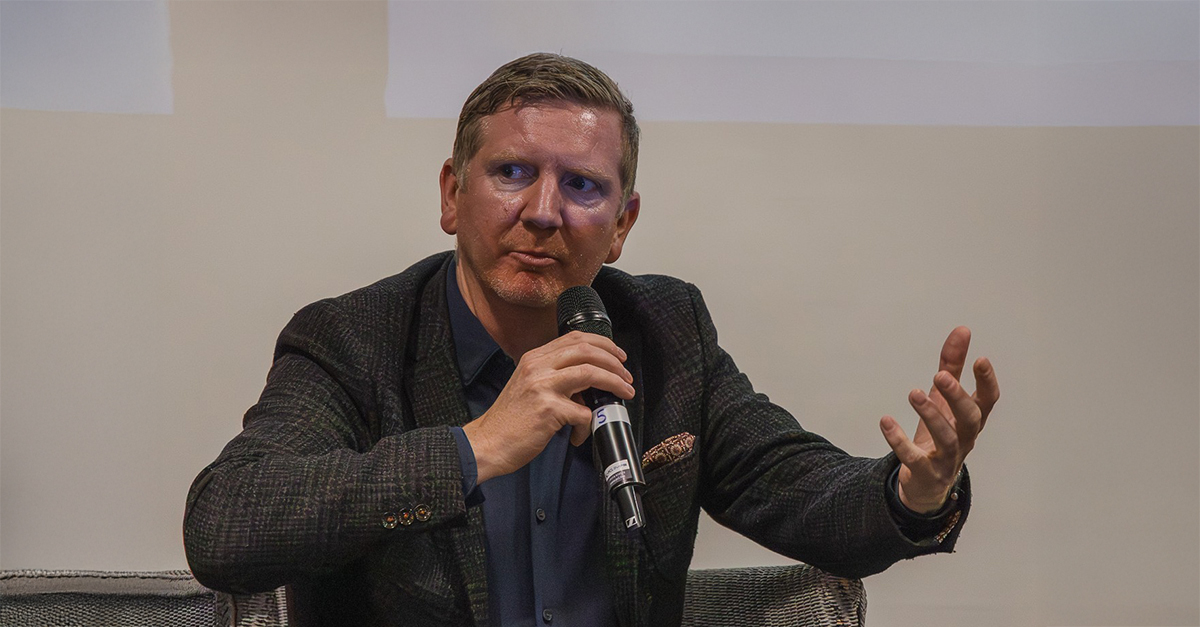

2026 is still in its infancy – but already one figure has emerged as a contender for those ‘Top Business Leaders of the Year’ slots. Dan McGrail, a Scouser who grew up on Merseyside and witnessed industrial decline and the crying need for urban regeneration, is on a national mission.
It’s not so much The Jam’s Paul Weller singing: “The public gets what the public wants”, it’s more about the delivery of the nation’s green energy transition to benefit the country and help accelerate the UK’s energy security worsened by years of growing geopolitical uncertainty.
After years of planning and international fundraising, 2026 is already the year of mega offshore windfarm projects. We have been assured this will be the start of steel in the water, jobs and investment in harbours and ports to see an increasing investment in offshore wind farms.
McGrail, the CEO of Great British Energy, told The Business Dealmakers’ breakfast in Aberdeen, to expect real acceleration in activity. That’s good news considering he is one of Scotland’s highest paid industry professionals on £350,000 a year.
Industry contractors have complained that the ‘stop-start’ of projects in the green energy pipeline has already taken a heavy toll on jobs – and that many skilled engineering and fabrication workers are being lost to the opportunities. There are also question marks over whether young people are being trained to fill the thousands of opportunities that will arise in the UK’s energy industry.
While there have been a number of successful fixed bottom wind projects in UK waters, it has been near impossible for supply chain companies to proper plan resources.
“I believe this is the catalytic moment when all of the expectation starts to turn into reality. That’s why we’ve invested in Pentland in AR7. That’s why we should have a degree of optimism that this can happen and we can really accelerate a transition of oil and gas capability into this world of deepwater wind,” he explained.
How does McGrail, who was previously head of RenewableUK, a trade association which represents over 500 green energy firms, and worked in Siemens UK on the delivery of windfarm blades, explain?
“The projects that went through allocation round Auction Round (AR7), including the Norfolk array, was first suggested when Gordon Brown was Prime Minister. It’s taken a long time for these projects to come to fruition. There is justifiable righteous impatience about getting these projects into the water. But four years given the consenting activity, the development work, given the two years of bird surveys that need to be done, all of this type of work does take time.”
But he is positive and upbeat that a corner has been turned. Prime Minister Keir Starmer and Ed Miliband, the Energy Minister, promised in their Labour manifesto to set up GB Energy. It remains a central plank of their energy strategy and the country voted for this. Now McGrail and his colleagues based in Scotland are well into their stride.
GB Energy stemmed from a simple premise that the British people, who pay their energy bills, should have the right to own and benefit from the country’s natural energy resources.
Speaking about the development of GB Energy, which is due to sign a lease for its new headquarters in central Aberdeen, McGrail is determined to get the message out across the country.
“At the beginning of December, we launched our strategic plan in Aberdeen. The launch was deliberately at the Donside Community Hydro. It is a brilliant example of where the community comes together and builds a clean energy asset in the heart of their community. Not only does it do something to deliver energy but is also does something about creating place and building community cohesion,” he says.
STRATEGY OF FOUR PILLARS
McGrail explains that GB Energy’s strategy is built around four pillars:
“Each of those pillars is designed to do something that is complementary. We want to be able to solve our big priorities, which are to create and drive jobs, accelerate clean energy deployment, drive down costs where we can, and open up new industries.”
In order to do this, the organisation has created balance within its portfolio and strategy. Central to Aberdeen and the North-East of Scotland, GB Energy has set up an offshore business to focus on deepwater offshore wind.
“It won’t exclusively focus on that, but the priority will be about accelerating the commercialisation of this technology. It’s very much in its nascent phase.”
He says Scotland has an ‘incredible’ opportunity around deepwater offshore wind, with around three-quarters of the pipeline of deepwater offshore wind projects.
“It is one of the biggest of its types in the world and we think intervention is needed there. We think that ‘activist’ public investment will make a difference.”
GB Energy made its first investment last November in the Pentland Floating Offshore Wind Farm.
“I’m really delighted that this year started with this project securing a Contract for Difference (CfD) in the AR7 round.”
The Pentland project, located off the coast of Dounreay in Caithness, is now progressing towards a final investment decision in 2027, with operations expected to commence in 2030. Once operational, the wind farm will have the capacity to generate enough renewable electricity to power up to 70,000 homes.
The wind farm is being developed by Highland Wind and is majority owned by funds managed by Copenhagen Infrastructure Partners (CIP). Project development activities are being led by Copenhagen Offshore Partners (COP). COP and CIP will become familiar acronyms in far Sutherland.
GB Energy is investing too, alongside the National Wealth Fund (NWF) and the Scottish National Investment Bank. They join existing project partners Eurus Energy UK and minority shareholder Hexicon.
“Secondly, we are going to build an onshore business which will focus on utilising and maximising the potential of public land. We have a huge wealth of public land in the UK and in Scotland. We can unlock the energy potential of this land,” explains McGrail.
He said they would be looking particularly at energy storage, especially pump storage projects in the mountain areas of the Scottish Highland and Wales. This is a return in some ways to the Hydro Electric expansion of the 1950s, which became Scottish Hydro, and now SSE.
The third strand is the local energy business, such as the project at Donside Community Hydro, where the public and the community will see the benefits of GB Energy’s creation. This will include investment in solar panels in schools and hospitals. The micro hydro scheme is located at a bend of the River Don, at the edge of the former papermill which is now being re-developed with residential housing,
“We can bring communities together. We can drive down costs for communities and the public sector. We will be doing more of this in settings such as social housing and, ideally, on the people who need it most.”
ABERDEEN REMAINS A EUROPEAN CENTRE OF EXCELLENCE
What does McGrail see as the over-arching point of his strategy?
“Underpinning all of this, is the fourth element, which is our supply chain strategy. This is particularly relevant in Aberdeen and the North-East of Scotland in general. We have an opportunity to do much more of the engineering for renewable energy, and the significant growth that we anticipate, in this country with domestic technology. We build the technology and we build an export platform for this.”
“Aberdeen is a great centre for the supply chain and a great centre for service and, for this end, we are putting a £1bn of our budget into investing in supply chain.”
GB Energy will be able to co-invest with the private sector to leverage this capital, while part of this will be the £300m supply chain funding to unlock investment in factories, innovation and expansion of existing facilities. Here there is now a website to encourage supply chain contractors to sign up for project support.
“We think those four elements work in a complementary fashion. So as a result we set targets of 10,000 jobs, community energy projects, and investing in 15GWs of clean energy projects in the next few years.
“So 2026 is really about turning that intent into action. We’ve got our first CfD, we need to build our first pilot projects in local energy, and we need to unlock our development activity in public land, and really they are going to be our big intentions in the course of the year.”
“We are still open to looking at other technologies such as wave and tidal, or geothermal. We are keeping a degree of flexibility, but our core focus will be on offshore, onshore and local, but we will be creating room in our investment strategy for other areas.”
McGrail has to respond to criticism that much of the work – and even the investment, looking at the likes of US private equity giant KKR backing other AR7 projects down in England – is benefiting overseas competitors.
“It is a fair point that only 50 to 50 per cent of content for a wind farm is coming from the UK, which is why deeper water is the big platform for the UK to carve out a differentiation, and to really work on the migration capability.”
Dan McGrail said that while the Pentland and Berwick Bank projects, both in Scottish waters, were given approval in the AR7 round, all of the projects in English and Welsh waters should not be ignored by Scottish-based supply chain and contractors.
“There will be business. I’m certain that every single wind farm in this country that has already been built has relied in some way, shape or form, on skills and knowledge that have been drawn from this region and from Scotland.”
He also cites the need for deep marine engineering, an expertise which the oil and gas industry in Scotland has in spades. Some of the offshore wind platform will be on water up to 2000m deep, and specialist submarine cabling linked to substations on board the platforms will be required.
What should the UK public expect?
“I think GB Energy is the golden share for the public. It is the best stake we can give people, particularly young people, right the way across the country is a stake in prosperity. If we can create jobs that give meaningful long-term careers that people are excited about and believe in and be proud of, that’s the best stake we can give them.”
