
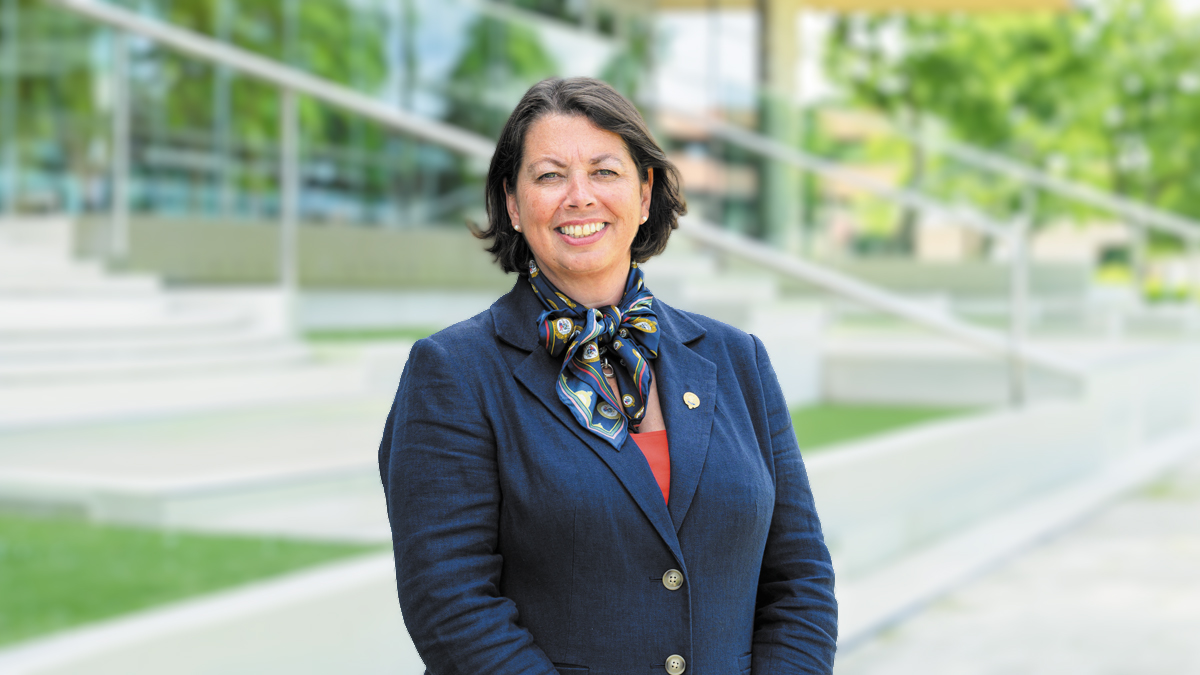

Kay Adam was three months old when she was taken to her first Royal Highland Show and became a member aged seven. Could there be a better choice as chair designate of the show’s board? Kenny Kemp went to meet her at her Newhouse of Glamis family farm
Kay Adam lives and works in a glorious part of ancient Forfarshire. The Vale of Strathmore on a clear spring morning is one of the bonniest places in Scotland.
Across the Sidlaw Hills from Dundee, oak trees with full green canopies line the A928 leading towards the royal castle at Glamis, once the childhood home of Elizabeth, the Queen Mother, with its historic parklands and charming village.
There are tractors at work tilling the rich soils, while fields have already been seeded for potatoes.
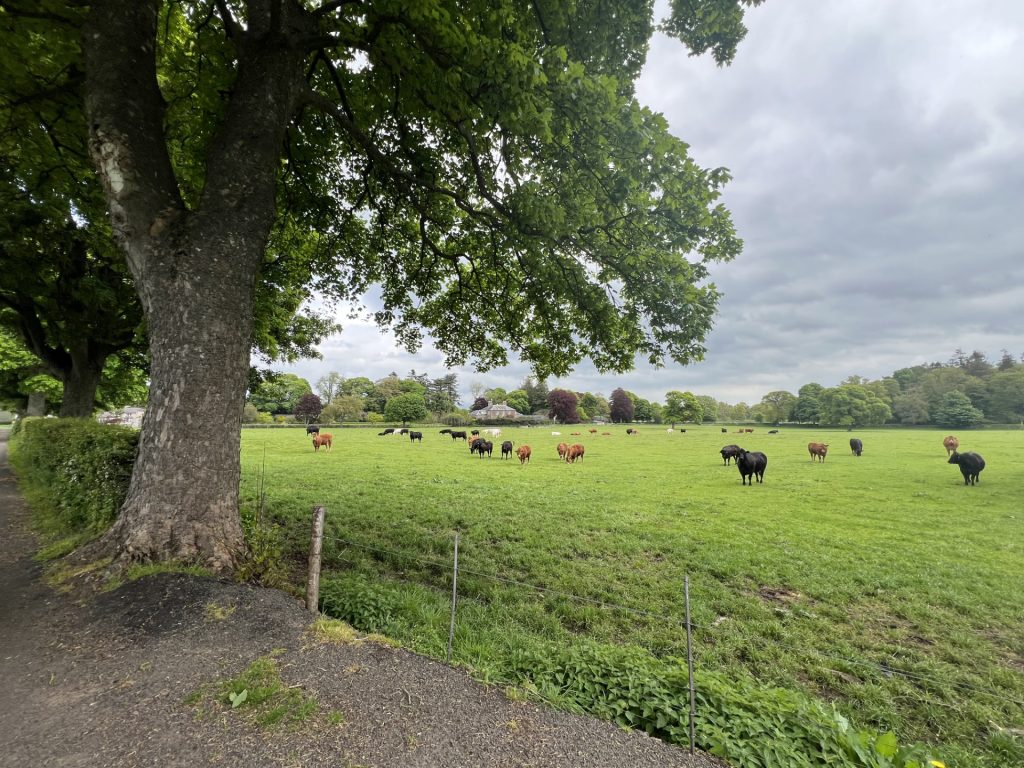
The vivid yellow of both Scotch broom and distant fields of oilseed rape add colour to the lush fields of verdant pasture, ideal for the award-winning beef cattle and herds of cows.
The prospect to the north includes the gentle summit of Cat Law, and the three grand glens of Glen Isla, Glen Prosen and Glen Clova. Then turning off just after Glamis, on the busy road to Coupar Angus, there is Newhouse of Glamis.
This is the mixed farm of Kay Adam, her husband, Bob, and their two sons, Andrew and James.
“It’s a family farm and my sons are the fourth generation on this farm. Along with Bob, we all work on the farm,” she says stepping out into the farmyard.
My dad was a big influence on my life. He would be extremely proud I had been elected as the future chair of the show
Bob’s father was Drew Adam, who raised prize-winning Charolais and Limousin, while his grandfather was Robert Adam, who bred the famed Newhouse herd of Aberdeen Angus cattle in the 1960s. Adam’s two sons have brought Aberdeen Angus back to the land.
Adam was born in Perth and brought up on Craighall farm at Forgandenny, and when she was only three months’ old her parents pushed her in a pram to the Royal Highland Show.
“I’ve been a life member of the Royal Highland Show Society for 50 years this July,” she says with a broad smile. She was seven years old when she became a member and has only missed the show twice in the intervening years: when she was working as a student in Sussex and when she was expecting one of her sons.
“After graduating with my farming diploma in Edinburgh, I came home and worked on my dad’s farm. We bred pedigree bulls like we do at Newhouse. I met Bob at the famous Perth bull sales.”
Such is the way farming life in Scotland intermingles with work, social life and play. Adam’s mother is still farming in Forgandenny, although her dad, Alan Fotheringham, passed away 16 years ago, at 70, with prostate cancer.
“My dad was a big influence on my life and he would be extremely proud to know about everything we are doing as a family, and that I had been elected as the future chair of the Royal Highland Show. He was a massive supporter of the show.”
The Adam’s family run 100 pedigree cows – many are currently pregnant and kept in fields where the grass is cropped shorter to help manage the calf size and prevent calving problems due to lush grass growth at this time of year.

The family farm of around 550 acres at Glamis uses up-to-date farming technology with an array of tractors and attachments.
“We just finished lambing and calving. We breed bulls. We have pedigree cattle, we have a hill farm four miles away just above Kirriemuir with about 600 Blackface and Cheviot ewes.
“Because we have the farm down here, we fatten everything and we grow our own turnips to fatten the lambs. Most of the lambs are sold to Woodhead brothers and end up sold in Morrisons supermarkets,” she explains.
In 2023, with farming becoming much more precarious in the UK, the Adams decided to think ahead and plan for their succession.
“I was at the Highland Show, and one of my fellow directors was talking about his own free-range egg production and its importance to the UK. It interested me as Bob had always had an inkling to go into poultry. So we did our sums, and we put up a free-range chicken farm along the road.”
The production of eggs has given the family vital regular cash flow which has allowed further expansion.
“I feel very strongly about the next generation of farmers and agriculture in Scotland. I’m very passionate about this. When I was growing up the Highland Show was the most exciting week in my whole year. We used to do a countdown on the calendar in the kitchen.”
Adam’s father, Alan, would exhibit Limousin cattle, and the show was the family’s annual holiday, in a caravan with an awning where the children slept. Seven-year-old Kay and her sister would roller-skate around the crowds.
The mechanisation of farming is a both a blessing and a curse. At one time, the farm had several farm hands and labourers; now it is strictly a family concern, with the aid of a full-time shepherd, a lady in the hen shed in the mornings and Charlie, a female apprentice farm hand. Andrew runs the livestock, while James, trained as an agricultural engineer and mechanic, is the fixer.
Until recently, Adam’s involvement with the Royal Highland Show has been with the beef team. “I’ve been involved with the exhibitors in the cattle shed. I was chief steward of cattle-line safety. I was also chief steward of Young Farmers.”
Like every sector of the Scottish economy, helping young people find decent, well-paid work is vital. “For the next generation to get into agriculture isn’t an easy step. You are working with a lot of machinery, often in harsh environments and weather conditions. The kit is really expensive. Our latest tractor has cost over £200,000 for example. How do we let a 16-year-old school leaver with no experience loose in a sophisticated machine?”
The Agricultural Wages Board is not helpful on this score. Everyone coming out of school today must be on a full agricultural wage unless they are on an apprenticeship.
“If things don’t work out, it can be an expensive problem. I wish we could work out a way to employ more youngsters who perhaps don’t want to go to college or university but want to work on the land, and we can let that happen and afford to do it.”
Adam is a pragmatic and optimistic woman who appreciates the multi-challenges of being a farmer in Scotland.
“Farming is a way of life. It can be hard at times, but it is a good way of life. We’re all chief executives of our own companies. Not the salaries though! Every day is different. Nature is always changing and challenging us, but we deal with it.”
How Adam is sowing the seeds for a sustainable future
You will find Kay Adam at the Royal Highland Show’s Young Handlers’ competition on Show Sunday. Those are the young people, in their starched white lab coats, leading their animals around the ring.
“That is where my passion lies. This is where I will see the next generation of Scots within the livestock industry flourishing. And if we look after them, and they are keen about raising and exhibiting quality livestock, then this will sow the seeds for a sustainable future.”
She is the first woman to take on her new role. Already a director, she will become the chair of the Royal Highland Show board following this year’s show.
James Logan is the current chair of RHASS, and the show board, and Adam will become chair, depending on securing the board’s vote, in July. She will then chair the board for two years.
“I’ve a few more years to give yet. But I’m wanting my time to be defined by helping the next generation get into agriculture.
“Every day at the show is a big day. Thursday is farming day, where we expect anyone interested in livestock or looking for new genetics within breeds will come and watch the judging.
“On Friday, there is more dairy cattle judging, while Saturday is our big day of championship judging, along with the young farmer competitions and Sunday is the young handlers’ day, and very much a family occasion.
“Then there is the horses, sheep and goats: they are all very important to the farming and rural communities of Scotland.
“Then there are all the exhibitors, the trade stands and the food halls. This year, Sunday is all about families. Most of the industry meetings and discussions are done on Thursday and Friday. Of course, the weather makes such a difference.”
She will also be thinking about her hens: an entrepreneurial project on a bonny Angus hillside. “We produce eggs for our packer who is Farmlay in Aberdeenshire and you can find our eggs in Lidl and Aldi.”
The Adams have invested in the construction of a hermetically sealed shed for the 32,000 hens. The state-of-the-heart facility with internal lighting and nesting is safely protected against the intrusion of avian flu, which has had a devastating impact on UK farms unable to prevent the virus entering the hens.
The hens, living to 18 months, are allowed out each day, and there is the spectacular sight of more than 30,000 H&N brown hens grazing and pecking, or sitting on their perches on a 40-acre hillside spot. Each day, they return to the safety of their enclosed nests in the air-conditioned shed.
“This is my baby and I’ve put a lot of effort into it and learned everything I can about hens.”
The Royal Highland Show is an annual event, showcasing the best of food, farming and rural life at Ingliston in Edinburgh. Thursday 18 – Sunday 21 June, 2026. Read more from our Royal Highland Show 2026 section here.
