



The Law Society of Scotland must press ahead more vigorously with the establishment of Alternative Business Services (ABS) for law firms in Scotland, after 16 years of ‘unnecessary’ delay, a seminar in Edinburgh heard.
As Scottish law firms of all sizes, from large city firms to small town operations, tackle the challenges of AI technology and the increasing complexity of legal work which requires a multi-disciplinary approach, there has been a growing request from some legal practitioners to bring Scotland in line with England and Wales.
The Business Legal Seminar in Edinburgh, chaired by Jonathan Ames, the Legal Editor of The Times, heard of a willingness to co-operate with the legal regulator, including an offer to set up a special ABS sub-committee to help the Law Society of Scotland accelerate progress on a matter that has been dragging its feet.
As a prelude to the panel session, Doug Lawson of Mark to Market, an Edinburgh-based deal data platform, gave a presentation of the market for mergers and acquisitions among law firms, suggesting there is still great interest in investors supporting growth in legal firms in Scotland.
Brian Inkster, the founder of law firm Inksters Solicitors, who has been a campaigner for ABS north of the Border, says Scottish legal entities have been at a disadvantage for 16 years and “it is time that that changed”.
Representatives of the Law Society of Scotland were invited to the discussion but declined to attend and take part. However, one member of its council, Ross Taylor of Gunnercooke LLP, told the seminar that the Society has to be applauded for dealing with a host of wider issues.

BACKGROUND TO SEMINAR IN EDINBURGH
Kenny Kemp, Editor of The Business, which organised the event, opened the session and introduced the speakers, before handing over to Ames, who joined the London-based newspaper in 2010, after editing The Law Society Gazette.
Ames stated that in the run-up to UK legislation in 2007, there was a great deal of discussion about alternative business structures. He spoke about the Menzies review, triggered by the David Clementi report on the regulation of legal services in England and Wales.
“There was an inability by the Law Society of England and Wales to deal with complaints as there was a mounting backlog. The main ramification of the Menzies review was a key recommendation for a different regulatory structure that allowed for alternative business structures,” he said.
“None of the horror stories, and there were a lot of horror stories at the time, came to pass.”
— Jonathan Ames
Contemporary commentators spoke about the dangers of ‘Tesco Law’, and the purchase of legal services at a supermarket checkout along with frozen peas.
“None of the horror stories, and there were a lot of horror stories at the time, came to pass. Although obviously there are some controversial elements with business structures itself.”
THE SCOTTISH DIMENSION
The legislation in Scotland was introduced three years after the 2007 legislation in England and Wales. Ames explained that Paul Rogerson, the former Herald journalist and now The Law Society Gazette Editor, had attended a seminar about Scotland following reform in England and Wales. He asked a question at the Signet Library about when Scotland would adopt the changes and was met with stony silence. He was almost escorted off the premises! explained Ames.
A CAMPAIGNER FOR CHANGE TO HELP RURAL FIRMS
Brian Inkster has been a lone voice in this matter but now has a legitimate body of support across a range of Scottish law firms. The ABS Scotland Group was formed in November 2025 and has 40 members, a mixture of all types of law firms plus several from associated companies who would welcome new business systems. The Law Society of Scotland, including its CEO, has agreed to meet this group on a quarterly basis.
“Looking across the Border from Scotland, there is jealousy when you see legal firms in England and Wales raising capital and being able to grow and do more innovative things with an injection of money,” he said.
He explained running a law firm in Scotland, if you are a partnership, means relying on partners putting in capital, borrowing funds from a bank, which these days is non-existent, finding third party lenders, or constantly investing profits to grow the business.
“It is an uneven playing field between Scotland and England.”
— Brian Inkster
“But that is a slow process. If you are wanting to do things that are innovative or grow more rapidly, you are then constrained. It is an uneven playing field between Scotland and England,” he told the seminar.
Inkster stressed that ABS was not just about private equity. Some of the first examples of ABS in England and Wales were to give non-lawyer members of the firms, perhaps practice managers or finance officers, equity in the firms. Also to allow spouses in as owners for succession purposes.

WHERE IS THE PROBLEM AND WHAT IS THE HOLD-UP?
Inkster explained that the 2010 Act on reform of legal services in Scotland had not been given a timetable by the Scottish Government. The issue was kicked into the long grass. Then, in 2023, it looked as if something might happen on ABS in Scotland, but this was overtaken by further legislation on legal reform. The Regulation of Legal Services (Scotland) Act 2025 introduced regulations which stated that entity regulation (a separate matter from ABS) had to be implemented within three years. It was then that the Law Society of Scotland put a hold on ABS. Yet, in Inkster’s view, the Law Society should have been working towards reform since the 2010 Act. Inkster says waiting 16 years for implementation is ‘ridiculous really’.
Inkster said he first spoke about this in May 2010 at a full-day conference on ABS organised by the Law Society of Scotland.
“16 years later, I’m on a panel here today and there has been no real movement in that time. You can hardly believe it. The Law Society, as the single regulator of law firms in Scotland, if they had a member that they regulated who had done nothing on a matter for 16 years, they would have something to say.”
The Law Society of Scotland put ABS on hold but there was no good reason why they should have been able to do so, he said. The Law Society explained it wanted to assess how the new legislation might impact on ABS. Yet, in Inkster’s view, the regulator should have gone ahead with implementing ABS in Scotland. One significant change was that the new Act allowed for 100 per cent non-lawyer ownership of legal firms, while the 2010 Act stated that lawyers had to own 51 per cent of the ABS business.
“The new act levelled the playing field on this. There was no other major development in the new act as far as ABS was concerned.”
Inkster made the point that the Law Society of Scotland had a scheme in place and ready to go in 2023, so is there anything that the regulator still needs to do heading into 2027? Meantime, the Law Society of Scotland has stated it was putting a freeze on ABS for at least two years, claiming this was due to lack of interest.
“Yet they hadn’t asked anybody, so how did they know there was no interest? There was no communication to their members. Even if there was a lack of interest, that was completely irrelevant because even if only one firm in Scotland wanted ABS, they should allow that firm in Scotland to do it,” said Inkster.
Inkster explained that perhaps one of the reasons the Law Society wanted such a freeze is because a new regulatory committee has been created to deal with the new act, and the society maybe wished to give it time to settle in, with its first meeting in January 2027. It will then be up for this committee to set a timetable for ABS. He said he was pleased to hear that there was movement on how ABS might be progressed, but still the implementation might take several more years.
“We are hopeful that we will get a definite timetable. I’m optimistic that it will be within that three-year timetable for entity regulation.”
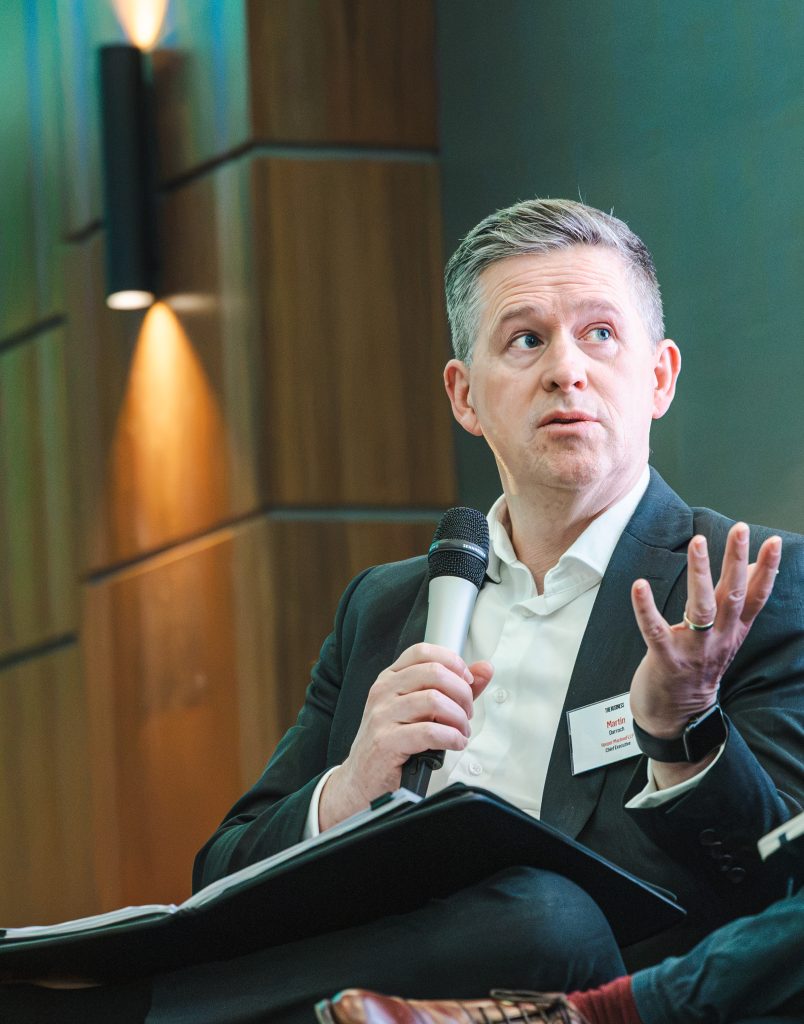
“It’s about creating options for all law firms as to what the appropriate business structure [is] from their strategic position.”
— Martin Darroch
HAS ABS BEEN A SUCCESS SOUTH OF THE BORDER?
Martin Darroch, the CEO of Harper Macleod, was asked how successful has ABS been in England and Wales? His firm has built relationship with firms in England and Wales, who are able to seek external funding for growth.
“We need to take a very balanced view in that it has given English and Welsh headquartered firms the capability to grow and consolidate for themselves as businesses. The absolute evidence is: ‘Yes, it has’. Now there will always be horror stories, but I think we’d rather focus on the positive context. That has created the ability for many of these firms to have access to an ABS environment.”
“The fact that there are 13 firms now in Scotland that are part of the ABS groups, and part of top 100 firms in the UK, with a combined turnover of £2.6bn, and the firms which can access ABS employ approximately 1,300 Scottish solicitors, with their practices based in Scotland, then I’d suggest there is definitely an ability to grow business in terms of market share.”
He said the largest is DWF Group, a stock market listed legal entity that was taken private in 2023 by Inflexion, and he mentioned the growth of Irwin Mitchell, which has invested in Wright Johnston Mackenzie, and funding that facilitated the take-over of Davidson Chalmers in the last 18 months.
“I see this as positive elements of what English and Welsh firms can achieve and it does create the ability for those who are non-solicitors to have a continuing positive impact with ownership rights.”
THE BENEFITS OF PRIVATE CAPITAL
Matt Powrie, a Scottish-trained solicitor who is now Head of Legal at the private equity group, August Equity, which made its platform investment into the legal sector with Higgs, based in the West Midlands, and since then expanded with non-regulated businesses of Navigator Employment Law and Vialex in Scotland.
“I would say from a private activity perspective and from an external investment side, there have been sort of positives and negatives across the sector. From our perspective, it’s gone incredibly well. We have historically been very interested in the financial services sector generally. We previously owned AAB, the accountancy platform.”
“We can be far more creative with the ways in which we incentivise a broader spectrum of individuals within a firm.”
— Matt Powrie
“We took a lot of lessons from accounting through to legal, although they are very different beasts. The same pressures were there within the legal industry as well, historically within the accountancy particularly with an LLP structure, whether that’s increasing compliance, regulatory burden, the sort of further professionalisation of firms, meaning that actually C-suite, traditional C-suite appointments in operations, people, accounting finance within those firms are becoming far more important. The ABS structure really allows that sort of democratisation of roles within law firms and it’s something that within the private equity industry we’ve seen to good effect in putting that investment in place.”
He said what private equity can offer law firms, which a traditional LLP structure does not, is the incentivisation of non-lawyers, non-partners.
“We can be far more creative with the ways in which we incentivise a broader spectrum of individuals within a firm.”
He said it was a balance of retaining and incentivising the right people in a legal environment that is changing, while allowing partners nearing the end of their careers to monetise their investment and work in the firm.
Jonathan Ames pointed out that there has been some high profile ‘horror stories’ about how legal firms have fallen out after changes to the structures.
Matt Powrie warned that ABS was not a simple process and it was also about getting the SRA [Solicitors Regulation Authority] in England and Wales comfortable with the business structures and ensuring investment for the ‘right reasons’. It was important to clearly ensure that the lawyers in the firms operate the firms.
“That’s the key distinction that I would make. I want to make it clear to the regulator in Scotland that outside investment into law firms is not about controlling what the lawyers do on a day to day basis. We are not in any position to tell them how to do their day job. One of the reasons why we think it is a successful approach to investment in law firms is that it actually provides the lawyers with the time to do their job and what they are trained to do well,” he says.
Furthermore, he says in his company’s case, this was not a dilution of quality of the legal services. It was big picture and they were not sitting in on client meetings.
He later stated that his company’s investment in Scottish businesses was difficult for investors to understand because of the confused ownership structures of bolt-on non-legal services in Scotland, and it would be better if this could be resolved.
THE OPTIONS FOR ABS: WHY ‘WORKAROUNDS’ ARE GOING ON
Darroch spoke more on this sense of confusion as he stated that ABS was about giving firms the option to pursue investment.
“I think it’s something that’s fundamental about ABS. It’s about optionality. It’s not compulsive to head up the PE investment path. That’s not what happens. It’s about creating options for all law firms as to what the appropriate business structure from their strategic position.”
The question of how to incentivise non-lawyers in a Scottish legal business is not new. Harper Macleod was one of 13 who called for reform in 2010. ABS can give law firms greater flexibility in the way they run their businesses, offering combined services such as accountancy, surveying companies, HR and technology.
“Our view is that it’s around the retention of existing people and how they’re rewarded. There is a huge proportion of the Scottish market which is essentially being serviced by ‘workarounds’ of the ABS environment.
He said this is not helpful because the Competition Markets Authority and other regulators demand global transparency for users of legal services. He pointed out that one Scottish firm describes itself as an independent Scottish law firm, which is factually not the case.
“That is an important point because the future of the Scottish legal profession is based on a foundation of trust. That has to be maintained at all times,” he said.
He said the lack of clear rulings on ABS leads to an unhealthy environment where some law firms are having to find ‘workarounds’ to the regulatory environment to ensure they have a sustainable future.
LESSONS FROM A LEGAL BUSINESS IN TAUNTON
Stephen Ward, who has been running the Barrister Group, a national network of barristers and mediators, based in Taunton, which has been helped by the introduction of new funding methods in England and Wales, but is not technically an ABS. Ward was a senior clerk and is a barrister partner, and not a trained legal.
He said this his company was able to bolt-on the unregulated aspects of legal services, so they were able to include marketing, technology and finance, and have bought several companies to service the legal work undertake by barristers.
“We didn’t go for ABS, because we didn’t feel we needed it.”
“I can only describe this as a fantastic journey. They came in to help us grow and this is what we are able to do.”
— Stephen Ward
The group took in capital from Lloyds Development Capital, part of Lloyds Banking Group, three years ago. “I can only describe this as a fantastic journey. They came in to help us grow and this is what we are able to do,” he says.
He said there are challenges for those looking at investment, and he says that what legal firms must do is ‘get their house in order’. They must understand the reason for investment, and how it will deliver growth.
COMMENTS FROM THE FLOOR
Ross Taylor, a partner with Gunnercooke LLP, a major independent law firm, and a member of the Council of the Law Society of Scotland, speaking in the question and answere session, said it was worth pointing out on the investment aside, there are already alternative business structures in place in Scotland.
“Gunnercooke is an example of that … We also wanted to put the record straight. We have to keep in mind that there has been a huge turmoil in regulation in Scotland over the last decade. At one point, we were facing the possibility of the Scottish Executive, the Scottish Government, regulating solicitors. So I just have to commend the Law Society of Scotland for what it’s done to find a path through that to protect the core regulation, and perhaps it has had to take a back seat from ABS because we have known the regulation of the regulatory environment has been tough.”
He then asked Brian Inkster if he would volunteer to come on and help the council on the ABS journey. In response, Inkster said the ABS Scotland Group have already made that offer to the Law Society of Scotland. He conceded that the new act with the entity regulation and a three-year time limit was going to sap resources.
“So probably it was more of a resource issue than a lack of interest issue. But the ABS Scotland Group have offered to form a subcommittee of the regulatory committee to push ABSs forward, if that is required. And that offer stands and has yet to be accepted. It’s been noted. And I think it depends upon this new regulatory committee in January and what they decide to do. So the offer’s there and we await the Law Society of Scotland’s acceptance or otherwise.”
NO MORE DELAY, PLEASE: Law Society urged to press on with Alternative Business Services
