

Visionary Hebridean businessman Angus MacMillan was inspired to found Benbecula Distillery to ensure that locals could forge a life on the island.
Angus MacMillan’s early career as an industrial engineer steered him to found West Minch Salmon, his own fish farm on Benbecula, in the Outer Hebrides in the mid-1980s.
MacMillan grew the business to 11 sites across Benbecula, North and South Uist and Harris. West Minch became a renowned Scottish salmon supplier and major employer for these Outer Hebridean islands for approaching three decades, with more than 80 people involved.
MacMillan was born and raised on South Uist, his mother was from Benbecula and his father from South Uist, and his family has lived on the islands for generations.
It was also the reason he spearheaded the South Uist, Eriskay and Benbecula historic community buy-out in 2006.
MacMillan viewed the buy-out, from a private sporting syndicate, as an opportunity to rejuvenate islands that had faced decades of population decline and little investment.
With MacMillan at the helm, £4.5m was raised to acquire 93,000 acres including South Uist, Eriskay and parts of Benbecula, as well as 850 crofts, three quarries and all the shooting and fishing rights.
In 2010, West Minch Salmon was sold to the Scottish Salmon Company, which was, in turn, acquired by the Oslo Stock Exchange-listed, Faroe Island-based producer of premium quality salmon, Bakkafrost, in 2019.
In the years that followed, the processing plants that MacMillan had built were moved from the islands to the mainland, significantly impacting employment on Benbecula and the Uists.
Despite his retirement, MacMillan was frustrated that employment opportunities had once again been lost and started to think about how that could be reversed.
“There will always be islanders who wish to move to the mainland, or indeed further afield, to create a life somewhere else, whether that be for a job, for a relationship or simply because they want to see and experience a different part of Scotland, the UK or the wider world.
“However, I wanted to ensure that if you grew up on these islands, it was always a positive choice to leave rather than it being a decision forced upon you through necessity, by a lack of employment opportunities.
“Likewise, if someone left to explore the world, I wanted them to feel confident that if they chose to return, that they could come back and forge a life back on the islands. All of those scenarios are predicated on job creation and the long-term stability of employment.”

The catalyst was a trip to Orkney that would eventually inspire MacMillan to build a distillery on Benbecula. On a visit to the Highland Park distillery, he noticed the proclamation of its 1798 establishment and it prompted MacMillan to reflect on how many distilleries were founded more than a century ago, if not longer, and the long-term contribution that those distilleries had made to their local environment and communities. The seeds of the Benbecula Distillery were sown.
MacMillan grew barley on his own croft (the island is sometimes referred to in Gaelic as ‘Eilean an Eòrna’ – the island of barley) and Benbecula had “the water, the barley, the people, the place . . . which together provides the core for the creation of a beautiful malt whisky”.
MacMillan concluded that a distillery could be beneficial to the islands, supporting long-term employment and creating a tourism destination with its associated benefits, while producing a product that would promote this part of Scotland to a wide audience.

Benbecula has much to offer. It is known for its landscape, its history, its golf and its wildlife. Capturing the essence of the island and the people of the island in a malt appealed to MacMillan.
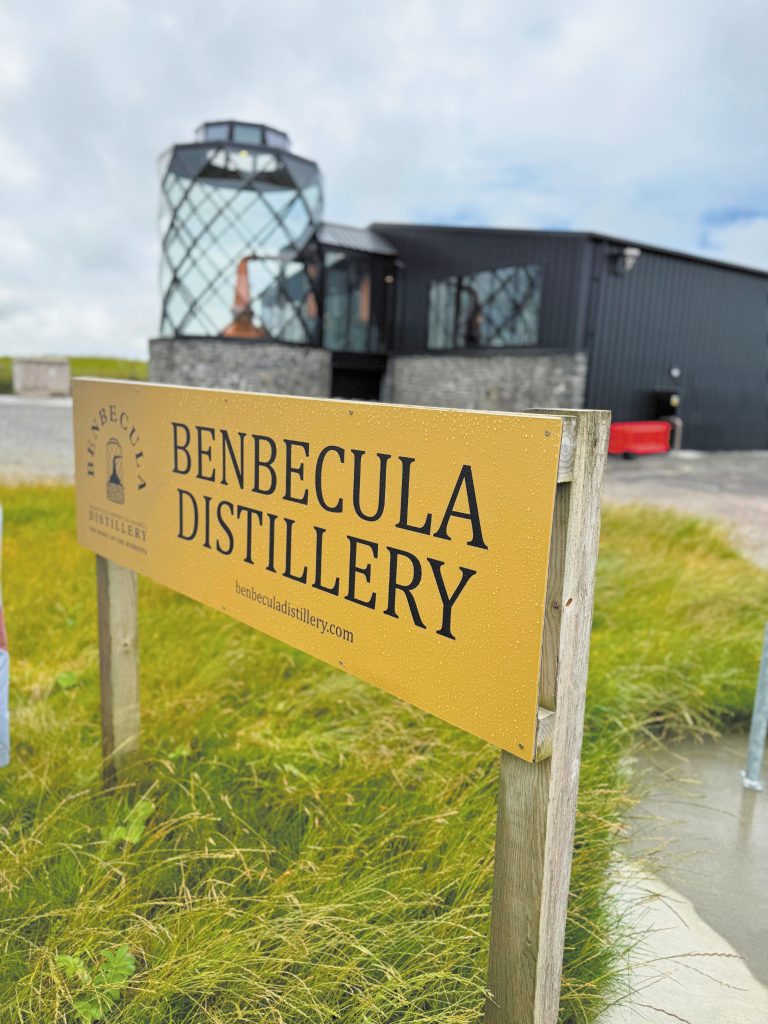
In the north of island is the Benbecula Distillery, opened in 2024, four years after the plans were first submitted. A visitor centre and café opened a year later in 2025.
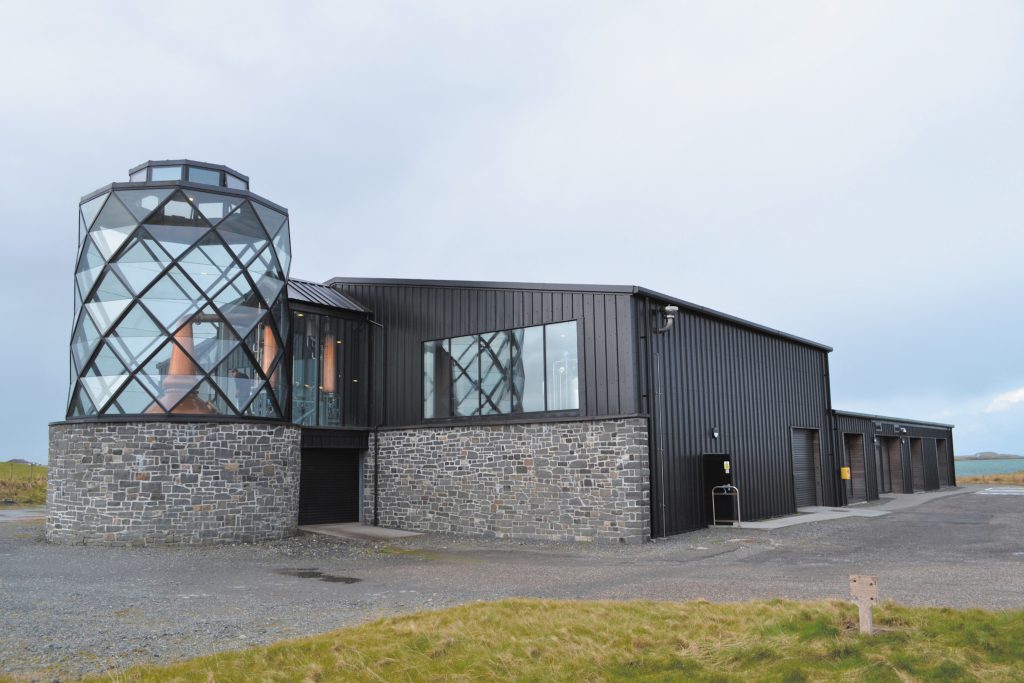
Initially the distillery, which cost in excess of £10m, was primarily self-funded by MacMillan, with supporting investment of £2m from Highlands and Islands Enterprise, transforming a former abandoned fish processing plant at the northern end of Benbecula into an impressive contemporary distillery with a glass lighthouse-style extension (inspired by the Monach Isles lighthouse, seen off the west coast of Benbecula) which houses the copper stills. It is a striking addition to the island’s northern skyline.
At capacity, the distillery will be able to produce 350,000 litres of new-make spirit every year. It is providing jobs across management, production and its visitor centre operations, as well as supporting the wider community.
The distillery managing director and the distillery manager both hail from the island. Local company MacInnes Brothers was the main building contractor for the project. Food for the distillery’s restaurant and café is sourced from local suppliers.
MacMillan has ambition to build warehouses nearby to enable the distillery’s new-make spirit to age on the island itself, which will create further employment opportunities, both in the short term from construction and in the longer term from the warehouse operations and management.
In 2025, the business secured £1.5m from the Investment Fund for Scotland, managed by Maven and delivered by the British Business Bank.
A classic maritime malt will be the end result, inspired by a 130-year-old recipe discovered by MacMillan.
It represented the fund’s first investment into the Highlands and Islands. The investment has been earmarked to support the distillery’s desire to scale production, launch its inaugural single malt and facilitate working capital requirements.
The distillery uses bere barley, which has been grown on the islands for centuries. Grown on local crofts, it is fertislised with seaweed from the Benbecula shoreline, embedding a taste of the island into the future malt.
The team at Benbecula will revive the ancient tradition of adding foraged island heather to their peat fires for kilning the bere barley.
This malting process creates a smooth, gentle smokiness and sweet, floral character to the spirit. A classic maritime malt will be the end result, one which was inspired by a 130-year-old recipe, discovered by MacMillan in the writings of the 19th-century distilling historian Alfred Barnard.
MacMillan knew the importance of having an experienced hand overseeing the creation of its new-make spirit and turned to the renowned Brendan McCarron as master distiller. He brings expertise from Glenmorangie, Ardbeg, Deanston, Tobermory and Bunnahabhain.
The distillery’s inaugural single malt is currently ageing in casks and will not be ready for another few years.
In the interim period, the distillery is growing its initial revenues from a combination of visitor tours, its restaurant and café, private cask sales and the release of a single malt known as Prophecy, curated by McCarron, which is an encapsulation of the style that Benbecula’s own single malt will ultimately produce. It recently won a silver medal at the International Spirits Challenge.
Despite some of the macro-economic turbulence and the recent challenges of the Scotch whisky sector, MacMillan’s hope is that the Benbecula Distillery is destined to become a beacon of long-term employment in these remote parts of the Outer Hebrides.