
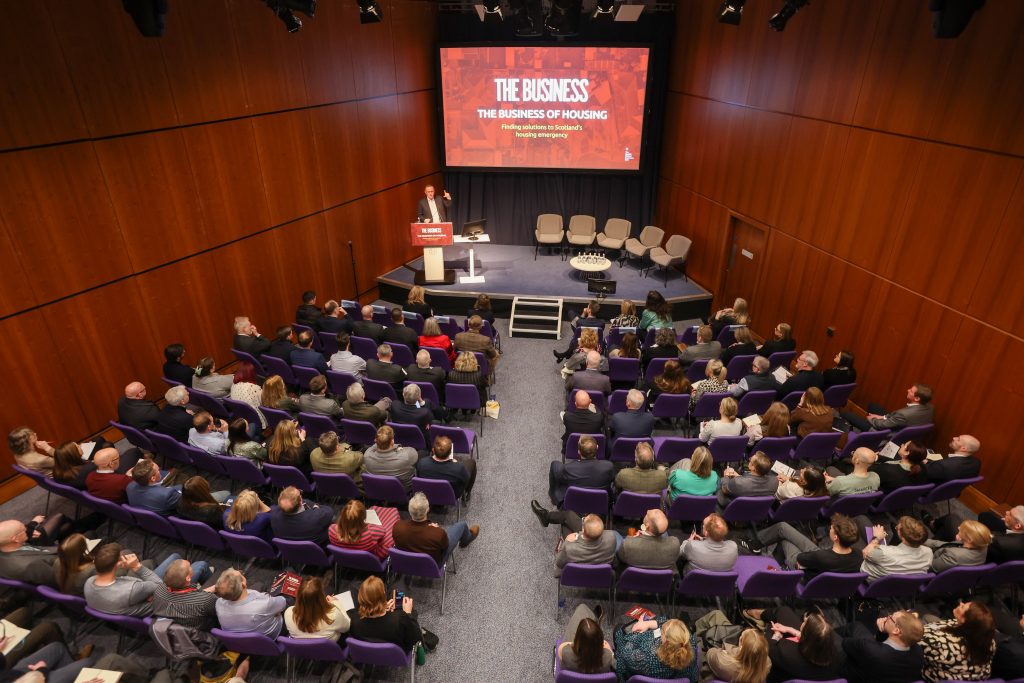
At The Business’s The Business of Housing 2026 conference, one word kept coming up: delivery. In particular, the d-word was said by many as the metric by which the Scottish Government’s new More Homes Scotland agency will be judged.
While its remit is broadly welcomed, the new quango’s proposed 2027–28 establishment date raised immediate concern. In the middle of a housing emergency, many in the room felt credibility will depend on what happens before then, not what is promised later.
Held on 3rd of February at the EICC, The Business of Housing 2026 was a forum that senior figures from across Scotland’s housing sector to look at solutions to the nation’s housing emergency. The conclusion repeated across panels was uncomfortable but simple: Scotland is not short of plans; it is short of homes.
That context matters because More Homes Scotland arrives with the right language but a difficult timetable. Announced on 22 January by John Swinney, ministers say the agency will focus on “simplicity, scale and speed” across all tenures. But with full operation not expected until 2028-29, many questioned how much can realistically wait.
When panellists and speakers were asked what the agency’s top priority should be, the answers were strikingly consistent: get homes built. John Alexander, Chief Executive of Hillcrest, summed it up as “focusing relentlessly on delivery”.
From the homelessness sector, Alison Watson, Director of Shelter Scotland, said, in stark terms that, “Delivery up until now has been too slow, too little, too late.”
Speaking at the end of the day, Cabinet Secretary for Housing Màiri McAllan, seemed to admit that progress in recent years hadn’t gone far enough. She outlined her vision of a “lean and mean” agency designed to speed up delivery. Those words matter because they can be tested quickly. If More Homes Scotland cannot unblock stalled sites and shorten the gap between consent and completion, many in the sector will see it as having failed its first test.
The Government’s own description of the agency points firmly towards delivery: large-scale affordable housing, rural and island homes, land acquisition and preparation, enabling infrastructure, and closer working with the Scottish National Investment Bank to unlock finance. Many in room remarked, perhaps cautiously so, that the above description sounds less like a policy unit and more like a delivery vehicle – a distinction that would be most welcome to the sector.
But there was also unease about repeating old mistakes. During a session on renting, Lord Haughey warned: “This new agency can’t just be a regurgitation of what’s happened in the past.” The concern was straightforward: Scotland cannot afford a two-year pause while another body is set up that might end up failing anyway.
One note of divergence focused less on operations and more on politics. Jane Wood, Chief Executive of Homes for Scotland, argued that continuity and cabinet-level backing should be the priority. Without it, she warned, a delivery agency risks spending its early years fighting for authority and attention rather than building homes.
International examples reinforced the point. Finland’s Housing First approach links homelessness policy tightly to housing supply and has been backed by sustained national programmes. Speaking at the conference, Finnish pioneer Juha Kaakinen put it simply: “The first thing is to simplify.”
That lesson applies directly to More Homes Scotland. Simplification is not only about messaging, it is what turns stalled land into serviced sites, and serviced sites into homes. A similar reminder comes from England, where Homes England is judged not on announcements, but on whether schemes are unlocked and built.
A full special report from The Business of Housing 2026 will be published in THE BUSINESS magazine, inside The Sunday Times Scotland, on 12 April.