
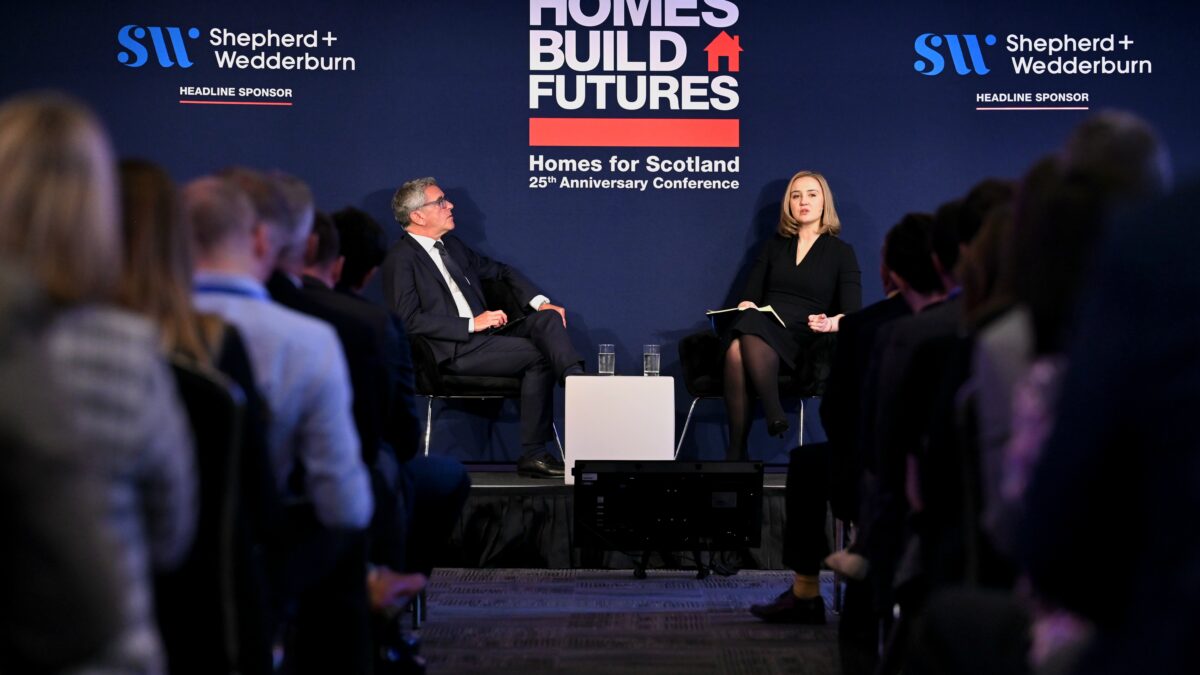


Scotland’s Housing Secretary Màiri McAllan will face intense political pressure if she fails to make serious inroads into tackling Scotland’s housing emergency as 2026 gets underway.
While she recently visited Social Bite’s pioneering accommodation Village tackling homelessness in Edinburgh, accompanied by Maree Todd, Minister of Drugs and Alcohol Policy. The village, one of three ‘net’ communities supported by the Cyrenians charity, has been highly praised but represents a drop in the ocean against a desperate backdrop of private sector completions at the lowest level since the end of September 2018.
McAllan will need to lean heavily on her SNP colleague Shona Robison, the Cabinet Secretary for Finance and Local Government, to get Scotland’s councils on track with planning consent and game-changing support for affordable housing.
COSLA, which represents Scotland’s 32 local councils, is urging the Scottish Government to provide a £16bn boost in revenue in the Scottish Budget on Tuesday 13 January, to secure fair and sustainable funding for councils. A demand for £844m capital settlement has also been requested, plus a restoration of the Affordable Housing Supply Programme to £955m, to maintain, repair, expand and secure the future of council estates.
On Tuesday 3rd February, the Housing Secretary will be a keynote speaker at The Business’ Housing Policy Conference; Creating Solutions to Solve Scotland’s housing emergency, at the Edinburgh International Conference Centre.
COSLA has launched a campaign urging the Scottish Government to use the Budget to provide councils with the fair, sustainable and multi-year funding needed to protect essential local services. The financial pressures in social care and housing are two key areas COSLA are asking the Scottish Government to specifically address in the Budget.
COSLA warns that without urgent action, councils will be unable to maintain essential services such as social care, education, housing support, roads, and community safety.
COSLA resources spokesperson, Councillor Ricky Bell, said: “The upcoming Scottish Budget is a pivotal moment. The Scottish Government must deliver a settlement that matches the scale of the challenge. Without fair funding, communities will see services reduced and inequalities deepen, and we will struggle to meet national targets in key areas such as child poverty, housing, and net zero.”
The statistics will made grim reading for McAllan, who has pledged to take bold and decisive action to resolve the emergency. Many will see her growing political reputation hanging in the balance over how the housing issues are handled in terms of both the public and private sector.
There were 18,347 homes built (completed) and 14,846 new builds started in the year to the end of September 2025. Completions were down by 1,498, which was 8 per cent fewer homes than the previous year, and new starts, down 738, meaning 5 per cent fewer.
The private sector built 14,225 homes and started 11,815 new builds in the year to the end of September 2025. There were 751 fewer home completions, down 5 per cent, and new starts, were down 392, which is 3.2 per cent, than the previous year.
The social sector built 4,122 homes and started building 3,031 homes in the year to the end of September 2025. Completions were down 15 per cent with 747 fewer completed, and new down ten per cent with 346 fewer homes, a 10 per cent dip.
Excluding 2020 (where Covid-19 impacted housebuilding), private sector completions were the lowest since the year to the end of September 2018 and starts were the lowest since the year to the end of September 2013.
In the social sector, completions were the lowest since the year to the end of 2017 and starts were the lowest since the beginning of this data collection from year to the end of September 1997.
In the year to the end of September 2025, there were 5,222 approvals, 5,494 starts, and 6,582 completions of affordable homes funded by the Scottish Governments Affordable Housing Supply Programme. This includes affordable homes for social rent, affordable rent, and affordable home ownership.
There were decreases in affordable housing supply approvals (-1,460, 22%), starts (-853, -13%), and completions (-1,931 -23%) in the year to the end of September 2025 compared with the previous year.
Affordable housing supply approvals were 55% lower than the most recent peak in approvals in the year to the end of September 2019. Starts were the lowest since the year to the end of September 2013 and completions were the lowest since the year to September 2014.
Chief Executive of sector body Homes for Scotland (HFS) Jane Wood said: “These statistics confirm what communities across Scotland are already experiencing first hand. Fewer homes of all tenures are being built year after year while the level of homelessness, social housing waiting lists and the number of children living in temporary accommodation remains unacceptable. This is the stark reality of Scotland’s housing emergency.”
“It is deeply concerning that both private and social sector home building are now at or near historic lows. Without a significant uplift in overall supply there is no credible route to addressing the housing needs of this and future generations, tackling affordability pressures and supporting economic.
“As we enter a critical election period, all parties must urgently come forward with policies which deliver the homes Scotland needs. We urge all parties to meet our calls to action so that Scotland can reap the wide-ranging social and economic benefits that are available by increasing the supply of sustainable energy-efficient homes across all tenures.
Wood said the Scottish Government has had repeated warnings from Homes for Scotland members that the situation would continue to deteriorate without urgent co-ordinated action.
“These figures show that both the Scottish Government’s affordable housing targets and the Cabinet Secretary for Housing’s recently stated ambition to increase all-tenure housing delivery by 10 percent year-on-year are slipping further out of reach.
“We now desperately need to see new deliverable housing sites expedited, infrastructure delivery support for SME home builders and a pause on further regulatory burdens that add cost and delay to new delivery.
“With the Scottish Budget fast approaching, it is essential that any increased capital consequential funding coming to Scotland is used to confirm multi-year funding commitments to the Affordable Housing Supply Programme which has seen approvals fall significantly as a result of previous budget cuts made in the 2023-2024 Scottish Budget. Support for First Time Buyers and increases to the planning budget are also required to ensure resource and capacity is increased.”
Wood said Homes for Scotland and its members stand ready to work with the Scottish Government and local authorities to reverse this decline and deliver the high-quality energy efficient all-tenure homes that Scotland urgently needs.
Register here for The Business of Housing 2026 conference at the EICC on Tuesday 3rd February.
