
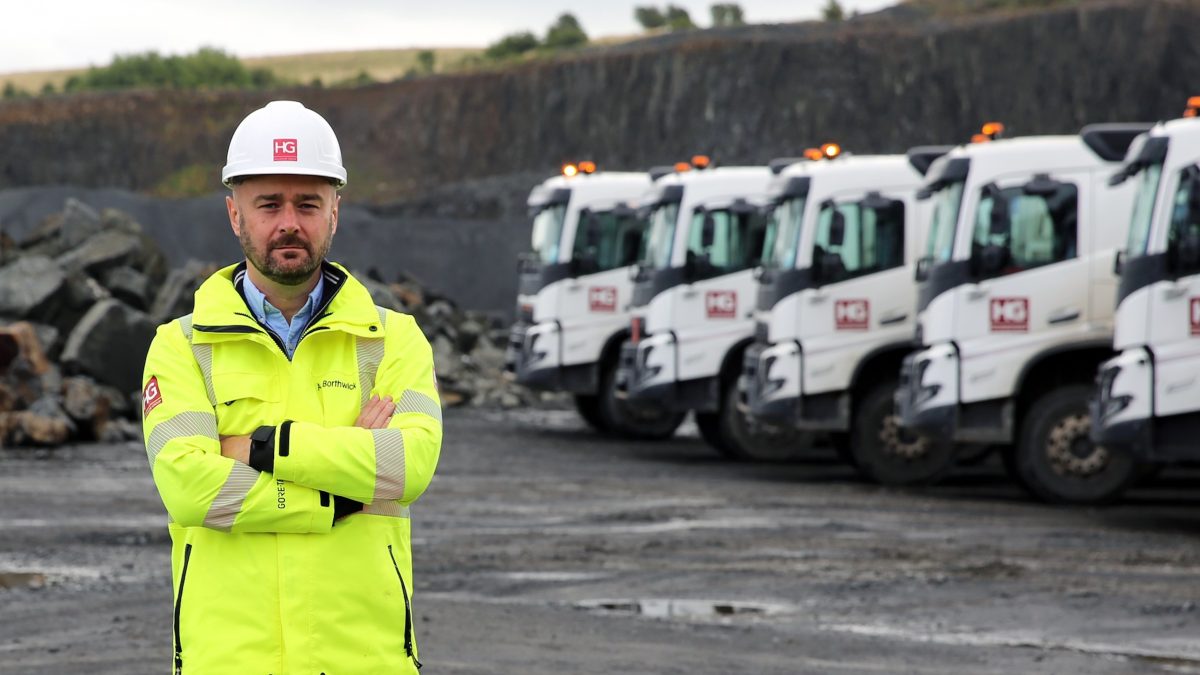

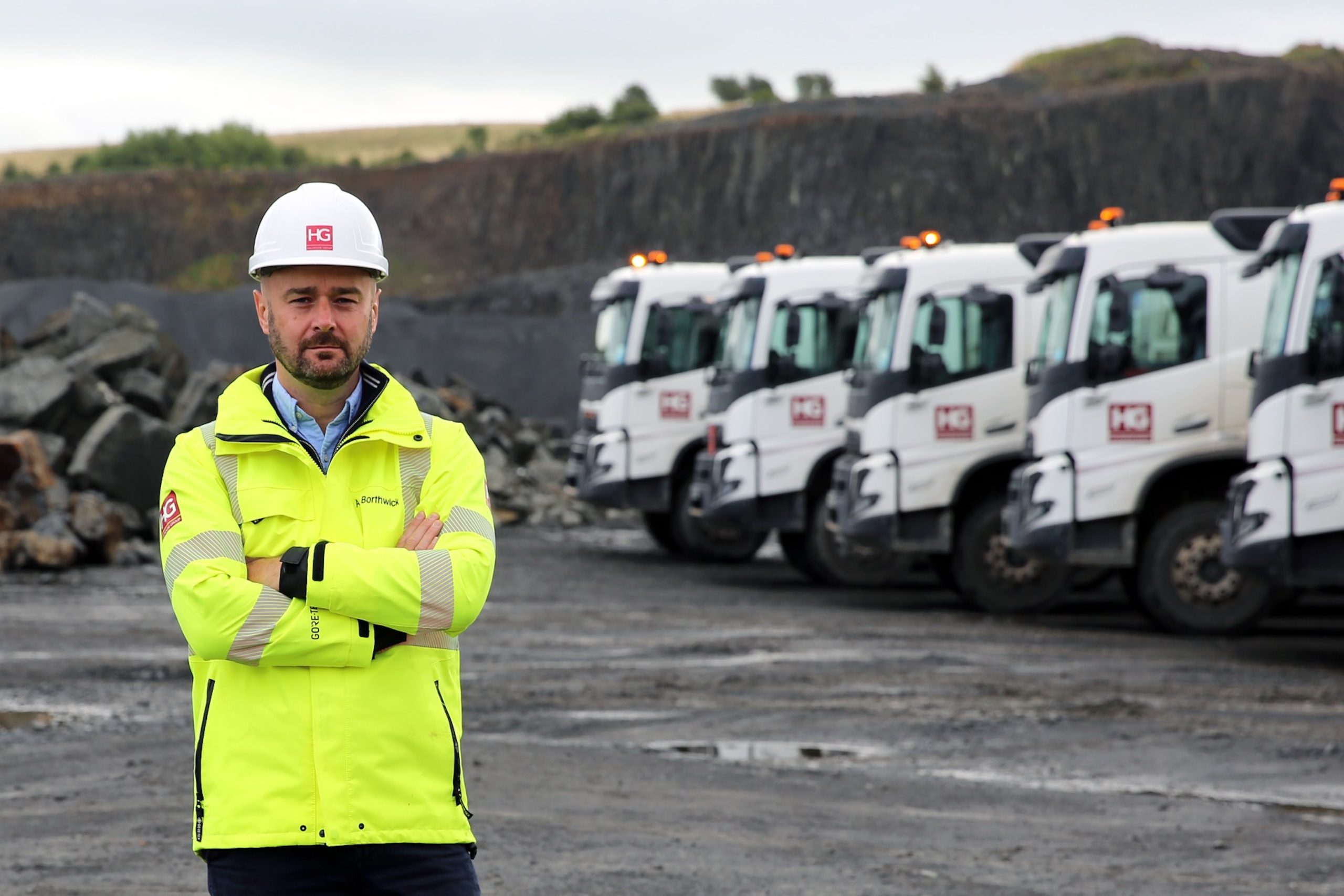
Chief executive officer of the Hillhouse Group, has big plans for the future of the company
We’ve all learned that Scots invented the modern world. Two hundred years ago, John Loudon McAdam, born in Ayr, died in Moffat in November 1836. He was the pioneering Scottish engineer who revolutionised road construction around the world.
He invented Macadamisation which produced a smooth, hard-wearing surface. Today’s modern roads originate from his design.
You can glean a lot about Scotland’s economy on a tour of an Ayrshire quarry. The Hillhouse Quarry at Troon with its views across the Firth of Clyde toward Goat Fell on the Isle of Arran is a litmus test for the economy. McAdam would recognise the raw materials of our national infrastructure, blasted and scraped from the seams of hardened igneous whinstone or dolerite, which lie between softer sediments of sandstone.
The grades of stone, from the finest powder and sand for ready-mix cement, to the gravel chips for roads or domestic garden paths, the courser aggregate for housing foundations, and the mixtures for asphalt to tar the highways and the apron at nearby Prestwick Airport, are all here.
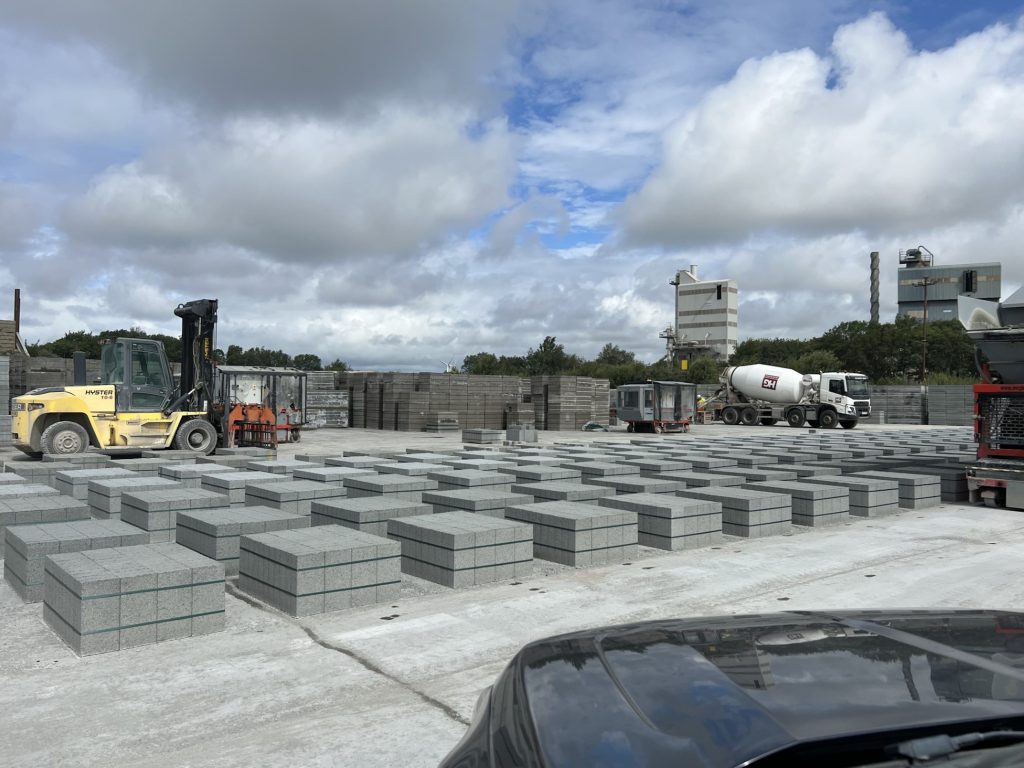
Alongside are the robotic cement machines churning out concrete breeze blocks for walls, and the large five and ten-ton armour boulders for the harbours and breakwaters of Ardrossan and Troon.
A 2019 Scottish Government survey of aggregate mineral extraction noted there are 131 quarries across Scotland, although that figure is likely to be nearer 237 active sites.
Alistair Borthwick, 47, is the chief executive officer of the Hillhouse Group, a private family-owned company that has just hit the magical turnover figure of £100m. He joined the company in January 2026 working alongside chairman Andrew Vernon and managing director Mark Munro.
Hillhouse Group expands into renewables, natural capital and tourism
The group, established in 1907, has a traditional quarrying business coupled with an interest in hydro and renewables schemes and Ride Ness, a new leisure and tourism project which is developing Scotland’s first custom-built and designed mountain biking trail centre at Fort Augustus.
Vernon is the visionary founder of Ride Ness, set in 700 acres of estate, and approved in February by Highland Council.
The group is also investing heavily in natural capital in the Highlands with the creation of woodlands, peatland restoration schemes and rewilding projects, which are offsetting the obvious carbon footprint of the extraction industry.
“I joined the business from NATS, the air traffic control and management organisation, where I had been chief financial officer for the last seven years.
“I was responsible for all the finance across the business of around 4,000 employees. I was also responsible for their global commercial basis with interests in the Europe, US and Canada, the Far East and Middle East,” says Borthwick.
Alistair Borthwick’s career from Deloitte to NATS
He is from Broxburn in West Lothian, studied accounting and finance at Heriot-Watt University, and qualified as a chartered accountant training with Deloitte in Edinburgh.
Ralph Adams was managing partner alongside the likes of Fiona Salzen, David Williamson, David Shearer, and around the time of the Rutherford Manson and Dowds merger. One Deloitte colleague was Ian Steele, an Ayr man who was a mentor and former STV director.
“They all had a huge influence on me. It was a great grounding working alongside these corporate partners and training by example,” he recalls.
Borthwick went on to work with Menzies Distribution, First Group, and was group finance director at Scottish & Southern Energy looking after its transmission and distribution business. It was then that he ‘steered his own ship’ by joining NATS in London and Southampton.
“I have known about Hillhouse Group for a long time, known the family who owned the group and their way of doing business. My wife, Linzi, grew up a stone’s throw from the quarry in Dundonald. It was something that we’d seen grow and develop,” he says.
The vision which the Hillhouse family shareholders have for this group really appealed. The future for the next ten to 15 years isn’t just about the quarry business, even although this is the biggest part of what we do, it’s about how we expand
A long-term vision for Hillhouse Group’s growth
He had been living in Ayrshire for 20 years but the international nature of his NATS work meant that he was increasingly away from his family as his children were growing up. Years of ‘dad guilt’ began to eat away, and Borthwick thought of finding a suitably challenging position nearer to home.
“I wasn’t willing to do anything. But the vision which the Hillhouse family shareholders have for this group really appealed.”
This was highlighted by the £40m acquisition of the Skene Group, an aggregates group based in Fife and the Lothians.
“The future for the next ten to 15 years isn’t just about the quarry business, even although this is the biggest part of what we do, it’s about how we expand,” he explains.
Traditional quarrying is about serving customers close to local demand. It is expensive transporting bulk materials long distances. The making of ready-mix cement and asphalt for roads means there is a finite radius for production.
Skene Group acquisition extends Hillhouse’s reach across Scotland
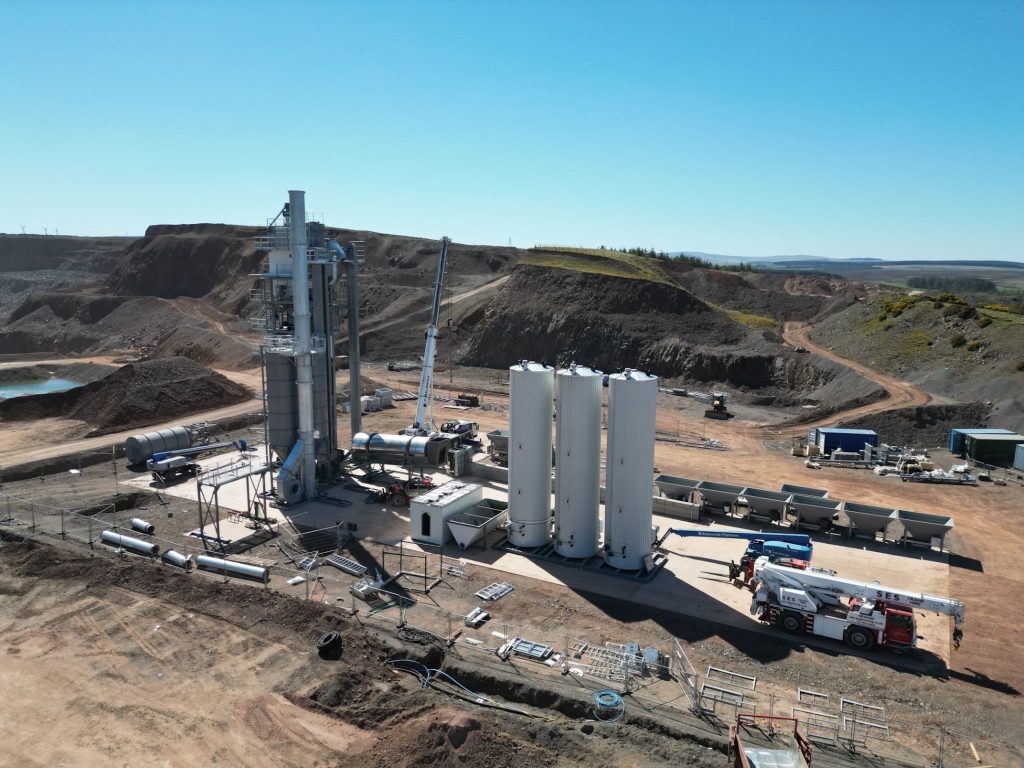
The £40m acquisition of Skene, with quarries at Soutra Mains, south of Edinburgh, has allowed Hillhouse to extend its footprint across Fife and the Lothians. Hillhouse has been making Tarmacadam since 1934, and ready-mix concrete since 1966. In 2019, it acquired MacAsphalt.
“Despite many challenges, we are investing in a multi-million-pound plant at Soutra to put in an asphalt-making plant. Before this, they had been supplying aggregate only with some concrete blocks. We’re known for the quality of our asphalt and we are one of the biggest independents in Scotland. It is about serving local customers,” he says.
Scotland’s road network has seen long-term decline in maintenance and upkeep. The issue of potholes is now a matter of national embarrassment, but it is hard to blame councils that have been starved of funding for roads and transport infrastructure.
“We need to invest in our roads. But more than this, Scotland has a housing shortage which we need to address and we have to develop business and industry more generally.
“There is a crying need to invest in infrastructure beyond this. While there are fiscal challenges today, the future is in these areas,” he says.
Patient capital supports long-term infrastructure investment
Hillhouse Group was chosen as the sole supplier of asphalt and bituminous products to the M8, M73, M74 motorway improvement project.
It is high-profile, large-scale projects such as this which help show the group’s strength. Those who drive into central Edinburgh along Corstorphine Road near Murrayfield Stadium will have watched the level of care and night-time working as contractors renewed this stretch of badly-potholed trunk road.
“One of the appeals for me for my position, is we are patient capital. It’s about long-term value creation. The family have been involved in this for 119 years since 1907. For me, to move away from the grind of quarterly reporting, of markets and analyst meetings, has been a relief. I’m able to concentrate on the actual development of the business because we are backed by patient capital. That’s so refreshing.
“We are able to take a long-term view, and that is really important in Scotland for our national economy now too. The Scottish economy is slow just now. But I believe a recovery will come and it is about investing now so we are prepared for this uptick, providing the right kind of service to our customers, who include government, local authorities and private companies.”
Financing growth and Scotland’s shrinking listed company sector
Borthwick is under no illusion about the difficulties for mid-tier Scottish companies striving to build a sustainable business. He says nothing has changed in the fundamentals of business: cash flow is king. On the Skene deal, Royal Bank of Scotland helped with the funding and has been “very supportive and helpful as a Scottish bank”.
One of the appeals for me, is we are patient capital. It’s about long-term value creation
“I look back 25 years ago when I was training at Deloitte and the market for audit services among the Scottish economy as a young chartered accountant. We had all these companies such as the Wood Group, John Menzies plc, THUS, Stagecoach. Scotland had a strong and vibrant group of PLCs supported in Edinburgh by the banks. That PLC community has dwindled massively. They are very few and far between at the moment. We have a few on the AIM market, but many have been taken over by international private equity.”
Skills, apprenticeships and planning reform for Scottish business
The appeal of joining Hillhouse Group was the ability to grow a private business with a core and an ability to deliver into local communities. It also has a foundation which has given £1.25m to good causes.
Since 2019, the company has more than doubled in size; a split 50:50 between organic and acquisition.
“I want to see more growing companies in Scotland. But we need to have the right environment. This means the right set-up to allow this.”
Like so many business leaders, he sees the battle for talent and building and retaining a workforce as another challenge. The group employs around 400 people in Scotland.
“It’s good to hear Andy Burnham talking about the drive towards vocational working and apprenticeships. For us, we want to prep the next generation for the future skills that are needed. We clearly live in a world that is heavily influence by social media. A lot of younger people get distracted by this and the dreams that are sold.”
He can see the practical skills of the apprenticeship and vocational work being impacted by artificial intelligence, which will be able to take on the repetitive administrative functions. “This is a very interesting dynamic in how people will work, I believe,” he says.
The answer, Borthwick says, is having a future workforce that is “trained, ready, skilled, willing to go to work and has the right incentives to work.”
But Scotland’s policymakers, he adds, must step up and do their bit too. At almost every turn there are hurdles, including increasing levels of taxation which are deterring growth and stop-start delays in planning which hold up workflows.
“Planning for a new head office or for continuing development at our sites continues to be a headache and is a constraint on Scottish business. We have to sort this out to make things work more easily.”
Rising bitumen costs and the Ride Ness mountain biking project
Then there is external risk that can’t be sorted locally. This includes huge hikes in the cost of bitumen, the refined oil-based product vital for tarmac, which has increased significantly because of the US-Iran crisis and the blocking of the Strait of Hormuz. It all makes Borthwick’s work complex – and fulfilling.
A father’s work can often appear rather mundane to his children. Yet Borthwick and his family are super excited about Ride Ness, the mountain biking park at Glendoe Estate, Fort Augustus, which is taking shape.
Borthwick’s children are 15, 14, and 12 and all at school in Scotland. They live about five miles from the site and can expect to be among the early users biking across this Highland site.
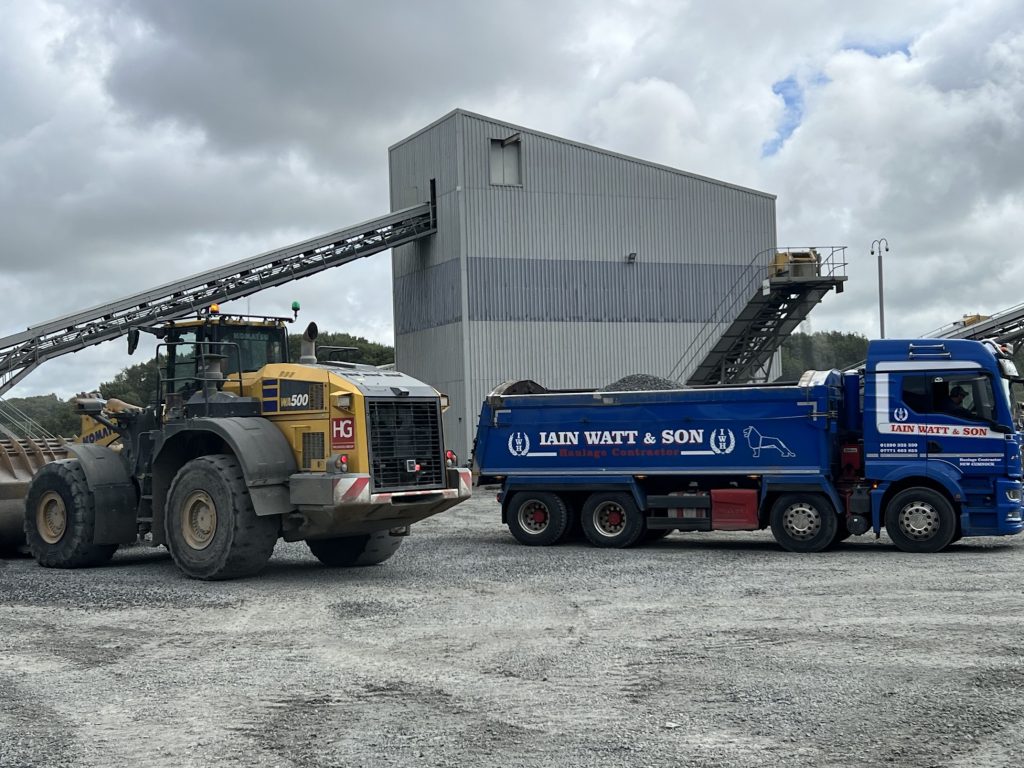
OUT IN THE QUARRY: blasting, crushing and tipping
The Ayrshire quarry is a lunarscape without meteor craters. Tony McMullen, 60, who hails from Airdrie, is Hillhouse’s quarry manager. He is the legally competent quarry operator covering the whole site.
He is responsible for the safe blasting of rock, which brings down up to 60,000 tonnes at a time. Because of the proximity of the village of Dundonald, the quarry attempts to keep blasting to a minimum, although locals in the vicinity say they can feel their homes shake on blasting days. Then 50 tonnes of rock is carried by one of two CAT 772 and an old CAT 775 dumper trucks, dropped into the crushing machines which grind different grades of gravel.
The main 1600 machine plant can process 240 tonnes per hour, while its partner tower can do 340 tonnes. So, at full pelt, it can serve a flow of 20-28 tonne lorries. It is energy intensive, but every slither of rock is used in some context, while returning lorries bring in used asphalt from old roads which is recycled in the mix for new use, meaning less bitumen is needed.
Single sizes of rock are tipped into massive crushing machines with conveyor belts. The finest material is kept in the sheds: the drier the stone, the less energy is required to heat it before using it for cement mixes. The sizes are ‘dust’, 6mm, 10mm, 14mm, 20mm and 28mm.
According to McMullen, 10mm is the gold dust of quarrying.
“Everyone wants 10mm. So we re-crush 20mm into this size. Every product you can think of has 10mm in it. It goes into asphalt and concrete. If you can make 10mm without a lot of waste, you’re a rich man,” he says.
The service for this equipment is vital, and there is a full engineering shed, while the CATs can have spares delivered and replaced within the day. The regular geo-tech expert, Eddie Bailey, is able to determine each strata of productive rock.
The Big Interview with The Business Editor Kenny Kemp
