


Industry leaders plug into debate on state of UK’s power network
The stark reality of the UK’s energy mess is out in the open for all to see. Decades of massive neglect of the UK’s energy system coupled with failure to connect approved wind farms to a creaking national electricity grid, which is now 100 years old, has come home to roost.
Between £6bn and £7bn – almost a quarter of the annual income of Scotland – has now been wasted by constraint payment to wind farms operators that cannot get their generated electricity connected on to the national grid but are still earning vast sums for overseas investors. In 2025/2026, constraint payments have totalled £1.9bn.
The level on policy-making and regulatory incompetence will make those facing winter heating anxiety shiver even more. The irony is that the UK needed Donald Trump and Vladimir Putin to drive the energy trilemma to the top of the political agenda.
The belligerent Russian leader’s assault on Ukraine triggered the UK debate on energy security and Trump’s war with Iran has shown that the UK cannot depend on foreign oil and gas to keep domestic bills down.
Andy Burnham’s Labour government now has Michael Shanks, the high-energy energy minister, spearheading this mighty complex issue.
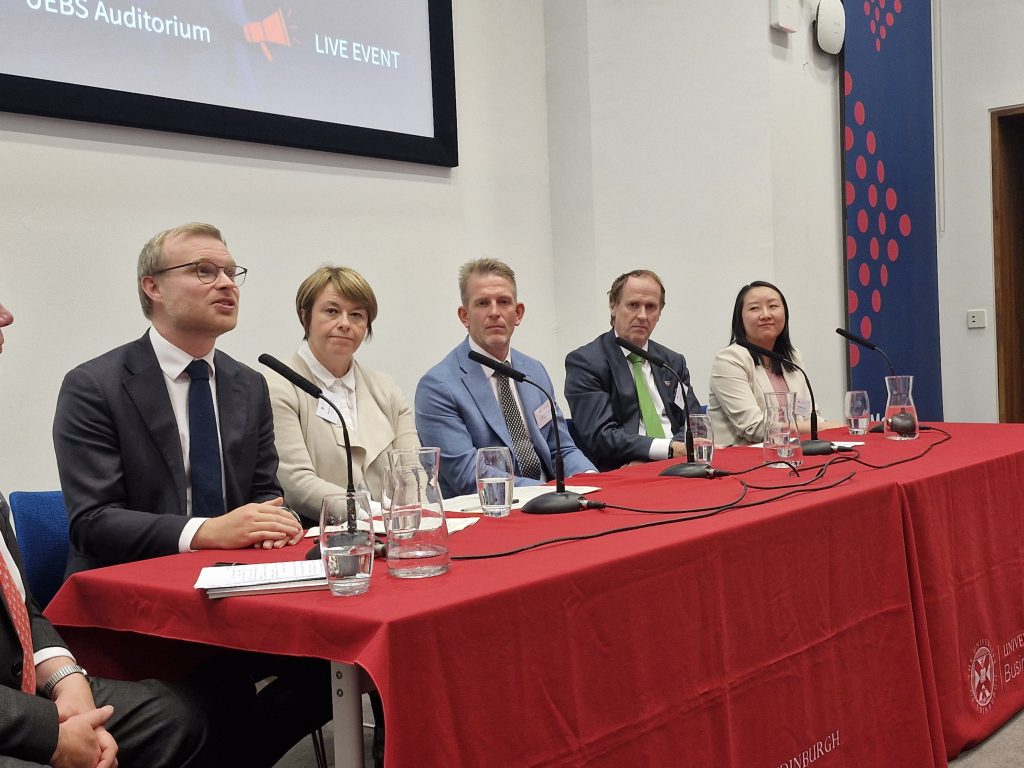
Shanks, who is also a Scottish Labour MP, spoke recently in a panel discussion on Clean Power by 2030, chaired by former energy minister Charles Hendry, at the University of Edinburgh Business School.
It was a series of civic discourses, under the remit of Professor Chris Carter, the school’s director of civic engagement. Shanks, who is one of the speakers at The Business of Energy event next week, said the Labour Party devised its Clean Power Mission by 2030 when it was in opposition, and “energy is the foundation of our modern life”.
He said: “Vladimir Putin reminded the world that energy is power in the most literal sense. Across Europe, households saw bills rise, industry faced difficult choices, governments were forced to confront a very simple truth that dependence creates vulnerability.
“The direct consequence here at home was £40bn of public spending, shielding households and businesses from soaring energy bills. And it was a moment when energy policy moved from the margins of political debate right to the very centre.”
Half of all UK recessions since the 1970s have been associated with oil price shocks, and the greatest threat to economic stability has not been a transition away from fossil fuels, but a continued dependence on them, he argued.
“That’s not energy security. It’s energy dependence.”
Shanks said that Britain has simply drifted for too long. “We allowed our energy system to stagnate. We became more exposed to energy insecurity … We told ourselves that drift was some form of pragmatism. But it wasn’t. It was a conscious choice and it came at a cost,” he said.
This ‘drift’ was brought home starkly by Keith Anderson, the long-standing chief executive of ScottishPower, on the panel along with Nicola Anderson of Scottish Enterprise, Laurence Rockey, chief executive of East Lothian Council, and Dr Mengfei Jiang, a finance lecturer and programme director at The University of Edinburgh Business School.
“The truth is, as a country, we’re probably 15 years behind where we should be. We didn’t recognise early enough as a country – or we weren’t fully invested early enough as a country – in electrification.”
Anderson said electrifying the economy and electrification is what supports climate change.
“That electrification is what supports economic growth. And we’ve ended up with a transmission system that’s not fit for purpose because we didn’t invest and build it early enough.” He said his energy company, which is owned by Spanish energy group, Iberdrola, has been sweating assets way beyond their useful life.
“The system has no longer kept pace with the design of a future economy. It’s not kept pace with the switch to renewables, it’s not kept pace with the needs for growth in the economy, which is what’s led to lots of organisations and inward investors to the UK knocking on the door of Number 10.
Shanks agreed that the national electricity grid was a central problem.
“For far too long, we invested far too little in the grid. Alongside building new generation, we knew we also had to embark on the biggest upgrade of our electricity network since the 1950s. Now have we got everything right along the way? We certainly have not. And we’ve definitely got much, much more to do.
“But what I think the mission [Clean Power by 2030] has demonstrated is that when government does provide clear direction, when it works in genuine partnership with industry, it is possible to tackle problems that once seemed intractable and we can make real progress.”
He said that Clean Power was the ‘north star’ of the energy department. His department lifted the “absurd ban on onshore wind in England” and consented to clean energy projects to power more than 20 million homes. But hard decision were now being taken.
The predictions are if we do nothing, constraint costs will go to £7bn or £8bn. If we build and invest in the system, then we will bring those constraints back down to near zero
Earlier Shanks laid out the massive challenges. “There is a £60bn to £70bn investment programme to rewire the country. That will tackle a huge proportion of the current constraint costs in the system because we’re connecting generation in very, very different places than we used to and the ability to switch it, and move it, and push it around the country is critical.
“So building, investing and redesigning and expanding the system will help us be able to shift and move that power about. The predictions are if we do nothing, constraint costs will go to £7bn or £8bn.
“If we build and invest in the system, then we will bring those constraints down too – whether it comes down to zero, but it will come down to a much, much more manageable level.”
The ScottishPower chief spoke about other challenges including planning and also the need for more skills across the sector.
“As a country, we take too long to build things. we need to get a lot faster, a lot faster, and hopefully that is underway as well.
“But it’s essential – the minister said it on a couple of occasions – the grid is critical to all of this. If we don’t have that grid system, we don’t have anything else and we can’t build anything else. So that needs to be delivered.
“And then the next wave of it, which will create another big debate, is the distribution system. So that’s some of the billions going into the transmission system huge big pylons and towers.
“The distribution system, which is what gets that power into your house or your local business, that also needs a huge wave of investment as well to allow us to expand the electrification of transport and heating system, and to connect with local companies, local housing estates, local businesses.”
Shanks revealed: “Some of those hard decisions have just uncovered problems that have been sitting out there for a long time.
“When we came into government the connection queues, or the number of generation assets waiting to connect to the grid in Britain, was surpassing 700GW. And it was going up and up. It was a scandal that had been left totally out of controlled for a long time.”
On the prospect of re-nationalisation the UK’s energy network, Shanks did not rule it out. He said 40 years of Conservative privatisation was meant to improve lives in Britain but has not radically improved lives.
He stated the ‘drift’ in energy policy was because there was not enough public control of national infrastructure.
This article will be featured in the Winter Edition of The Business magazine published on Sunday 29 November 2026 in association with The Sunday Times Scotland.
The Business of Energy 2026 is at the EICC in Edinburgh on Tuesday, December 1. Tickets are still available here.
