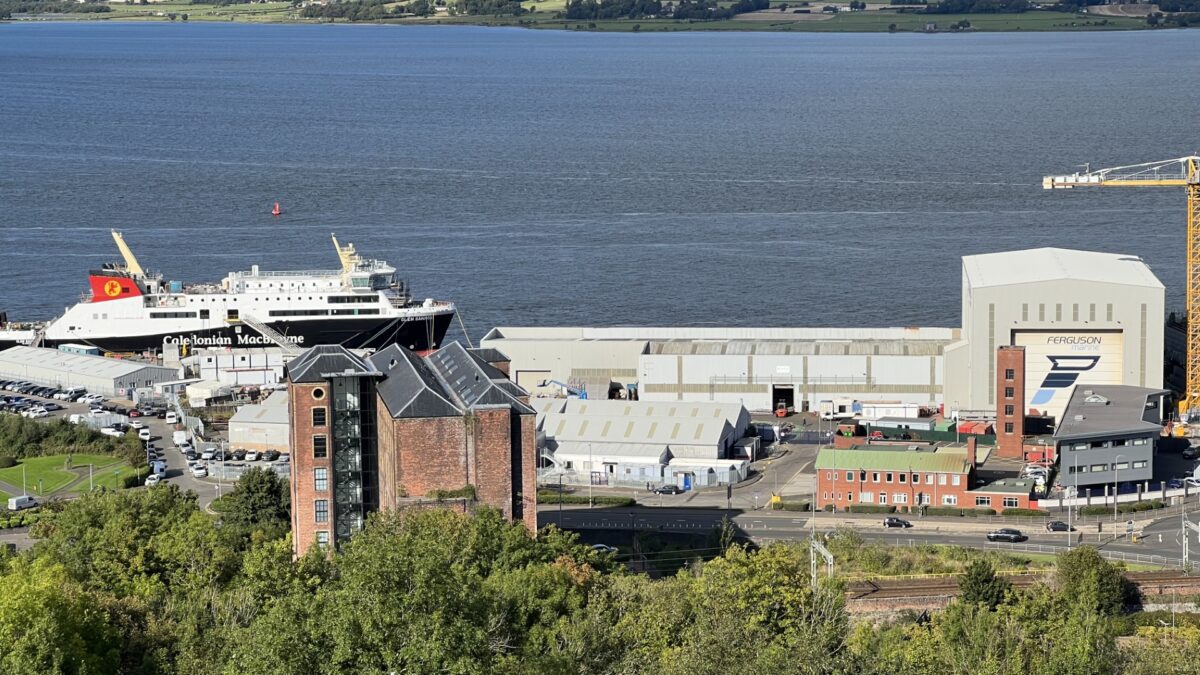
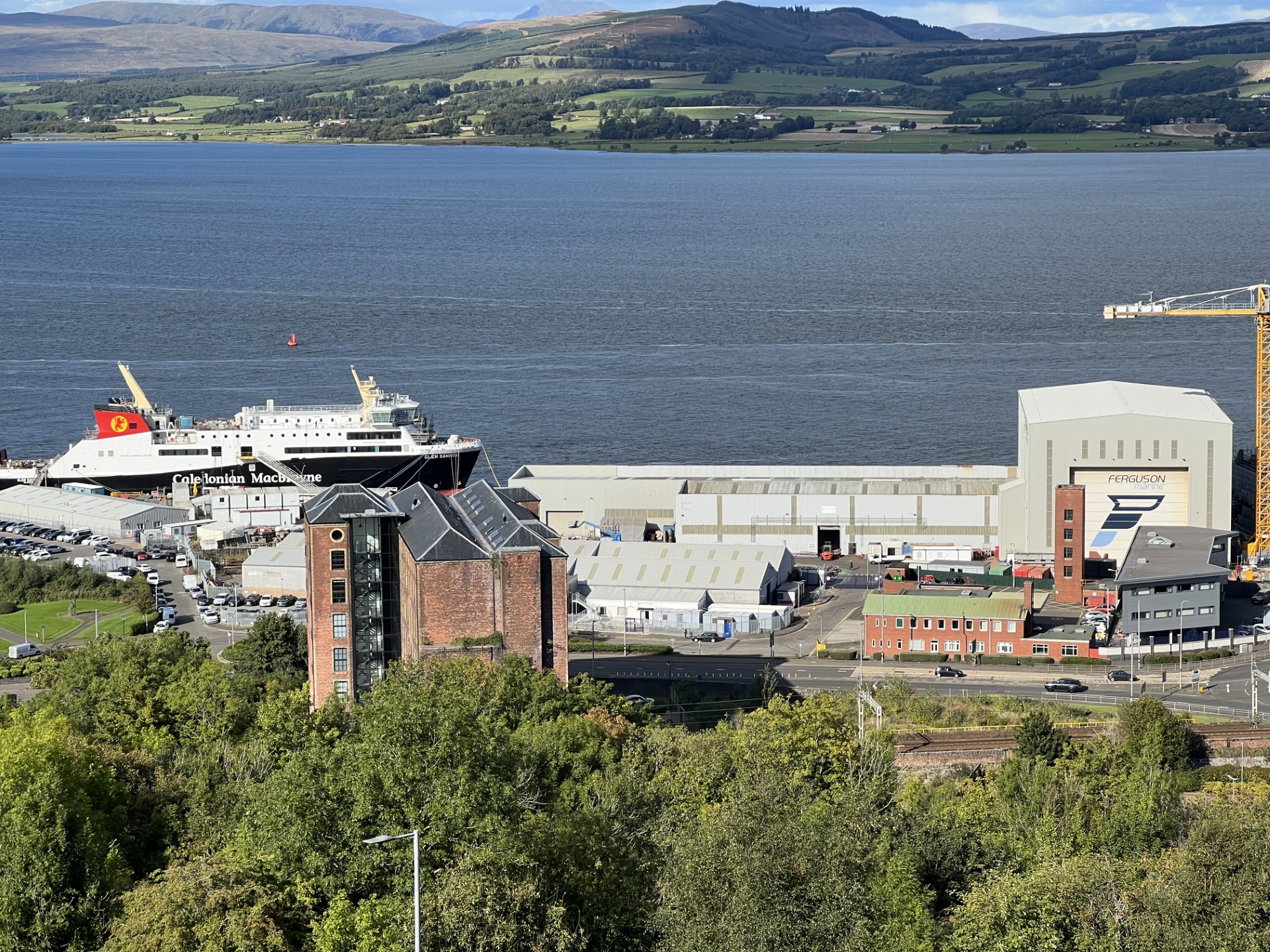
Campaigners pressing First Minister John Swinney to instigate a public inquiry into the operations of Caledonian Maritime Assets Limited (CMAL) – Scotland’s arms-length ferry procurement agency – have been rebuffed by Scottish Government officials.
However, despite an official response, member of the Inchgreen Campaign group are continuing to raise a catalogue of concerns with Mr Swinney regarding CMAL’s procurement strategy and the building of the Scotland’s ferry fleet abroad rather than in Scotland.
The campaigners say the Scottish Government’s reply from an Edinburgh-based civil servant has simply deflected the issue onto Port Glasgow-based Ferguson Marine and not tackled the fundamental issue of what it sees as the failure of CMAL.
The campaign’s objectives are to safeguard the Ferguson Marine workforce that has been used as a “political football by the Scottish Government, Transport Scotland and CMAL”. They also want the disused Inchgreen drydock, owned by Peel Ports, to become part of a revived commercial maritime industry on the Clyde.
The campaign, led by Robert Buirds, a former trade union leader and secretary of the Campaign to Save Inchgreen Dry Dock, has the full support of Prof Alf Baird, and Roy Pederson, both former members of the Scottish Government’s Expert Ferry Group, which was disbanded after disagreement about the government’s vessel procurement strategy. Also part of the group is Dr Stuart Ballantyne, Chair of Seatransport, an international marine architects and shipbuilder, and Malcolm Warr, a former Royal Navy commander based in Scotland.
A reply from Lewis Paterson, of the Ferguson Marine Governance and Oversight Unit, part of the Directorate for Economic Development, stated: “The Scottish Government is not considering a public inquiry, as extensive scrutiny of both CMAL and Ferguson Marine is already underway through multiple Parliamentary Committees. We continue to cooperate fully with Committees, as well as with past inquiries by Audit Scotland.”
He said the Scottish Government understand the disappointment with Ferguson Marine not being selected as lead bidder for the Small Vessel Replacements Programme (SVRP) Phase One.
“Ferguson Marine have received feedback and we understand that their bid scored highly on quality.”
“I also want to take this opportunity to reassure you that the Scottish Government remains firmly committed to supporting Ferguson Marine to competitively bid for future contracts and to securing a sustainable, long-term future for the yard.”
He said that a further £14.2 million will be invested in the yard. A portion of this funding has already been allocated to support improvements in health and safety and to enhance productivity in the delivery of MV Glen Rosa.
However, the campaigners are not satisfied and have written again to John Swinney.
“Transport Scotland’s response seems to be merely an attempt to justify the perceived failure by CMAL to manage Scotland’s ferry procurement.
Mr Buirds says that dismissing the ferry advisers who were recruited specifically for their expert knowledge of the Scottish ferry services was seen as a deliberate ploy on the part of Transport Scotland to avoid scrutiny of CMAL’s management and procurement failures.
The campaigners claim CMAL’s failure’s resulted in:
- Over specified major vessels requiring twice the size of crew required by more productive operators;
- The requirement for crews to live aboard vessels designed for short crossings;
- Excessive on-board catering provision;
- New ferries that can’t be accommodated at the terminals to which they were intended to operate without massive additional expenditure;
- Overpriced hybrid electric ferries, that emit more CO2 per car space than fuel efficient conventional ferries on the short transit routes in Scotland;
- Inefficient labour-intensive terminals and failure to invest and explore automated docking technology;
- Failure to adopt a simple ship design for frequent short crossings to reduce costs and increase capacity and patronage;
- Apparent inherent bias against a proven more efficient and reliable catamaran option that would have greatly reduced capital and operating costs;
- Blocking proven and catamaran designs that have been used successfully for similar routes from serious inclusion, which has prevented key areas in economics, operations, environmental and advanced safety technology from being applied in tenders.
Mr Buirds points out that the MV Alfred, the catamaran which has been operating efficiently between the mainland and Arran, has recently had its lease extended due to the delay of the Glen Rosa.
“If catamarans are not suited to our island routes as CMAL claims, how can the Alfred be operating so successfully alongside the Glen Sannox built to CMAL’s design?”
The campaigners say such questions require a proper public inquiry needs to address, and the Scottish Government should be asking both Transport Scotland and CMAL to justify their decisions.
“After all, they have been spending vast sums of public money yet seem to answer to nobody. An independent enquiry would give them the opportunity to justify their decisions before an expert panel,” they say.
“It seems clear that CMAL is not fit for purpose and that the Scottish Government is not facing up to this long standing problem. There needs to be an independent public inquiry to get to the truth. Our island communities deserve much better,” says the campaign group.