
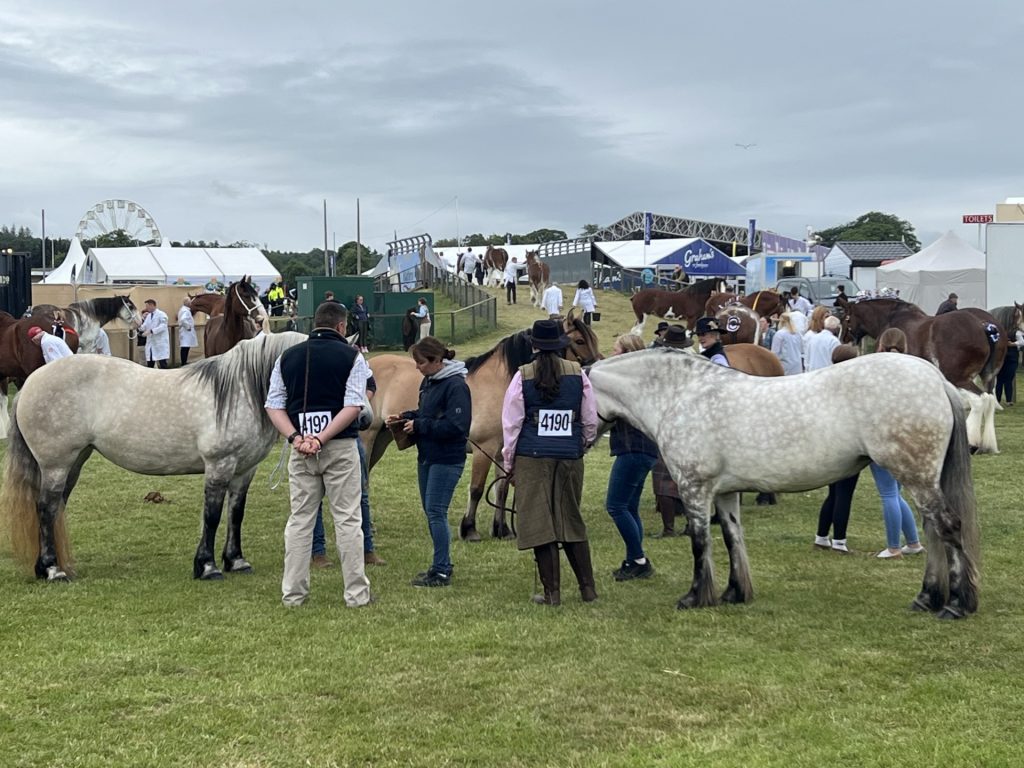
Just after a quarter to eight, Duke, a beautifully-coiffured Shetland pony, all the way from Cambridgeshire, with floppy dark hair covering his eyes, was among a posse of horses preparing for their turn in the early morning show ring.
Duke’s nervous adult handlers had brought him up without a hitch for their first trip to the Show.
“He’s very chilled and there’s been no bother with him. We’re delighted to be here. We’ve heard so much about this Show. This is our first time here and it’s amazing,” said Duke’s younger handler.
The Opening Thursday of the Royal Highland Show 2026 was a roaring success, and the expected heavy rain, which held off until after 3pm, did not dampen spirits. This gave the hundreds of human competitors, with their manicured cattle, brushed sheep, combed goats and polished horses, time to proudly traverse the Ingliston ring.
David Tennant, Head of Show for RHASS, said: “The first day of the Show saw us welcome more than 50,000 visitors through the gates of the Royal Highland Centre, including thousands of pupils from across Scotland visiting the RHET Discovery Centre to learn more about farming and rural life.”
“More than 6,000 livestock have started competing across the Show and we’re gearing up for an extremely busy Friday and weekend as we stage the first Royal Highland Show presents The Reeling, a traditional Scottish music festival on Saturday, and our dedicated family day on Sunday, featuring everything from hobby horsing to milking demonstrations.”
While the show has the woo-factor for new arrivals, including Duke and his Cambridgeshire handlers, it still manages to excite the old hands who have been returning time and again every year.
Kay Adam, the Royal Highland Show’s President for this year, has only missed the show twice in the last 50 years.
“It is an intrinsic part of our family life. We used to come here for our holidays in the caravan and the whole gathering with all the people and the animals, and exhibitors and visitors, still continues to deliver the magic of rural Scotland.”
Early Thursday, the roads to West Edinburgh were chocked with cars and trucks, private hire cabs, batting through the snarl-ups, with those lucky to find an early parking space. Lothian Region’s special buses were packed to the rafters.
Soon the Showground’s avenues were mobbed with school parties, and thousands of others enjoying the very best of rural life. The place was heaving. Most exhibitors’ tents and display areas were bursting at the seams, and the likes of Tesco and Lidl, had steady queues for youngsters wanting their goodie bags.
The gleaming tractors, trucks and trailers, from those international manufacturers, seem to get more expansive every year, with some combine harvesters the size of a two-storey house. The chainsaws at the lodging areas were buzzing and burning, while the main show ring witnesses a procession of beautifully kept animals, perhaps the great thrill of the Highland Show. Meanwhile, the bars grew busier with the stockmen and women as the day progressed.
What is the state of Scottish agriculture?
There are reports that the British milking herd has hit record lows, suggesting that 190 dairy producers across the UK have quit over the past few years. Average milk volume per farm in Britain has increased to 1.9m litres, an increase of 7.6 per cent, which emphasises consolidation into fewer, larger farms.
NFU Scotland milk committee chairman Bruce Mackie said milk deliveries are down 1.5 per cent compared to the same week last year, although daily production remains about 1.35m litres higher than the five-year average.
However, Carol Graham, the marketing director of Graham’s the Family Dairy, remains upbeat. Her company has its own herds and a host of independent milk farmers supplying this successful Bridge of Allan based business. “We offer the highest price for milk at the farm gate, which helps secure our supply,” she explains.
Moreover, she spoke about the astonishing success of cottage cheese, produced at their factory in Fife. Gen Z’s interest in protein foods has pushed this humble milky product back into vogue, via TikTok. The company produce a range of cottage cheese which is now massively popular in the UK, and also airfreighted each day to the Middle East and Hong Kong. Even the recent war in the Middle East didn’t stop the cottage cheese in the hold of an Emirates Airlines flight from getting to the supermarkets and tables of Dubai.
“It’s been an enormous boost for our business. We had two large processing containers in Fife. We’re thinking about building another container vat to keep up with demand.”
Meanwhile, the business is doing well with its Greek-style high-protein shakes, and also Protein 25 yoghurts in a variety of flavours. Ms Graham also explained the Gold Top milk from the company’s Jersey herd was also growing in popularity as consumers wanted simple, quality products.
There is one Scottish tipple which isn’t doing so well with younger drinkers. One malt whisky industry producer, serving in the Scottish Larder Hall, lamented that Gen Z are not drinking Scotland’s national alcoholic beverage.
“The TikTok generation appears to be looking at what they see as healthier options, and this is having an impact on malt whisky,” he said.
This will resonate with the First Minister, John Swinney, who returned from the United States to attend the Show. He met some of Scotland’s finest food and drink producers exhibiting in Scotland’s Larder, including producers of haggis and ice cream.
Meanwhile, a veteran Haddington farmer, who also runs a grain store, spoke about the massive amount of unsold wheat which is still in store, and being kept for an upturn in the distilling and malting barley market.
He also said that the Inheritance Tax issue for farmers planning succession is now a very hot topic.
“I’ve got two sons who are both in the farming business. You’d be a fool as an elderly farmer not to be sitting down and having a serious conversation about inheritance tax and how to continue running a successful agricultural business in Scotland,” he said.
“Leave us alone to get on with what we do. We care about the land and what we produced, so let us do what we do best.”
What would be his message to the politicians?
“Leave us alone to get on with what we do. We care about the land and what we produce, so let us do what we do best.”
Marcus Wright, the NatWest Groups’ head of forecasting, reminded a packed audience in the RHS Members Pavilion, that agriculture is an energy-intensive sector, and the Israel-US-Iran conflict and the challenges over the Strait of Hormuz had an impact not only on oil prices but also on the cost of fertiliser.
Responding to news of a ceasefire between the US and Iran, he said peace will have a positive impact on global energy prices and the inflationary cost of food supplies.
The Royal Bank of Scotland’s relationship manager, Andrew Macdonald, speaking more specifically about Scotland, said: “Wheat and barley prices are depressed, with futures contracts not as positive as they have been. There is a lot of grain sitting in sheds across Scotland.”
This excess tonnage has been blamed in some way on Donald Trump’s tariffs on Scotch whisky.
“The good thing that has helped the cattle prices is the price of feed barley, which is about £150 to £153 per tonne, and as low as £133. What we are seeing is that it is coming back up, so if you have a circular herd, then you are tending to make a bit of money.”
“What we are seeing at the bank is customers coming to us and asking if they can have extra money to buy store cattle, and fatten them, because it is so expensive and the herd prices are high. They bought their cattle when it was expensive, when the beef price was really high. Now that the price has dropped back, all that cash that the customer might have borrowed from the bank is not sitting in the value of the cow.”
This became a liability because the customer had paid the high price, taken out a loan, yet the value of the beef animal had dropped. So margins are stretched, which is a difficulty in the beef market.”
Meanwhile, he says lamb prices are holding up well, although pork prices are down because of African Swine Flu, which is in Europe, so the Chinese have stopped taking European pigs. Meanwhile, futures on the oilseed prices are strong.
“Hopefully, we don’t have a windy harvest, and it blows all the peas away.”
– Andrew Macdonald
However, the potato price is not good in Scotland this year, with a lot of potatoes sitting in sheds with contracts fulfilled. This is due to a flooding of the market with farmers planting extra acreage on the assumption that the demand would hold up.
The RBS economic talks brought up the issue of AI and its adoption rate. Marcus Wright said we need to expect ‘workforce reshaping’ in the labour market.
It seems as if farmers are now taking note. His colleague added:
“What we are seeing is farmers using AI to model weather and find the best time for planting. AI is also being used to improve animal health and genetics. There are a lot of different programmes with computer software. This is positive for the Scottish agriculture sector. There is a lot of technology in the agricultural sector, and farmers are looking at how to adopt some of this.”
GOING TO THE SHOW TODAY?
“For anyone planning a visit over the coming days, we encourage the use of public transport wherever possible, with the dedicated Service 98 bus coming to the Royal Highland Centre from the city centre and the Edinburgh Tram stop nearby,” says David Tennant. Read Tennant’s RHS top 10 not-to-be missed events this weekend.