

Fast fashion watch out. The Scottish textile industry is fighting back
The hardy sheep has played a rough and scratchy part in Scotland’s history. Those docile grazing beasts have been blamed for the destruction of the ancient Ettrick Forest, the hunting grounds of Scotland’s kings, in the Scottish Borders, and several centuries later, the arrival of the sheep heralded the clearances from many Highland townships.
Before the mass arrival of the Blackface and Cheviots breeds, introduced by absentee landlords from 1750, it was cattle, goats, pigs and deer that were the staples of rural Scotland.
By 1818, Inverness became the most important market for Scottish wool-brokers and, in 1836, 75,000 sheep were sold at the famous Falkirk tryst, previously a cattle market. Human migration to the cities and transatlantic emigration have been the inevitable consequences of the expansion of sheep. Yet, those simple animals, which provide both food and warmth, are now an ingrained, and even controversial, aspect of our culture.
Television programmes such as Game of Wool: Britain’s Best Knitter, a show promoting the hobby of knitting, is proof that you do not mess with our woolly heritage.
On the show, ten knitters are seated in a remote Ayrshire barn filled with a range of yarn weights, colours and brands, as well as knitting needles and crochet hooks.
The knitters’ creative techniques are watched over and judged by experts Di Gilpin and Sheila Greenwell, known for their work with Chanel, Vivienne Westwood, Paul Smith and Nike.
However, serious knitters from the Shetlands islands have complained about the show’s cultural appropriation and basic errors about knitting needle width, as well as an unrealistic challenge of trying to knit a Fair Isle tank top in 12 hours.
Helen Barwick, who runs Shetland Stitch Club, a mobile sewing school, told The Guardian knitting was a feminist issue: “You have to remember that this is a huge industry up here, and traditionally a way for Shetland women to earn a decent income, that has been killed off by fast fashion which labels designs as Fair Isle when they don’t stick to the tradition of even using Shetland wool.”
It’s a fair point. Moreover, new generations of exciting Scottish designers are using the natural wool yarn from these hardy hillsiders to bring fantastic items to our specialist stores.
Here an early New Year’s resolution might be worth making: treat yourself to at least one item of Scottish-made woollens in 2026. Increasingly, there is an abundance of choice from hats, scarves from the Shetlands, a great gansey once made for fisherfolk, exquisite christening shawls made of lamb’s wool, and Harris Tweed herringbone coats.
While the fast fashion of the high streets remains a dominant force in clothing, there is an enthusiastic cohort of professional artisans and woollen mill producers from the Shetlands, the isles of Harris to the Scottish Borders who are fighting for the indigenous industry.
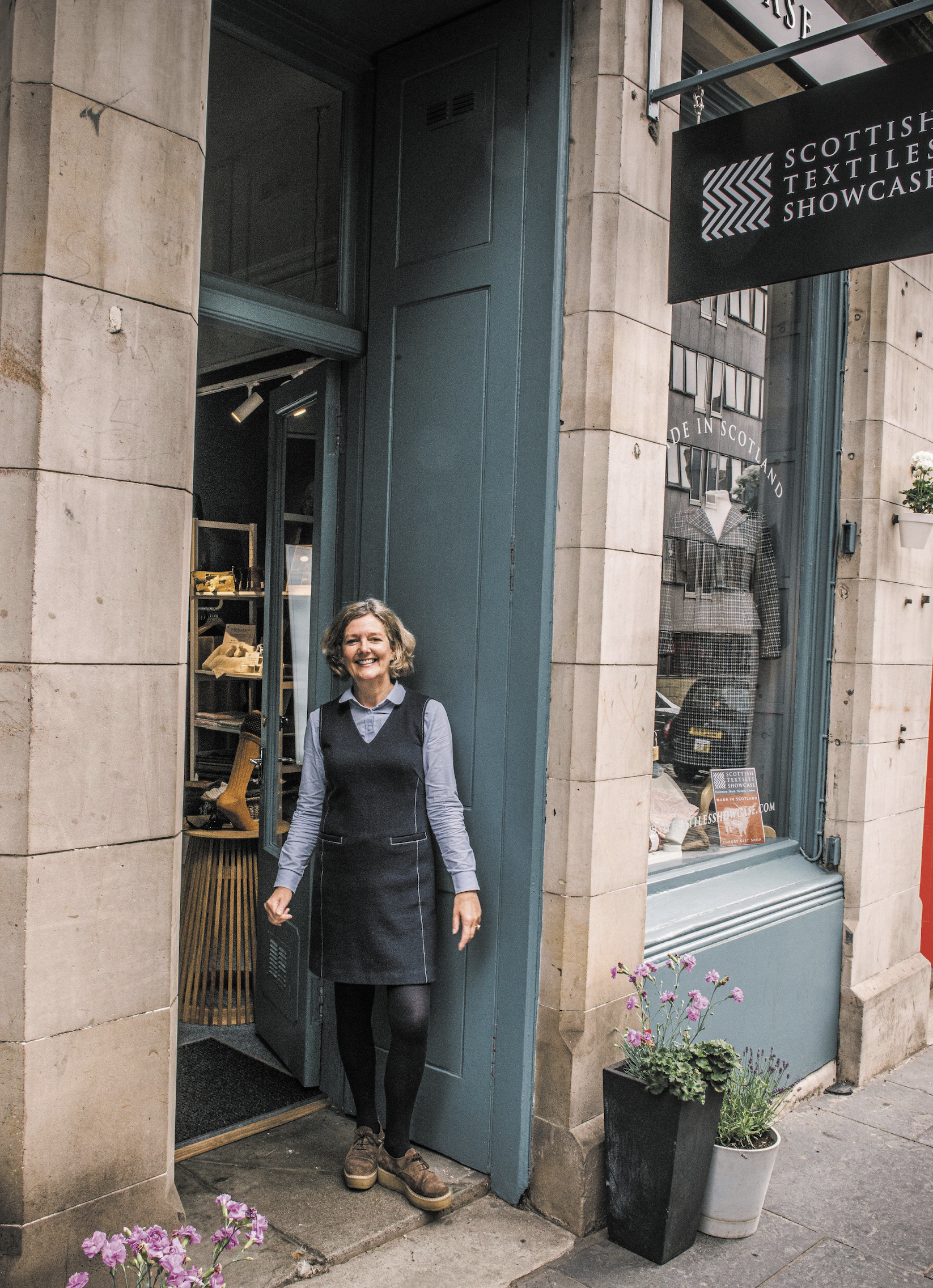
Kitty Bruce-Gardyne, who set up the Scottish Textiles Showcase in Edinburgh’s St Mary Street, was drawn to the Scottish industry after living in Italy, where there was immense national pride in clothing that was ‘Made in Italy’.
Bruce-Gardyne, who was a Mackenzie before marriage, undertook a tour of the Scottish Borders and discovered the history of the mills and the people.
“They were making yarn for Yves St Laurent, Chanel and all these famous luxury brands, using cashmere and other wool products.
“You would see this Scottish excellence on a tour, yet you were not seeing it represented in Edinburgh and Glasgow in the shops and retail spaces.”
She was introduced to James Sugden, a champion of traditional textiles skills, and managing director of Johnstons of Elgin, which opened its knitting mill and cashmere visitors centre in Hawick in 2011.
“James was involved in opening the centre. He was my mentor, and he was a very important support to me. He was saying: ‘We’ve got to get people down to the Borders to see this’. So we started working with the hotels and encouraging visitors who wanted to explore. I thought there was so much potential that needed to be exploited.”
Sudgen died in 2018, but his legacy remains, and his daughter, Rosie Sudgen, is now a designer, with 85 per cent cashmere luxury socks, made in Scotland, selling for £42 a pair.
“The sad story was that Borders textiles was an industry in terminal decline that was closing down, and it just needed some help. It needed to be celebrated. I thought there needed to be a centre in Edinburgh telling the story, just like the Scotch whisky industry.”
Bruce-Gardyne and her colleagues worked on researching a visitor centre which could sell woollens that were designed and made in Scotland. The original space opened in 2019 in the Tron on the High Street.
“We had no funding, and we built it all ourselves on a shoestring with the support and goodwill of the textile community across Scotland, including James Sugden,” she says.
One simple tool was a large map which pinpointed the mills and the designers from the Shetlands to the Borders.
“The map allowed people to connect with the textile story and what we were about. Everything in the shop is Made in Scotland: that’s our USP.
“We are working with the bigger Scottish mills, such as Lochcarron, who provide the volume for blankets, yet we have pieces, such as the overcoats, designed by Elizabeth Martin, handmade in Lanarkshire,” she says.
The mills, including Johnston of Elgin, have supported the concept of the Scottish Textiles Showcase. Organisations such as the Harris Tweed Authority in Stornoway; Knockando weaving mill, near Elgin; New Lanark Spinning in the UNESCO heritage village; Lochcarron of Selkirk; Alex Begg in Ayrshire; Bute Fabrics on the isle of Bute; and MYB Textiles, the lace and madras weaving mills in Newmilns, Ayrshire, are all represented on the store map.
There is also the likes of the fabulous Falkland Blanket, 100 per cent undyed yarn from the Falkland Estate in Fife, woven by the Newburgh Handloom Weavers.
“The main thrust for us is the natural wool fibre, such as from Uradale Farm on Shetland, that the clothing is made of, which are from breeds that are environmentally sustainable and organic,” she says. At Uradale, no artificial fertilisers, herbicides or pesticides are used on the certified organic farm.
Another recent addition, which fits the sustainability mould, is a knitted jumper by Lindsay Girvan, who is based near Linlithgow, in West Lothian. She has a flock of 200 Shetland sheep on Bonnytoun Farm.
“These garments, which are one-sized, are all made on the farm. The un-dyed wool, a range of wonderful natural colours, is processed but all the yarn comes from the sheep on the farm.”
The items are intended to become long-wearing, much-loved clothing that will last for years.
Scotland’s textile industry is fighting back. Of course, crafted items are not cheaply mass-produced and the higher prices reflect the meticulous production and design.
It’s now up to the nation to support this industry and wear something Scottish-made with pride.
The Scottish Textiles Showcase, 20 St Mary’s Street, Edinburgh, EH1 1SU
