Mixed signals on economy but families suffer as holiday airfares see 30 per cent jump

A complex, and at times contradictory, picture has emerged from recent economic data. Inflationary pressures are building while wage growth remains strong, but the Bank of England chose to cut interest rates citing weaknesses in the labour market. 

Business sentiment is improving for the services sector, but weakening in manufacturing. Overall, UK GDP growth has slowed down but remains stronger than for much of Europe. Rent increases were the slowest in three years while house prices have continued to rise. But price pressures are building across the economy, particularly in transport and food and drink

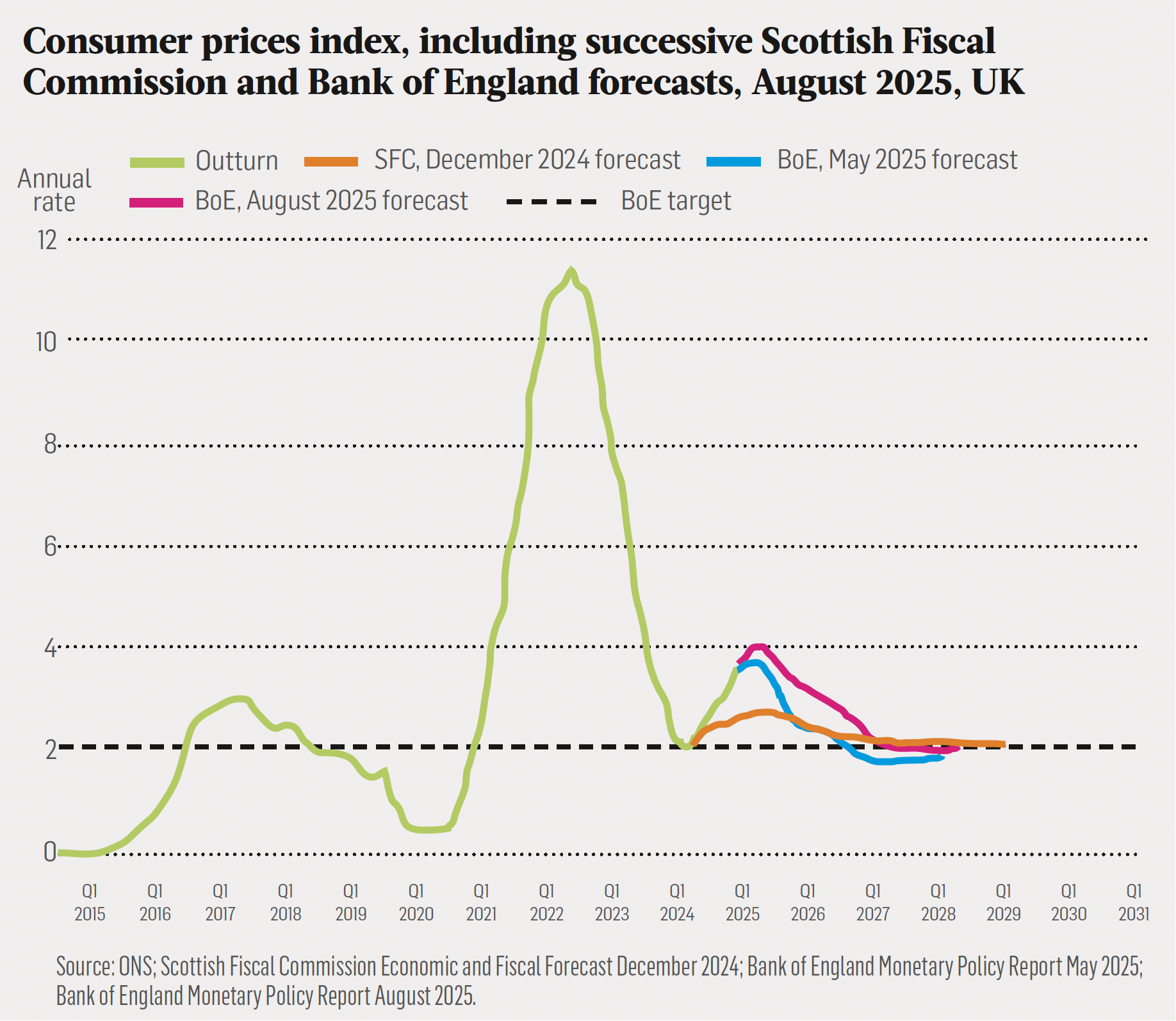
The rate of inflation remains elevated above the Bank of England’s target of 2 per cent on the consumer price index (CPI) measure.

 Over the previous 12 months, CPI rose by 3.8 per cent in July, up from 3.6 per cent in June, and increased by 0.1 per cent over the month. With housing costs included (CPIH), inflation rose by 4.2 per cent in the year to April, and by 1.2 per cent compared to the previous month.

The largest sectoral contribution to the headline inflation rate came from transport.

The timing of the summer holidays was partly responsible, with a large 30.2 per cent jump in airfares between June and July this year (compared to 13.3 per cent in the same period last year). 

In contrast, owner occupiers’ housing (OOH) costs had a downward impact on headline inflation.

Over the 12 months to July, OOH rose by 5.5 per cent, down from a high of 8 per cent at the start of this year.

On a monthly basis, OOH actually fell by 0.1 per cent in July – the first such decrease since March 2010 with a noticeable downward contribution from rents.

Average monthly rents across the UK increased by 5.9 per cent, to £1,343, in the 12 months to July. Private rents averaged £999 in Scotland in April, an increase of 3.6 per cent on the year, which was the lowest annual rise in three years.

A range of sources indicates a worsening picture in the job market across Scotland’s cities, towns and rural areas

The average price for a house in Scotland was £192,000 in June, an increase of 5.9 per cent over the last year, up from 4.1 per cent in the 12 months to May. Average house prices across the UK are higher, at £269,000, but increased at a slower rate of 3.7 per cent. 

The Bank of England forecast in August that CPI would peak at 4 per cent in September, up from May’s forecast of 3.7 per cent.

However, the Bank’s Monetary Policy Committee still cut interest rates by a quarter of a percentage point, to 4.00 per cent, due to concern about a softening of the labour market. CPI is now forecast to return to the 2 per cent target by the second quarter of 2027.

Hiring freeze weakens labour market

A range of sources indicates a worsening picture in the job market. The number of employees on company payrolls fell by 0.6 per cent in the 12 months to July in both Scotland and the UK overall; the eighth consecutive month of falling payroll employment in Scotland.

There were notable reductions in the accommodation and food service sectors (ie hospitality) at both Scottish and UK levels, at around 5 per cent over the 12 months to July.

 With 6.5 per cent of the Scottish payrolled workforce employed in this sector, this is a substantial number of people, with the impact felt widely across Scotland’s cities, towns and rural areas.

Scotland’s North Sea oil and gas also continued to fare badly, with a concerning 4.4 per cent reduction in payroll headcount in the Scottish mining and quarrying sector and 2.6 per cent across the UK.

There was, however, brighter news in the energy production and supply sectors (ie electricity and gas utilities) with impressive growth in employment of 7.8 per cent in Scotland.

The Scottish claimant count for those unemployed and claiming benefits was 3.6 per cent in June, an increase of 1.7 per cent over the month, but down by 1.2 per cent from June 2024.

Labour Force Survey (LFS) data must, nevertheless, be treated with some caution due to ongoing volatility with estimates. These suggested that in the second quarter of this year both employment and unemployment increased, while economic inactivity fell, both UK-wide and in Scotland. 

These findings seem to contradict the administrative HMRC data on payroll employment. 

Analysis by the independent Resolution Foundation think tank suggests that the LFS headline employment estimate is likely to be misleading.

Unless there has been an unexplained rise in self-employment, its analysis finds that the UK employment rate has fallen by 0.6 per cent in the 12 months to July, rather than increasing by 1.8 per cent as the LFS implies. 

Despite the backdrop of a challenging climate for jobseekers, wage growth remains strong; a trend that has perplexed many economists. 

Median monthly pay in July was £2,575 in Scotland, a rise of 6 per cent on the year, slightly above the UK which increased by 5.7 per cent to £2,536.

There was brighter news in the energy production and supply sectors with impressive growth in employment

Consumer confidence weak as shoppers rein in spending

The Scottish Consumer Sentiment Index remains negative for expectations for the economy and household finances, and current household spending, after first dipping below the neutral zero level in September 2024.

Overall consumer sentiment worsened in July, to -8.8,compared to May and June although not as low as April’s score of -14.3.

This masks a notable worsening of future expectations of both the Scottish economy (a drop of 7.6) and household finances (down 5.3), which were only partially offset by a modest improvement  in the score on current household spending (up 5.6, but an overall negative score of -16.7). 

Consumer pessimism is reflected in retail performance, with total retail sales adjusted for inflation down by 0.5 per cent in July compared to last year. Shopper footfall fell across Scotland by 1.3 per cent in the 12 months to July, although there was regional variation with a 1.5 per cent decrease in Glasgow countered by a modest 0.6 per cent rise in Edinburgh, driven by international visitors.

Business activity driven by services

After a weak start to 2025, Scottish business activity started to recover in May.

The Royal Bank of Scotland Regional Growth Tracker, a seasonally adjusted index that measures the month-on-month change in manufacturing and service output increased to 50.9 in June in Scotland, up from 50.5 in May, with above 50 indicating growth.

Output prices for firms fell, which suggests firms were absorbing cost pressures

However, that does not tell the full story, with growth solely coming from the services sector while manufacturing output fell. The tracker also showed that input prices for firms had increased markedly in June, with respondents noting higher costs for materials, labour, energy, and rising supplier prices.

On the other hand, output prices for firms actually fell in May and June, which suggests that many firms were absorbing cost pressures rather than passing them over to customers.

All survey measures in the Fraser of Allander Institute Scottish Business Monitor in the second quarter of 2025 were negative for the third consecutive quarter, with more firms saying that indicator activities would decrease rather than increase.

 The picture was slightly less negative for sales, new business activity, turnover, employment and capital investment. 

Only the score for export activity worsened compared to the first quarter with a net balance score of -25.3 percentage points in the second quarter, down from -16.6 in the first quarter. 

UK maintains growth lead over Europe

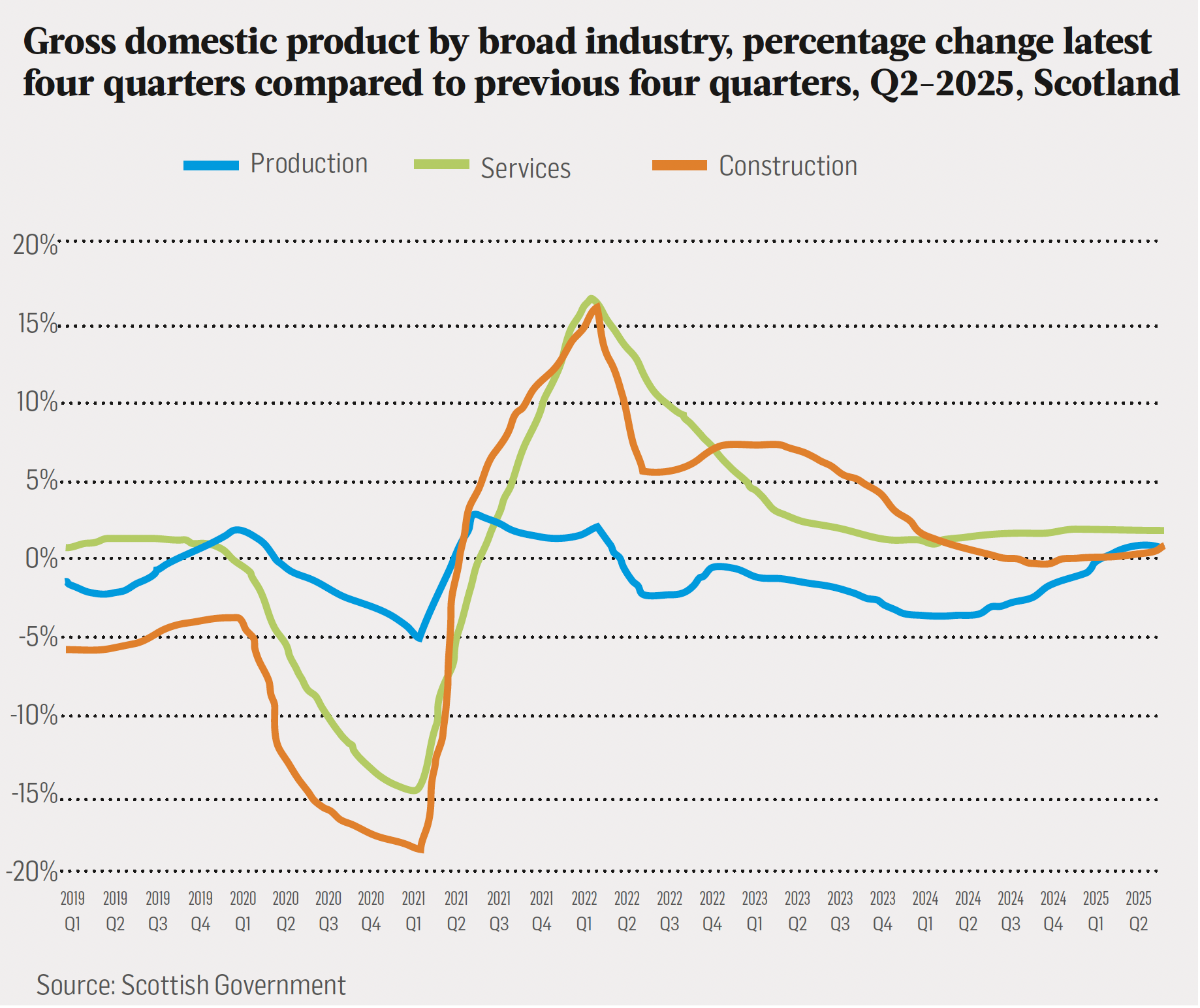
UK GDP growth slowed in the second quarter of 2025, to 0.3 per cent, down from 0.7 per cent in the first quarter. Initial estimates (subject to revision) suggest that Scotland followed the same trend albeit with weaker growth, with the Scottish economy growing by 0.2 per cent in the second quarter, compared to 0.4 per cent in the first.

Compared to the same quarter a year ago, real UK GDP (taking into account inflation) has increased by 1.2 per cent, ahead of Scotland (0.9 per cent).

Growth forecasts for this year and next remain sluggish and uncertain. 

In June, the FAI slightly cut its forecasts for Scottish economic growth in 2025, 2026 and 2027, to 0.8 per cent, 1.0 per cent and 1.1 per cent (down from 0.9 per cent, 1.1 per cent and 1.1 per cent in its April forecast).

The Bank of England’s forecast from August for UK GDP is for growth of 1.25 per cent in 2025 (up from 1 per cent in the May forecast), followed by 1.25 per cent in 2026 and 1.5 per cent in 2027 (both unchanged since May).

UK growth was stronger in the second quarter compared to Germany, which contracted by 0.1 per cent, but was slower than the US which grew by 0.7 per cent following its contraction of 0.1 per cent in the first quarter.

Both the IMF and OECD forecast that UK GDP will grow by 1.2 per cent and 1.3 per cent respectively in 2025, exceeding France, Germany, the Eurozone and Japan, but lagging behind the US, China, India and Brazil.

Analysis of data since the pandemic suggests that UK real GDP is now 4.2 per cent higher than at the end of 2019, a more positive picture compared with Germany which has barely grown at all (0.3 per cent), but far behind US growth of 12.9 per cent.

In association with Prosper