
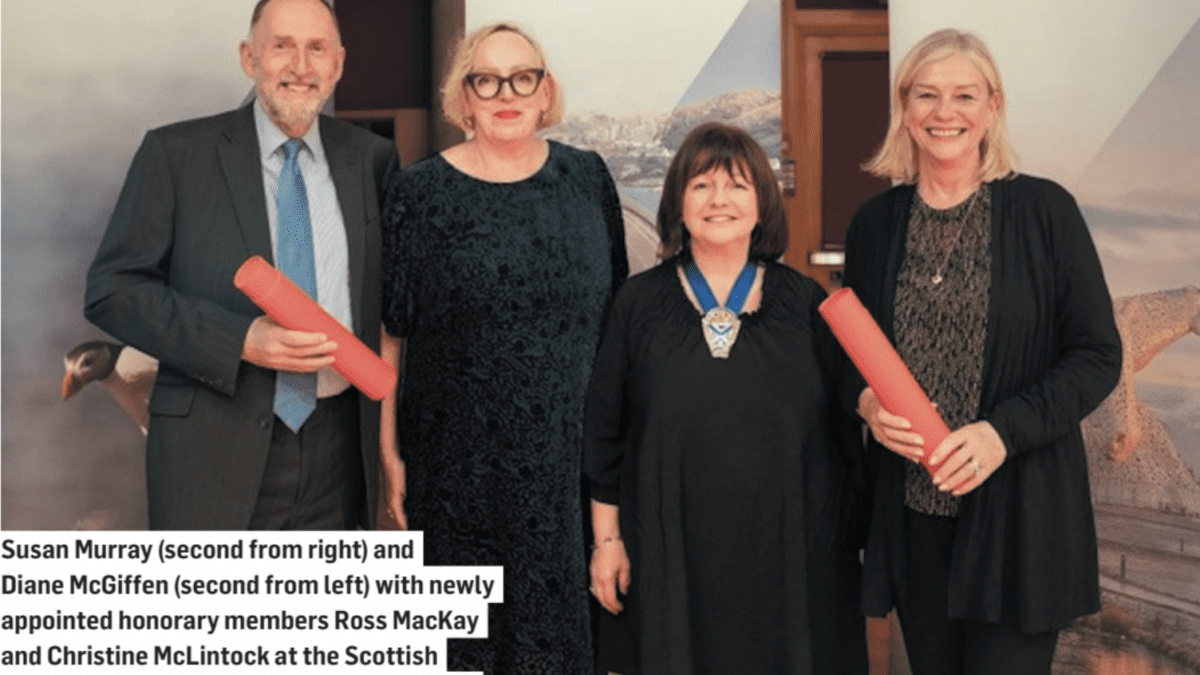

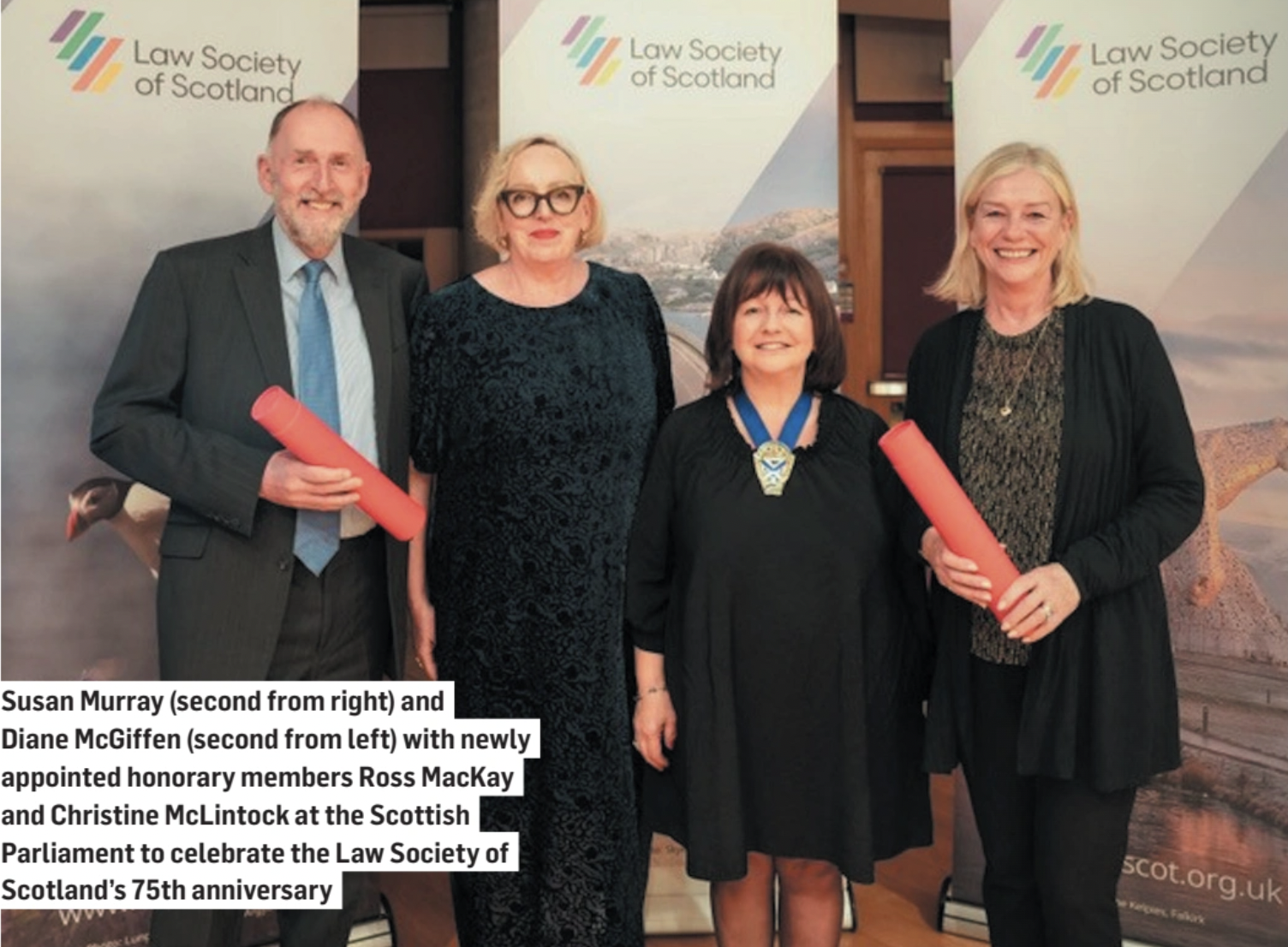
This year was a landmark for the Law Society of Scotland, which celebrated its 75th anniversary as the professional governing body for Scottish solicitors.
Both the profession and the society have witnessed profound and often demanding changes since 1949, as Susan Murray, its current president, notes. “This year, as a profession, we can reflect on how much the work that we do for our clients has developed and diversified since last century,” she says.
“The profession has evolved greatly, with huge progress on many fronts, including the emphasis on maintaining our own good mental and physical health. But we also need to consider what it will look like in another 75 years, and how can we support members to thrive in a changing world so they are best placed to support their clients.”
Last month, Murray presented certificates of enrolment to 127 new solicitors in a single day – a record number that she said reflected employers’ confidence about the demand for legal services and that new legal talent is choosing to train in Scots Law and join the Scottish legal workforce.
Having worked as a litigator for NHS Scotland for her entire legal career, Murray was involved in contentious building issues, then moved into medical negligence and specialised in high value medical claims.
A key part of my role as president to be a strong voice on fundamental values to the profession, such as the rule of law, the independence of the legal profession, and access to justice,’ says Susan Murray
Since 2008 she has acted on behalf of NHS clients in public inquiries involving treatment with blood and blood products and has now moved full circle to work on the Scottish Hospitals Inquiry, alongside her Law Society role.
“I first became involved with the society by standing for election as a council member for Edinburgh more than seven years ago,” she says. “It was a way for me to find out more about the society I had been a member of for my whole career. I quickly learned that it is a dynamic organisation which supports, regulates, and provides value in a diverse range of ways, both to the solicitor profession and to society more broadly.
“I see it as a key part of my role as president to be a strong voice on fundamental values to the profession, such as the rule of law, the independence of the legal profession, and access to justice – or to put it another way, the ability of all members of society to have their legal rights upheld.”
Extending that to those who can least afford it is hugely important and for many years Legal Aid has been one of the most pressing concerns for the society, its members, and the wider profession in Scotland.
“We’re witnessing an acute deterioration and growing abandonment of the system for providing the people of Scotland with financial support to pursue and uphold their legal rights,” she says. “Solicitors are leaving this area of law in droves while young solicitors are not even entering it.
“Increasingly, disadvantaged clients are finding it difficult to access legal advice and support. We want to work constructively with the Scottish Government to acknowledge the problems together and implement the required solutions. Fundamentally, that means financial investment and improved policies and processes.
“It also requires a holistic view of our justice system that recognises how vital access to justice is and the wider societal benefits of achieving it. We need to keep Legal Aid practitioners working in this vital sector and to attract new talent to this part of the profession.”
Across the board, however, she believes that the sector is in an extremely healthy state with private practice legal firms and in-house legal teams prospering. It continues to contribute significantly to the Scottish economy, adding more than 20,000 high-value jobs and generating revenue in Scotland of £1.5bn each year.
Murray points to the fact that more than 750 legal traineeships have commenced in Scotland in the past year. “This maintains four years of unprecedented momentum in terms of new entrants, which is exciting, and it is for us as a profession to make sure that we provide the incentives for them to grow and stay.”
An influx of young people will also be important in tackling the rapidly evolving world of new technology, including artificial intelligence (AI). “The focus on technology is ever growing and with good reason. We know that firms and solicitors are increasingly exploring the use of AIbased tools to improve their ability to serve clients and compete in the legal market,” says Murray.
“To ensure best use and management of risks, the Law Society recently launched a guide to help members with questions on the integration of AI in their work. As solicitors, we need to make sure we are part of the big conversation around AI and that professional skill and experience continue to be needed and valued by society.”
Other challenges include the growing regulatory burden.
“The Law Society has statutory obligations in overseeing AML (anti money-laundering) and financial compliance across our membership and we’re very conscious of the workload involved for members and their practice units and strive to achieve the right balance in terms of also maintaining public trust and regulatory confidence.”
The reality is regulatory oversight is here to stay. “We all need to navigate our way through it and once again, technology is and will be an important part of this conversation, to reduce the burden in terms of both time and cost.”
Murray is also aware of the ominous threats issued to lawyers in England during the civil unrest earlier this year.
“I was extremely concerned, as were many Scottish solicitors, to hear that some of our colleagues faced intimidation directly because of the important work they do. Several of our members in Scotland expressed that they felt similarly exposed and potentially in danger as the situation developed.”
She says it is important that the profession stands together against such intimidation.
“Lawyers play a vital role in upholding people’s legal and human rights and ensuring that happens fairly and equally. Violence and intimidation have no place in a modern society which observes the rule of law.”
Murray is encouraged that the Scottish Government’s legislative agenda has reflected the importance of the legal sector to the Scottish economy, and to society more generally. “Modern regulation is needed to protect the public and ensure that confidence in Scottish lawyers remains high,” she says.
“The Law Society will continue to work constructively with both Holyrood and Westminster to ensure that legislation is fit for its intended purpose and that includes the Judicial Factors (Scotland) Bill and several other pieces of new or amended legislation.”
She notes recent significant development in relation to the Victims, Witnesses, and Justice Reform (Scotland) Bill, where the Scottish Government has withdrawn its proposed pilot scheme for judge-only trials in sexual assault cases. “That outcome reflects the considerable input and constructive conversations we’ve had with MSPs and others. We’ve made it clear that we support improvements to our criminal justice system, but not changes that threaten the administration of justice or the fundamental integrity of the system.”
On the issue of any implied or actual political interference in decisions made by the justiciary, she is equally clear.
“We also imminently expect positive changes to the Regulation of Legal Services (Scotland) Bill, particularly on the earlier contentious proposal of the imposition of ministerial powers to intervene directly in the regulation of the legal profession.”
Engaging with lawyers from other jurisdictions, she adds, has been extremely valuable.
“Many of the challenges we face in Scotland and the UK are shared by those operating in other parts of the world and this year we have shared international speaking platforms with lawyers from other countries to get that message out globally – and loudly.”
