
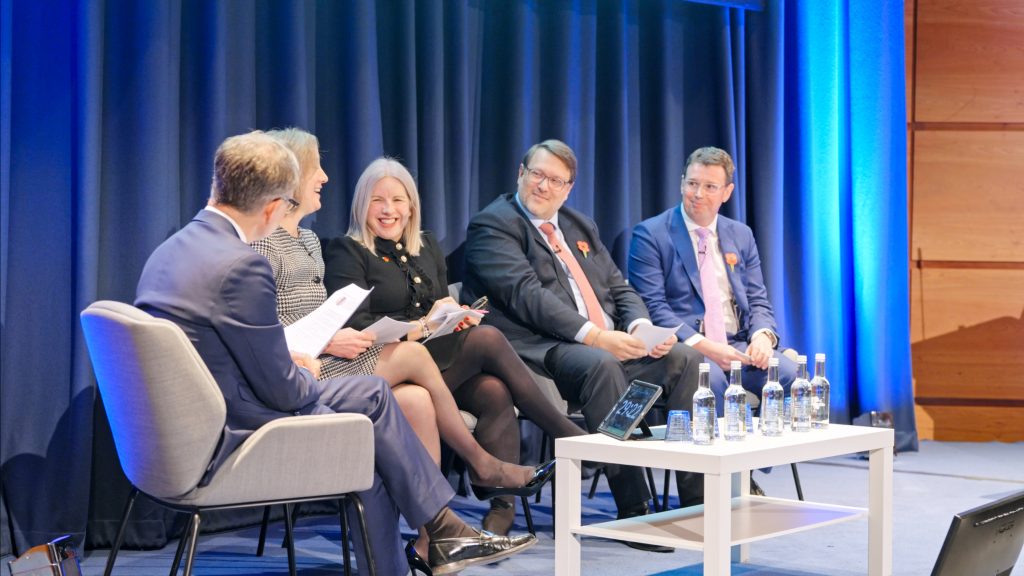
The UK Investment Association conference hears leaders urge investors to put more of their savings into active assets
The clarion call from Scotland’s investment community is our nation must turn from being a haven of savers into one of active investors. The UK Investment Association’s flagship annual Scotland Conference in November was unflinching in its call for more action.
Leading executives from Scotland-headquartered institutional investment groups including Aberdeen, Baillie Gifford and Aegon Asset Management proved to be feisty panellists with strong opinions.
Leaders of international investment giants with major operations in Scotland were in the mix, including BlackRock, the world’s largest asset manager, which now employs 1,400 in Scotland and is a part owner of Edinburgh Airport via its Global Infrastructure Partners business.
The Scottish Government and UK Government sent senior politicians in Scottish business minister, Tom Arthur, and the UK’s Scottish Secretary, Douglas Alexander, to explain the role the public sector can play in Scotland’s growth.
Alexander was in punchy form as he delivered some home truths about Scottish politics and business.
In many respects, Scotland is the home of the UK investment industry, having played a huge role in pioneering the investment fund and pension fund industries – and the growth of UK banking. The annual conference is recognition of Scotland’s role.
The big institutional investors at the 2026 conference fielded some tough questions about the direction of the asset management industry and their plans to keep Scotland at the forefront of change and opportunity.
The big challenge highlighted by all was how to transform the public in Scotland and the UK from nations of savers into nations of investors.
Kirstie MacGillivray, chief executive of Aegon Asset Management, speaking on the leadership panel, entitled Navigating a Changing Industry, said: “We are so far behind, compared to some other countries. We need to get people comfortable that [investment] is the right thing to do.”
They were all quick to emphasise that Scotland has advantages for investment companies not enjoyed by other locations.
Sandra Boss, UK chair of BlackRock UK, said: “We put our AI hub here because we can get super well-educated happy people at low cost in Edinburgh vis-à-vis the way this works in London.
“This is attracting a new kind of capital and what we need to think about is how can we then bring in international investors,” she added.
“So, I’ll use the example of our Global Infrastructure Partners (GIP) business. We have invested in Edinburgh Airport … we invested in Clydeport through Peel Ports … We are bringing GIP money from overseas investors to make those investments.”
The investors addressed the opportunity provided by volatile international politics and markets.
Xavier Meyer, chief executive, investments, Aberdeen Group, said: “It is probably a much better environment for active asset management than it was before … skill is going to be even more important.”
They discussed the prospects for Scotland’s traditional strength in developing smaller, boutique investment firms that grow into bigger players.
Scott Wallace, operations partner at Aberforth Partners LLP, which employs 19 people, said: “We have a fantastic, recent generational history of boutiques in Scotland.
“These are boutiques that have gone on to become global asset managers such as Baillie Gifford and Aberdeen Asset Management.
“I worry about the next generation of (Scottish) boutiques in terms of the barriers.
“We’ve got the external barriers around the geopolitical and economic and we have, frankly, the UK staggering outflows of capital over the last ten years. The regulatory burden is now high, and these are hard hurdles to overcome.”
Alexander was asked how important UK international relationships were in attracting investment into Scotland and he addressed the negative impacts of Brexit on Scotland and the UK.
“Essentially, the post-Brexit trade story is that as a UK we under-performed significantly on goods, but have significantly over-performed in relation to service. In essence, geography still matters in trade policy … and if you put up significant new trade barriers to your largest trading market, there are consequences.
“We have suffered genuine economic damage as a consequence of the choice that was made in 2016.
“And that’s a big part of why, as a government, we are working so hard to broaden, deepen and strengthen the relationships between our friends, partners and neighbours in the European Union.
“And, at the same time, we continue to greatly value and work closely with our friends and allies in the United States.”
He said the big winners out of the global financial crisis have been the US banks.
“I spent some time working in the States, when I was sensible enough to be away from Scottish politics, and in that sense I’ve got a pretty deep appreciation of how internationalised the businesses became … Our responsibility is to make the UK an investable proposition for inward investment.”
Alexander was asked if UK and Scottish politicians understand financial services.
He replied: “In 2015, I tried very hard not to lose my seat but every aspect of my life got better when I did … that’s the brutal truth.”
Alexander said he was out of politics for nine years, during which he founded his own business, worked with a corporate law firm and worked for private equity firm TPG in San Francisco.
The Scottish MP said that after his experience in politics then corporate law, investment and consulting … “talent is pretty evenly distributed … you have really talented people in all of those domains and you some complete schmucks and idiots in all of them as well. So the idea that all of the bad people are in politics and all of the good people are in investment banking … it’s not true.”
I think we have a responsibility … to find ways to celebrate the dignity and worth of people who found their own business
— Douglas Alexander
Alexander was asked: what is the national growth story for Scotland?
“We Scots have a challenge culturally. I was educated at a state comprehensive in west central Scotland in the 1980s. I can’t think of a single person in my class who aspired to run their own business.
“I think we have a responsibility … to find ways to celebrate the dignity and worth of people who found their own business. Culturally, there is more that we can and should do.”
Alexander was asked about the narrative that the UK is not the place to scale a business.
“We do face a challenge in terms of scaling businesses. We need to have more people within the academic community comfortable with the idea of commercialising their ideas. But beyond the venture stage and the angel stage, we need also pools of capital available.”
Alexander was asked about the vision for the financial services sector in Scotland.
He traced problems all back to the rise and the fall of both Royal Bank of Scotland and Bank of Scotland as strong, independent companies. The banking collapse of 2008 is still being felt.
“We lost both. My sense is, after that a lot of confidence was lost here in Scotland. We have still got real expertise in terms of asset management.
“We’ve still got real and growing expertise in terms of fintech but I would make a plea to this audience to find your voice in the public square.”
When asked what should be done to rebuild confidence, he backed entrepreneurs.
“We need the wealth creators around the table. If you look at Scotland … say 25 years ago … we had the General Accidents, the Standard Lifes, the Scottish & Newcastles, big corporate Scottish-based entities, a number of those are no longer with us.
“But we also had the Entrepreneurial Exchange in 1999 and 2000, a rising generation of really successful Scottish entrepreneurs, and it feels to me that we need to generate that same sense of excitement again.”
This article is featured in the Winter Edition of The Business magazine published on 29 November 2026 in association with The Sunday Times Scotland.