

Libby Heathcote, the new president of the Royal Incorporation of Architects in Scotland, on why more input from architects would help in the housing crisis
Architects must regain their rightful place at the forefront of all built-environment projects, says the new president of the Royal Incorporation of Architects in Scotland.
Libby Heathcote, who will be installed this week to begin a two-year tenure, wants architecture in Scotland to return to its civic pedestal in defining the places where we live, work and relax.
“It’s been tough in the profession for a number of years, and we all need to be looking up, not down, and talking to the wider public about the amazing work we all do,” she says.
“The RIAS awards show the exceptional quality and the ambition of architecture in Scotland. We need to start singing more about that – and the benefit that buildings bring to our society, our economy and our wellbeing.”
In Heathcote’s world, the noble architect has an ability to lift human spirits – and make a subliminal impact on the lives we lead.
“Across all kinds of projects, as general practitioners, we are the overseers. We are people who hold and defend the design principle from start to finish. We’re the right profession to do this, because we really care about the end result.”
Yet, the position of the architect has been undermined by the drabness of austerity, and the brutal functionalism of mass-produced buildings which do not fit well in Scotland’s urban and rural landscapes.
“We’ve been in such a difficult political time with the profession, perhaps too busy talking about the ‘business’ of architecture, worrying about compliance, regulation, fee structures, and procurement.
“Certainly, the RIAS exists to support members dealing with these elements, giving practitioners space to talk, but we need to go much further with a series of nationwide presentations and organised visits.”
She envisages high-level engagement with the policymakers who are facing into a housing crisis, the mass house builders and council planners to open discussion about how to break down the barriers and change stock responses.
How does she plan to engage with the wider world?
“I think it’s about setting up a series of opportunities and space for the profession to start talking about architecture and the role of brilliant design.” She points to the glittering work of the RIAS winners. There must be, she says, more ‘place-led architecture’ something which chimes with Architecture and Design Scotland.
“There is a lot of architectural innovation going on in Scotland, and it is a fantastic time for us to keep promoting brilliant buildings. We’ve got to speak more loudly about the design quality and character that we can bring to the mass volume housing builder.”
We’ve got to speak more loudly about the design quality and character that we can bring to the mass volume housing builder
Why are there so many dismal modern housing locations, poor in terms of design and lacking in context with Scotland’s built environment?
“One of the great challenges is how we deal with the housing crisis as architects and as a profession when so much of it is done by house builders that are solely motivated by profit, and understandably so.
“The barrier to better housing design is the perceived cost. The house builders have a formula which they can sell. I also wonder if it is a cultural issue and people really want to have three ensuite bathrooms in a three-bedroom new home?”
Like many architects, she casts her eyes to Scandinavia, where there is time spent on educating people about design and how to live more sustainably.
“This includes talking about design from a very early age. I feel this is something we need to do more of in Scotland. Perhaps this is role for the architectural profession to take on in a more radical way.
“As a society in the UK, we seem to be going down a very Americanised route with community building. Yet today, with a climate emergency, it seems to be at odds with this. Perhaps we should be thinking about how we live more frugally and in a more environmentally sustainable and better way.”
As president, she feels that we need to reset wider values on what the housing needs are. She cites the work of Mary Arnold-Forster, based in Dunkeld, and Dualchas, in Glasgow and Skye, who are people looking at tight planning regulations and spaces, yet build joyful places to live and experience.
She disagrees that tight budgets are the reason for poor housing design.
“I think if we, as architects, know there are budget restrictions and certain parameters, our added value is working within those parameters. Building a box is not an architectural response. We respond very differently.”
Heathcote is an associate director at Reiach and Hall Architects, working on projects from education and public sector court buildings to heritage projects such as the Bannockburn experience and, more recently, the Kilmartin Museum redevelopment, which opened in 2023. Before lockdown, her firm handed over the Inverness Justice Centre, with its four criminal and two civil courtrooms, plus a tribunal hearing suite.
She has also worked on smaller housing projects, including the retrofit of Scotland’s older housing stock, and the refurbishment of university buildings, such as Victorian laboratories at the University of Glasgow.
“I haven’t left Reiach & Hall because the work we do is so interesting. I love it. However, there has been so much change in the profession since I started and you have to grapple with this.”
In the wider realm of major civic projects and public procurement, she speaks of construction as “a team sport” with mutual respect for the various disciplines working together. However, the root of many problems is that architects are not at the initial table when the business case is being prepared and developed.
“We are not then able to influence the progression if we’re not at these initial sessions. I absolutely believe that architects should be at the table in the early stages of planning, not just in housing, but on major construction projects. This is one of the major issues of recent years in terms of national procurement and quality of design.”
This lack of preliminary architectural input and the domination of spreadsheets created by project managers and cost consultants who have skills but are seldom design experts, is a root cause of poor decision-making and wasted time and effort.
“Once a business case and a budget is set and benchmarking undertaken which doesn’t tie in with the brief of the building, you are on a hiding to nothing.”
Innovative design is seldom able to rescue such false starts.
“So getting to the table at the outset, is something we, as a profession, really need to be pushing for, and have been pushing for,” she says.

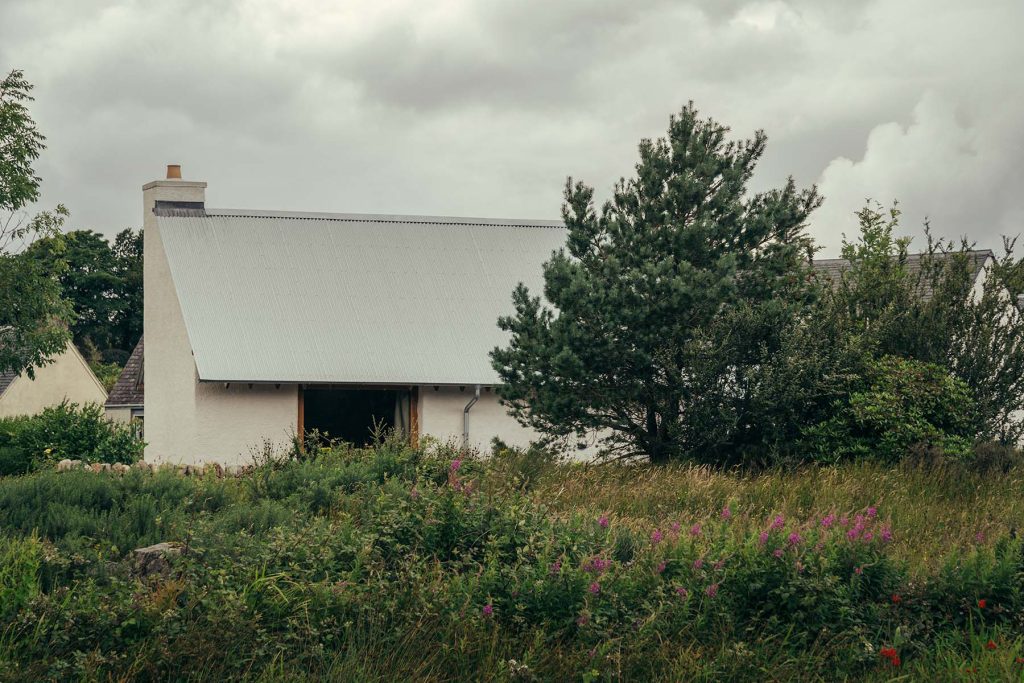
The 2026 RIAS Award Winners
Iorram (Highlands) by Baillie Baillie Architects (pictured above)
Edinburgh Futures Institute (Edinburgh) by Bennetts Associates
Neilston Learning Campus (East Renfrewshire) by BDP
Paisley Central Library (Paisley, Renfrewshire) by Collective Architecture
Parkhead Health & Social Care and Community Hub (Glasgow) by Hoskins Architects
Preston Tower, Doocot & Gardens (East Lothian) by GRAS
St Andrew’s Drive Phases 2 & 3 (Glasgow) by jmarchitects
Tarlair Outdoor Pool Pavillion (Macduff, Aberdeenshire) by Studio Octopi
The Canna House Project for the National Trust for Scotland (Isle of Canna) by LDN Architects
Usher Building, University of Edinburgh (Edinburgh) by Hassell