

Scotland’s National Investment Bank will use its financial heft to face into the housing emergency, helping to build more homes across the nation.
The Bank, which published its investment strategy and business plan for 2026-2027, has will bolster its £100m fund to support more technology hotshot emerging from Scotland’s universities.
The updated strategy is the first to be spearheaded by new chief executive David Ritchie and focuses on the Bank’s commercial investment remit and long-term financial stability.
The mission-led, impact investor outlines new priorities under each of its three missions. Its place mission will focus on expanding its all-tenure approach to increasing the supply of homes for communities around Scotland. The Bank’s investments have already supported the delivery of nearly 1,000 new homes.
This element of the strategy is based on developing strong partnerships to unlock stalled sites and support small-to-medium-sized housebuilders.
The Bank will also working to increase the depth of the housing supply chain by crowding-in more capital to support Scottish development, as it has done with fund investments in Octopus Capital and L&G, both of which included crowding-in ratios.
“This means that for every pound the Bank invests, a further pound or more will be invested in Scotland by the funds,” says the Bank.
The Bank has expanded its innovation mission, which previously targeted technology and life science innovation, to be sector agnostic. Its focus moving forward will be on businesses with demonstrated growth and a distinct position in the market.
It will be looking at how AI and machine learning is effectively embedded within companies where it is integral to their service or product.
Aligned to its net zero mission, the Bank is looking at opportunities in energy security and stabilisation, as demonstrated by in its recent acquisition of a minority stake in the Devilla Battery Energy Storage System near Kincardine. It will continue to direct its capital towards bottlenecks in the renewable energy supply chain, especially within grid infrastructure and energy systems.
The Bank will also manage third-party capital, utilising its expertise as a fund manager. It intends to design a fund to support innovative businesses emerging from Scottish universities in the coming year. This would build upon the £100m the Bank has already invested in university derived businesses.
David Ritchie, chief executive of the Bank, said: “The Bank is entering its next phase of maturity. This is an opportunity for us to learn from our first five years and sharpen our focus on the commercial returns that will ultimately deliver long-term societal impact.”
“While our risk appetite remains unchanged, our new strategy ensures we also stay grounded in our commercial fundamentals. Our vision is to become a perpetual fund that delivers impact and generates returns that can be reinvested, harnessing the potential of emerging opportunities for future generations.”
Publication of this new strategy is the latest of several key milestones in the Bank’s history. It celebrated its five-year anniversary last November and has committed more than £1.2bn in capital, with £1.9bn invested alongside.
The Bank has also experienced portfolio failures, which it says are an expected part of investment, particularly for a development bank that is mandated to take on higher levels of risk. The Bank has reviewed and identified lessons to be learned from failed assets, some of which are reflected in the investment strategy.
Ritchie, who was appointed chief executive in January this year, continued: “Whether you’re a business trying to secure investment or a family trying to balance a budget, we are all feeling the impacts of our challenging macroeconomic climate. Investor appetite has tightened as global conditions continue to shift. Volatility is now the defining feature of the market.
“While we have seen these issues impact Scottish businesses, there are also clear opportunities, and our strategic direction is calibrated to capitalise on this potential, channel more investment into Scotland, and support the development of a thriving economy.”
THE BANK IN FIGURES
- Investments have impacted 325,739 people through regeneration, high-quality housing and connectivity, an increase of 118,697 from the previous year;
- Investments have supported the building of 983 new homes, an increase of 241 from the previous year;
- Portfolio has supported 3,330 jobs, an increase of 239 from the previous year;
- Investment portfolio has avoided, reduced or removed 235,429 tCO2e, an increase of 99,898 tCO2e from the previous year;
- Portfolio companies reported a £411m supply chain spend in Scotland, up £134m from the previous year;
- Portfolio companies reported £149.2m spent on research and development activity, up £55.2m from the previous year.
Read our recent article on Scottish National Investment Bank, BUILDING TO RENT. The coverage includes the commitment to build-to-rent housing with a £50m investment in L&G’s Build to Rent fund, support for SME housebuilders, and Scotland’s record investment growth in 2025. The Bank is positioning itself as a major investor in Scottish high-growth companies, innovation from university spin-outs, and the energy transition.
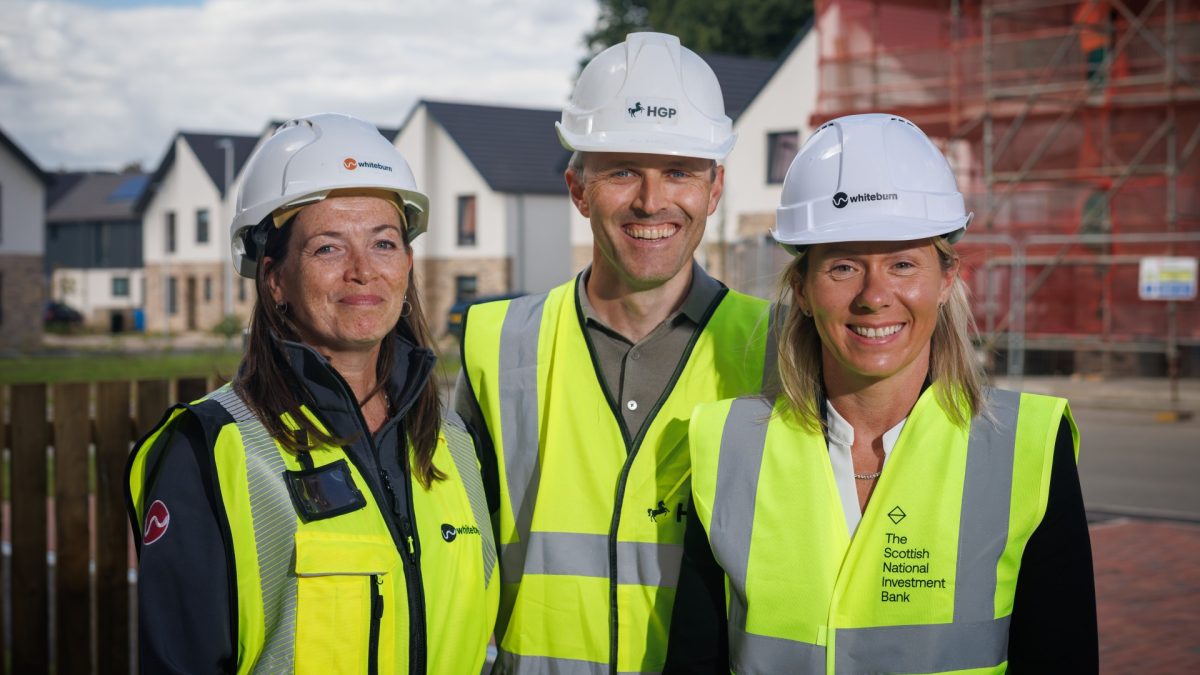
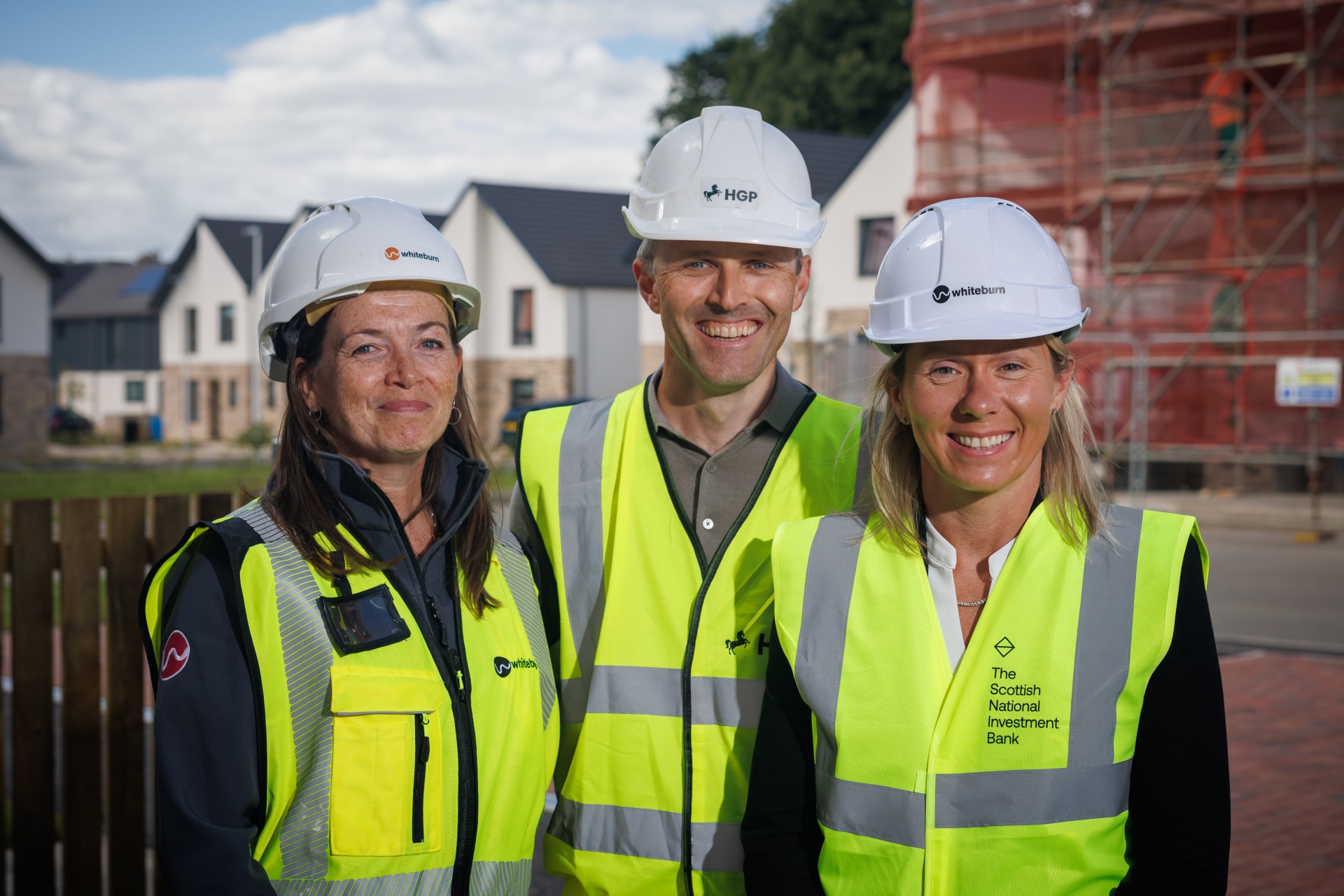
Pictured: Homes in Scotland: Eve McCurrich, managing director of Whiteburn; Colin Bennett, investment director at Housing Growth Partnership; Nicola Douglas, executive director, sustainable investment at the Scottish National Investment Bank. Photo: courtesy of the Bank
