


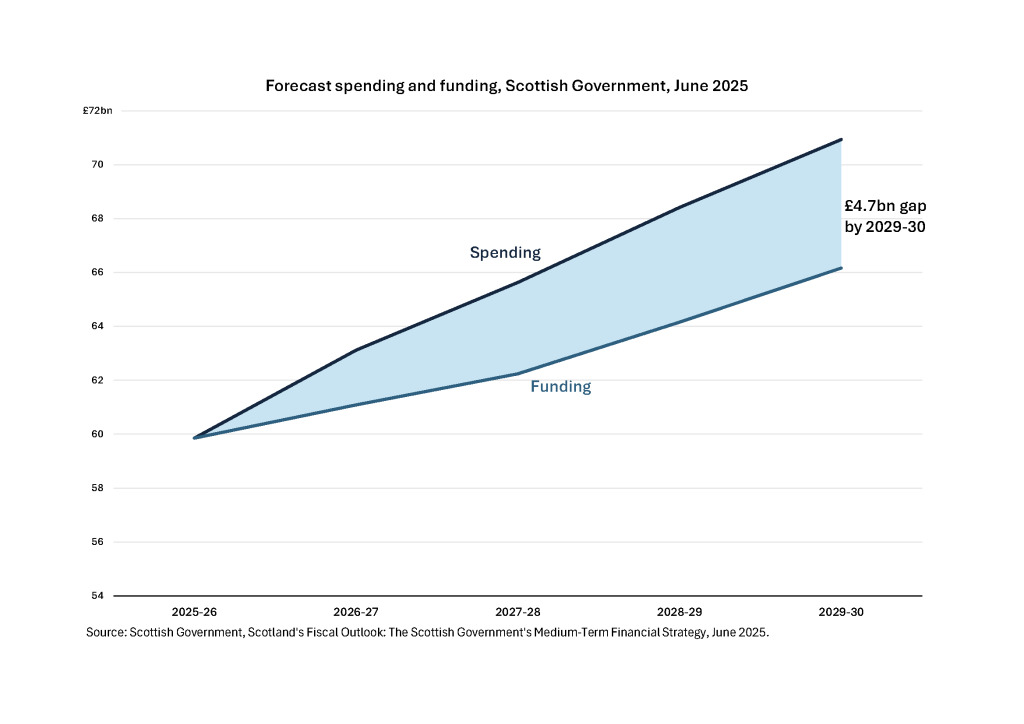
The challenge facing Holyrood: Scottish Government’s own projections show a £4.8bn shortfall between spending and funding by 2030.
Our political parties spent this year’s Holyrood election campaign promising more spending, lower bills and better public services. They devoted much less time discussing how to close a financial black hole that is projected to amount to the equivalent of £850 for every person in Scotland by the end of the decade.
According to the Scottish Government’s own projections, annual spending will reach £70.9bn by 2029-30, while funding from devolved taxes and the block grant from Westminster will amount to only £66.1bn.
The resulting £4.8bn shortfall exceeds the entire budget of either the transport or justice departments. Yet anyone following the Scottish election campaign could be forgiven for thinking the problem didn’t exist.
Asked at a Prosper member event in Inverness before voting day whether the politicians were being honest with voters about the state of the public finances, Professor Mairi Spowage, director of the Fraser of Allander Institute at the University of Strathclyde, replied bluntly: “No, and it’s not just those who are in power at the moment, but it’s those who wish to be in power after the election.”
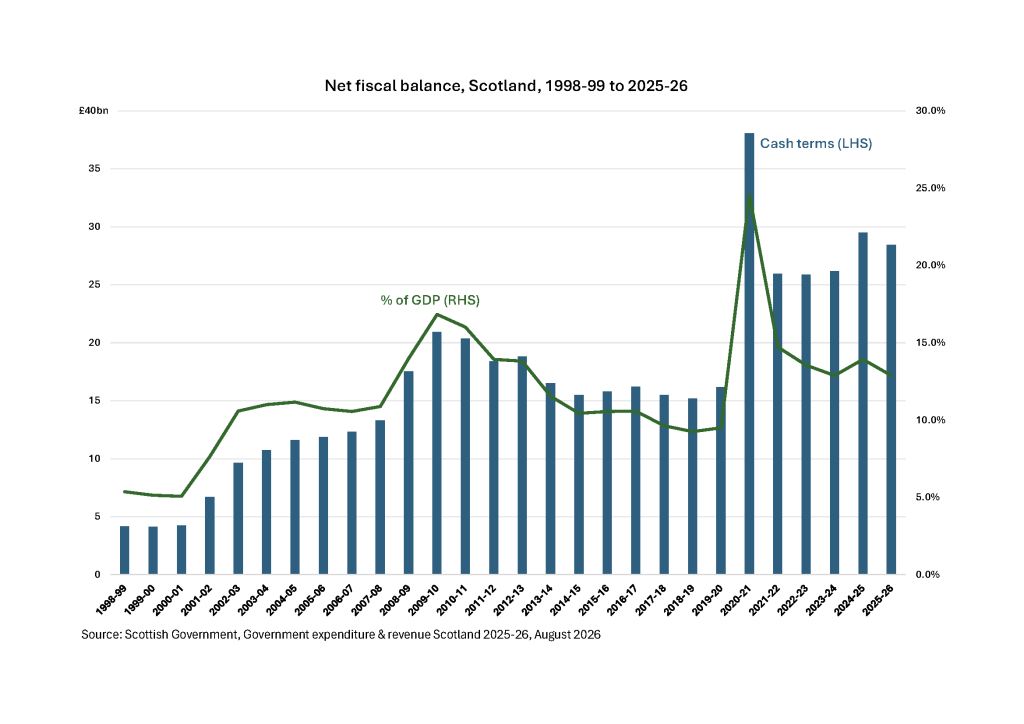
Scotland’s wider fiscal position is also weak. Taking into account UK taxes and spending by the UK Government, latest estimates show that total public expenditure in Scotland exceeds tax revenues by around £28.4bn (excluding the North Sea).
This gap is financed through UK-wide borrowing and fiscal transfers from the wealthier economies in London and south-east England.
But the Scottish Government’s borrowing powers are highly limited and so the fiscal constraints it faces are very real.
While Scotland’s wider fiscal deficit is absorbed across the UK, the Scottish Government must still find a way to close its own projected £4.8bn gap by the end of the decade.
The Scottish Government’s borrowing powers are highly limited and so the fiscal constraints it faces are very real
Professor Sir Anton Muscatelli, a former principal of the University of Glasgow and now president of the Royal Society of Edinburgh (RSE) believes it is highly unlikely that the ‘fiscal cavalry’ of the UK Exchequer will come to Holyrood’s rescue.
The conflict in the Middle East has pushed up inflation and interest rates, making government borrowing more expensive.
SNP ministers will say that the Scottish Government has balanced its budget throughout their time in office.
On paper this is correct but as Stephen Boyd, director of the centre-left think tank IPPR Scotland, points out: “This is a red herring as the Scottish Government is forced by law to run a balanced budget, which does not necessarily prove that its fiscal strategy has been prudent.”
While the Scottish Government cannot borrow its way out of the £4.8bn fiscal squeeze, it can raise income tax rates and bands and Land and Buildings Transaction Tax. Local authorities, which also face acute spending pressures, can also introduce new measures such as overnight visitor levies, as Edinburgh has done.
Scottish income tax: why higher rates do not guarantee higher revenues
According to the Scottish Fiscal Commission (SFC), the official tax and spending forecaster, income taxpayers in Scotland will pay £1.8bn more in tax this year relative to their counterparts in England, Wales and Northern Ireland. But the SFC also estimates that this will only raise an extra £1bn for the Scottish Government budget.
Scotland can raise extra tax, but if its tax base grows more slowly than the rest of the UK, some of the benefit is offset through the fiscal framework.
Since income tax was devolved, Holyrood’s block grant from Westminster has been adjusted to reflect the revenues that would have been raised had Scotland remained within the UK tax system.
Higher tax rates have been partly offset by weaker growth in Scotland’s tax base than elsewhere in the UK
The SFC calls the resulting £800m difference Scotland’s “tax base performance gap”. In practice, it means that higher tax rates have been partly offset by weaker growth in Scotland’s tax base than elsewhere in the UK.
If earnings and employment grow faster in Scotland, Holyrood keeps the additional revenues. But the SFC forecasts earnings growth of 2.9 per cent in 2026-27, below the 3.5 per cent forecast by the Office for Budget Responsibility for the UK as a whole.
According to analysis by Tax Policy Associates, the research group led by tax lawyer Dan Neidle, Scotland’s 48 per cent top rate of income tax on earnings above £125,140 may have reduced revenues by £22m. Higher taxes can encourage more pension contributions and the shifting of income into dividends, reducing taxable earnings.
Neidle’s estimate is based on how the incomes of existing top-rate taxpayers grew following the increase in the top rate to 48 per cent in April 2024, compared with a counterfactual in which they had faced the 45 per cent rate elsewhere in the UK.
But Neidle himself acknowledges that it is too early to draw firm conclusions and that the result may reflect short-term volatility rather than a lasting behavioural response.
Although growth in top incomes lagged behind the rest of the UK in 2024-25, HMRC data show the number of Scots earning more than £125,140 actually rose from 35,400 to 41,400 following the increase in the top rate to 48 per cent. What decreased, however, was the average income per taxpayer in the top rate band.
While some argue that Scotland’s higher taxes are making the country less attractive to mobile professionals and entrepreneurs, the available evidence remains limited. It is more likely that we are simply seeing the result of better tax planning, rather than a mass migration of high earners across the border.
As the chair of the SFC, Graeme Roy, has observed, we “simply don’t know from the data currently available” whether Scotland has crossed the famous Laffer curve, where higher tax rates begin to reduce revenues.
What is clear, however, is that, as Muscatelli argues, “the £4.7bn gap can’t just be made up with taxes… so there will need to be a combination of spending and tax changes”. The question is not whether there will be cuts, but where they will fall.
Public sector pay and workforce pressures on Scotland’s budget
Just over half of the Scottish Government’s day-to-day budget is on pay. Officially, its public sector pay policy envisages wage increases averaging three per cent from 2025-26 to 2027-28.
But pay awards to date have all exceeded this, meaning agreed budgets will only cover deals for next year of 1.1 per cent. It is unlikely that trade unions will agree to below-inflation pay rises, meaning the Scottish Government will face a choice between costly industrial action or topping up public sector pay through cuts elsewhere.
With 472,000 full-time equivalent (FTE) workers, Scotland’s devolved public sector is bigger than in England, accounting for 22.7 per cent of the workforce compared to 17.2 per cent south of the border. It is also better paid, with staff here paid an average of £1,500 more per head.
The Scottish Government’s fiscal sustainability delivery plan proposed workforce reductions of 0.5 per cent from 2025-26 to 2029-30. But 2,800 full-time equivalent jobs were added to the total public sector payroll last year, an increase of 0.6 per cent.
The Scottish Government aims to deliver £1.5bn of efficiencies by 2029-30. It has intentions to reduce administration and property costs by 20 per cent, while protecting ‘front-line’ services. Health and social care, which takes up 40 per cent of day-to-day spending, has been a focus. But Boyd cautions that it is highly unlikely that “rapid productivity growth in the public sector will make a significant contribution to closing the fiscal gap”.
The Scottish Government will need to address much bigger ticket items of expenditure if it wants to make a dent in the £4.8bn spending shortfall.
Social security spending: balancing support and fiscal sustainability
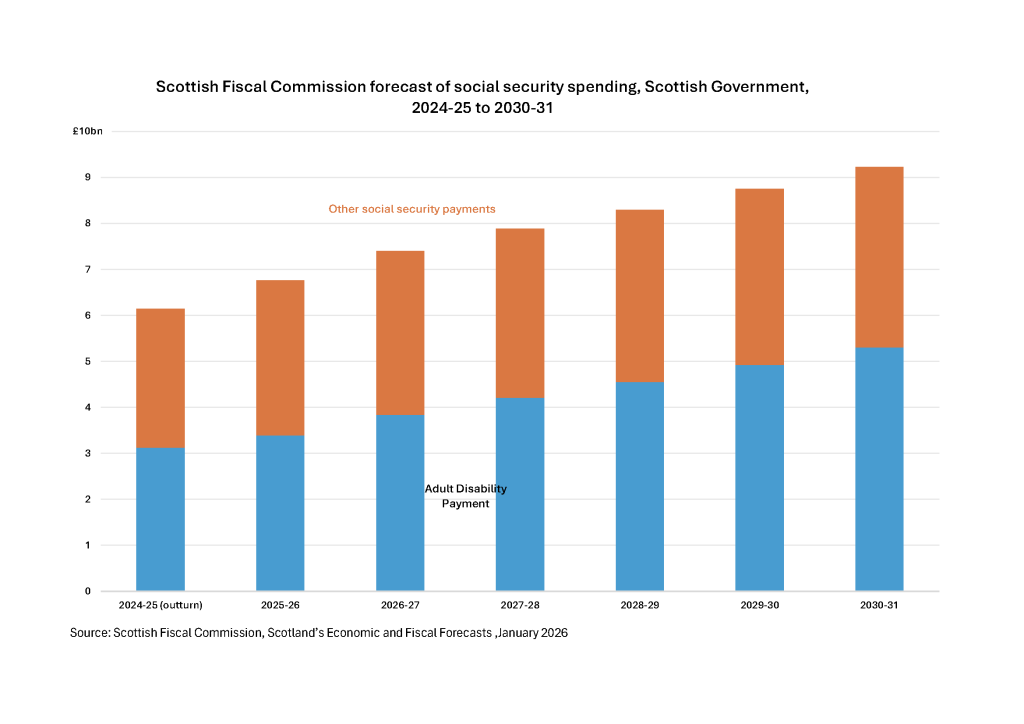
One of the most significant drivers of recent spending pressures has been the devolved social security system, with some Scottish benefits more generous and elements of the system more claimant-friendly than those elsewhere in the UK.
The Scottish Government receives funding from Westminster to account for the devolved benefits it administers. But decisions taken by Holyrood mean spending on welfare is expected to cost about £1bn more each year than funding received from Westminster.
While it would be politically difficult for SNP ministers to make any changes to its flagship Scottish Child Payment, which costs around £500m a year, there are other ways to address spending pressures in the welfare budget. In Scotland, the Adult Disability Payment (ADP) pays the same amount as the equivalent Personal Independence Payment in the rest of the UK, but its administration and review processes differ.
With rising demand for public services and welfare, cuts will be politically difficult
Ministers have deliberately moved towards longer-duration awards for ADP and lighter-touch reviews for people whose conditions are considered unlikely to improve. With rising disability caseloads across the UK, spending on ADP is forecast to rise in Scotland from £3.1bn in 2024-25 to £5.3bn in 2030-31.
Whether the current balance between claimant support and fiscal sustainability is the right one is likely to become an increasingly important question in future years.
With rising demand for public services and welfare, any cuts will be politically difficult. But unless political leaders get a grip, the most likely outcome will be what Muscatelli calls the “effective rationing of services”. The NHS, for example, will remain free at the point of delivery, but there will be less delivery at a lower standard.
It’s time for the omertà on Scotland’s fiscal challenge to come to an end and to have an honest debate about what we can afford and what sort of economy and society we want to have.
Peter Hourston is a policy manager with Prosper, a cross-sector membership alliance that aims to strengthen Scotland’s economy. From late September 2026 he will be an affiliated researcher at the Bennett School of Public Policy and Bye-Fellow of Fitzwilliam College, Cambridge.
FAQs
What is Scotland’s projected funding gap?
The article cites a £4.7bn gap between projected Scottish Government spending and available funding by 2029-30.
Is this the same as Scotland’s wider fiscal deficit?
No. The funding gap concerns the devolved Scottish Government budget. The wider fiscal deficit also includes UK Government spending and revenues attributed to Scotland.
Can higher Scottish income tax close the gap?
The article argues that tax increases alone will not be enough. Revenue also depends on earnings, employment growth and taxpayers’ responses.
What spending pressures does Scotland face?
Public sector pay, health and social care, and rising social security spending are central pressures identified in the article.

In association with Prosper.scot