


Sir Jim McDonald, the chair of Scottish Enterprise, wants Scotland to start believing in its potential and prowess for advanced engineering. The Business Editor Kenny Kemp reports.
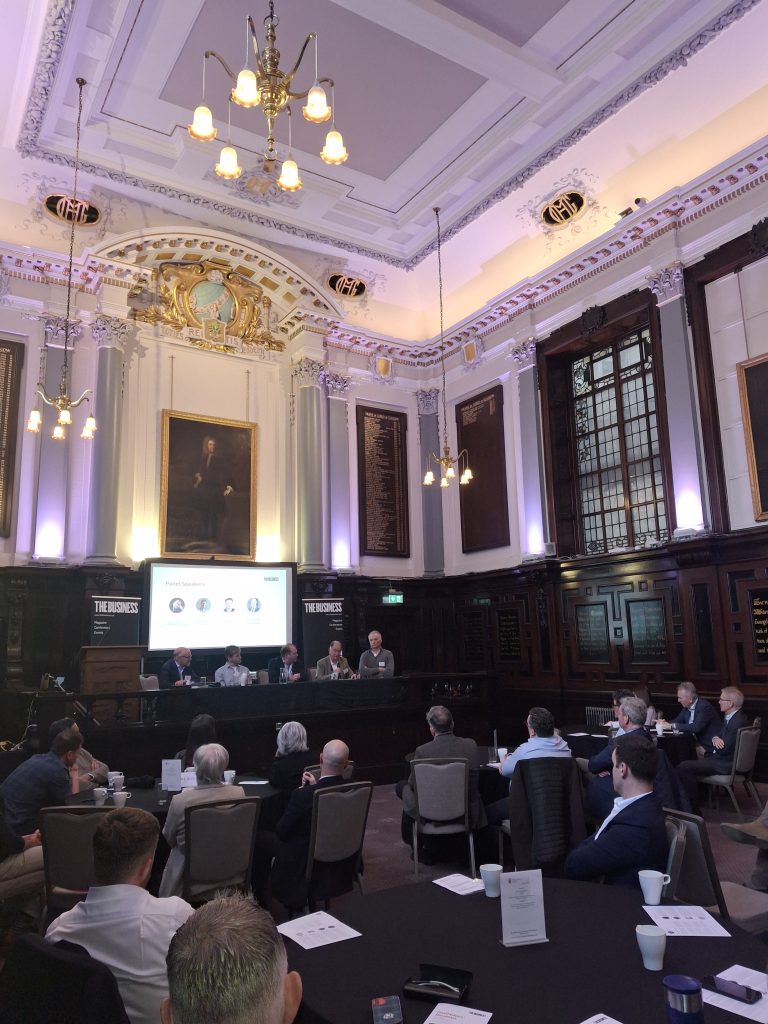
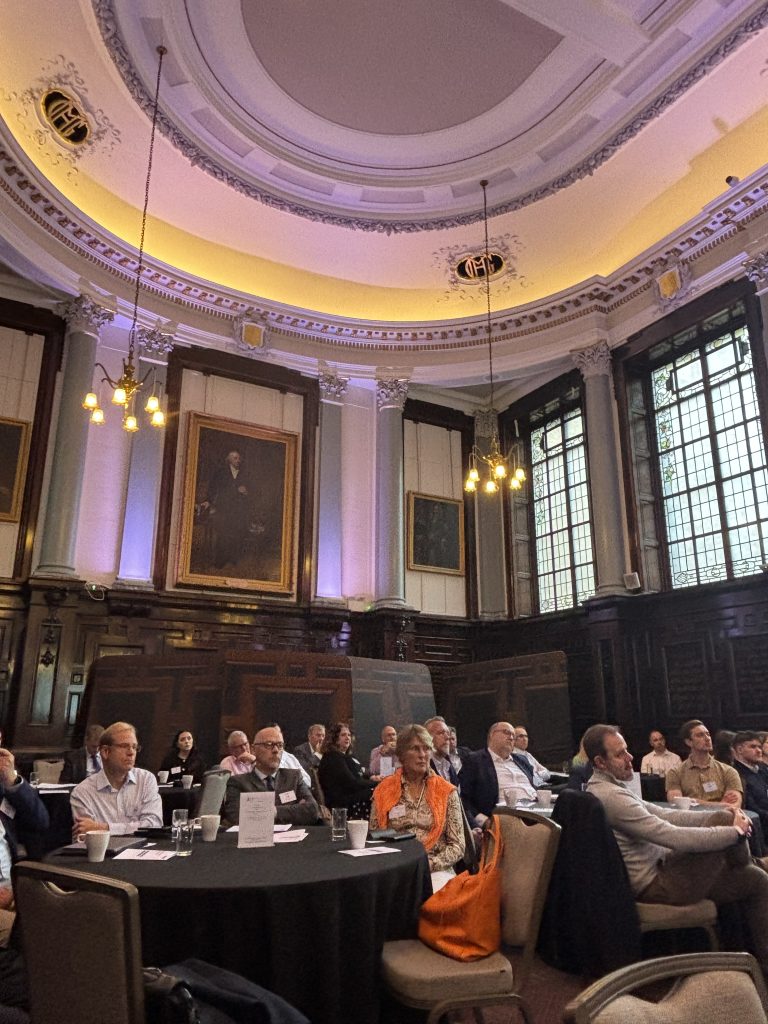
At the Merchants’ House of Glasgow, a Scottish institution where the guilds’ ledgers stretches back 500 years, Sir Jim McDonald can point to his own entry, earned not by wealth but by trade.
He told The Business breakfast that he joined because of his father’s occupation, a ropemaker on the Clyde who rose to become plant manager of the Gourock Rope Factory.
“There was a four and five-year-old kid being taken down there to see all this clunking machinery, which got me interested in engineering,” he says.
That Clydeside childhood visit set him on course for an illustrious career that has run from the electricity industry, where he began as a young engineer, through to becoming the Rolls-Royce Professorship of Electrical Systems at the University of Strathclyde, to the presidency of the Royal Academy of Engineering and, since September, the chair of Scottish Enterprise.
He shares his leadership role with its chief executive, Adrian Gillespie. Look out for Kenny Kemp’s feature in the Autumn edition of The Business magazine, this Sunday 27th September, distributed in The Sunday Times Scotland.
It is an appointment that has put a working engineer, rather than a career administrator, at the highest level of Scottish economic policy. Sir Jim understands the national correlation between the operation of energy networks, advanced manufacturing, photonics and where this all sits with the need for skills and apprenticeships.
His pitch to the rapt audience in Glasgow is not a plea for sympathy on behalf of a neglected engineering sector. It is a timely reminder that Scotland has for years undersold one of its genuine strengths.
“For too long, the Scottish government, and I’m not just putting it at the current government, has taken engineering and manufacturing for granted. It’s almost like white noise in the background. There’s an opportunity now to escalate.”
His specialism offers an illustration of the case he makes for innovation more broadly. Rolls-Royce, whose professorship of electrical systems he held at Strathclyde, is predominantly a mechanical and aerospace business. As an electrical engineer in such a mechanical environment, he was, for a long time, “a wee bit of the ugly child in the family”.
That has been changing. The race to make electric aircraft shows what happens when a discipline once treated as peripheral is allowed to mature alongside the mainstream engineering it eventually reshapes. It is, in miniature, the argument he makes about manufacturing as a whole: treated as background noise for years, yet if properly backed, capable of changing the shape of the industries around it.
“Innovation is absolutely critical, but investment in infrastructure and skills have to be behind it,” he says.
Sir Jim’s central complaint is not essentially about policy; it is about communication and perception. Scotland simply does not talk enough about what its factories, yards and laboratories already do.
In 2023, he says, manufacturing contributed £41bn in turnover to the Scottish economy, representing just shy of £15bn in gross value added and supporting 182,000 jobs, about 7 per cent of the total Scottish economy. Exports for the year ran to £31.5 billion.
“Numbers matter. Why are we not talking about it? Well, we’re talking about it this morning, but we need to talk about it.”
He wants more Scots to understand the bedrock of our national wealth and ability. Part of the problem is the image of the engineer. He is blunt about the stereotype we are fighting in Scotland. He says many folk in Scotland think of dungarees, overalls, spanners and hard work as the definition of engineering.
“Well, some of that might still be true, but it’s innovation, it’s design, it’s production, and we need to make more things in Scotland, and we need to attract investors as well as the indigenous companies.”
In essence, we need to decipher advanced engineering in Scotland for ordinary people to understand.
Scottish Engineering, the trade body, and its chief executive Paul Sheeran have been tracking a cautious recovery in engineering. According to Sir Jim, Sheeran’s most recent reading of the sector, still working through the after-effects of Brexit, the global pandemic and subsequent global shocks, shows order intake up 8 per cent and output volumes up 11 per cent.
Export performance remains concerning, not least because of tariffs, and hiring intentions have been strengthening only slowly. It is not an unqualified boom nor is the sector in decline.
Shipbuilding on the Clyde and space showcasing industrial potential
“Order intake actually started to look positive … So if there are any investors out there paying attention to this, there’s no trouble in there. This is an aircraft, its nose is coming back off the runway again,” he says of Scotland’s performance.
Sir Jim points down the Clyde. Eight Type 26 frigates are under construction on the Clyde for BAE Systems, a programme he has visited, touring the hulls with Sir Simon Lister, the company’s managing director for naval ships. This connection is personal as well as professional: both of Sir Jim’s brothers served their apprenticeships in the same yards.
“That does my heart a lot of good,” he says of watching the programme create around 2,500 jobs.
Across on the Firth of Forth at Rosyth, Babcock is building five Type 31 frigates, part of a programme of more than £15 bn of investment.
“We don’t talk enough about that,” he says.
The scale of shipbuilding is only the most visible part of a wider industrial base that includes both very large and very small manufacturing.
“That’s manufacturing big things, but we need to manufacture small things as well,” he says. On the small end of the scale sits photonics, where he says Scotland’s companies, clustered across the Central Belt, sit in the top quartile globally and, in some component areas, the top decile, producing lasers, systems and measurement devices.
The next stage, he argues, is to build on that strength to establish a presence in quantum technologies before the industry matures elsewhere, describing the task as one of anticipating nascent capabilities early enough to create entirely new industries around them, rather than importing them once they are already established elsewhere.
Space, too, is treated as a genuine Scottish capability rather than an aspiration. He describes it as a sector that now touches almost everything, from near Earth observation and measurement technology to defence and security work. He appreciates the subject of national security is sometimes harder to discuss publicly in Scotland than it ought to be.
Taken together, these smaller, less visible industries matter as much to the country’s long term prospects as the frigates on the Clyde, even if they attract far less attention.
One subject that matters more than any other: is the need for skills and a skilled workforce. Sir Jim describes the shortage of skilled people as among the biggest constraints on Scotland and the UK’s ability to grow its engineering and manufacturing base.
“We have been, I’m going to say collectively, we have been slow for about 15 years,” he says, declining to lay the blame at the door of any one government.
He chairs Enginuity, the not-for-profit organisation that succeeded the UK’s Sector Skills Council for Engineering, Manufacturing and Technology, and speaks about its role in pushing apprenticeship policy, including within the UK government.
As the Emeritus Vice Chancellor of the University of Strathclyde, recognised as one of the UK’s leading technology universities, he has spent much of his career extolling the value of graduates and postgraduates. But the system, in his view, now needs more apprentices and more college leavers equipped not only with traditional trade skills, such as turning and materials handling, but with an understanding of the digital technology that increasingly sits alongside them.
For too long, engineering and manufacturing have been taken for granted. It’s almost like white noise in the background.
— Professor Sir Jim McDonald
Engineering skills remain key to Scotland’s economic success
He wants thousands of apprentices who are also digitally enabled, rather than a workforce split between those who make things and those who understand computers.
He recounts a conversation in London with senior figures from BAE Systems, Barclays, Rolls-Royce and HS2, in which Mark Wild, the chief executive of HS2, the high-speed rail network, and a former head of the Crossrail project, made a stark observation. In Wild’s assessment, the United Kingdom currently has the capability to deliver only one mega project at a time, whether that is high speed rail, defence shipbuilding, or the broader rebuilding of national infrastructure.
“Skills are very often the unseen risk in all of this,” Sir Jim told the audience.
He is careful not to let this point become a cause of pessimism.
He describes a business led initiative taking shape in Glasgow, following a discussion at which Alan Milburn and Keith Anderson, the chief executive of Scottish Power, were present alongside other business leaders, aimed at tackling worklessness in the City Region through work experience and entry level jobs.
He acknowledges the anxiety that artificial intelligence is displacing entry level roles, and does not dismiss it.
“But industry and business want people in their businesses. If we can get business and industry at the front of this, alongside policy commitments, then I think we’ll see a very quick uptick on the number of jobs that will be created, as long as we deal with the ability to invest and be profitable,” he says.
How artificial intelligence is reshaping Scottish engineering
We need to serve out hope, don’t serve out dismay, because no one buys into that.
— Professor Sir Jim McDonald
On AI and advanced machine learning, Sir Jim cites a recent review by the Office for National Statistics that he says surprised even him. Across UK businesses generally, the ONS found 35 per cent regularly using AI tools; in construction, the figure was just 13 per cent. In Scottish engineering and manufacturing, by his account, the proportion was 72 per cent, more than double the national average.
“Broadly speaking, Scotland’s engineering sector is looking like a very significant early adopter of AI. We don’t talk a lot about this: we don’t talk up the capability.”
Scotland needs a stronger investment landscape
Scottish Enterprise’s role, as Sir Jim describes it, sits alongside that of the Scottish National Investment Bank and private capital in helping companies move from start up to established exporter. He is dismissive of the fashion for chasing unicorns [tech companies with valuations of $1bn] as an end in itself.
“Give me 100 companies that are turning over £100 million. I’ll take those, and if we get the occasional unicorn, fantastic. Because that really allows you to grow an ecosystem.”
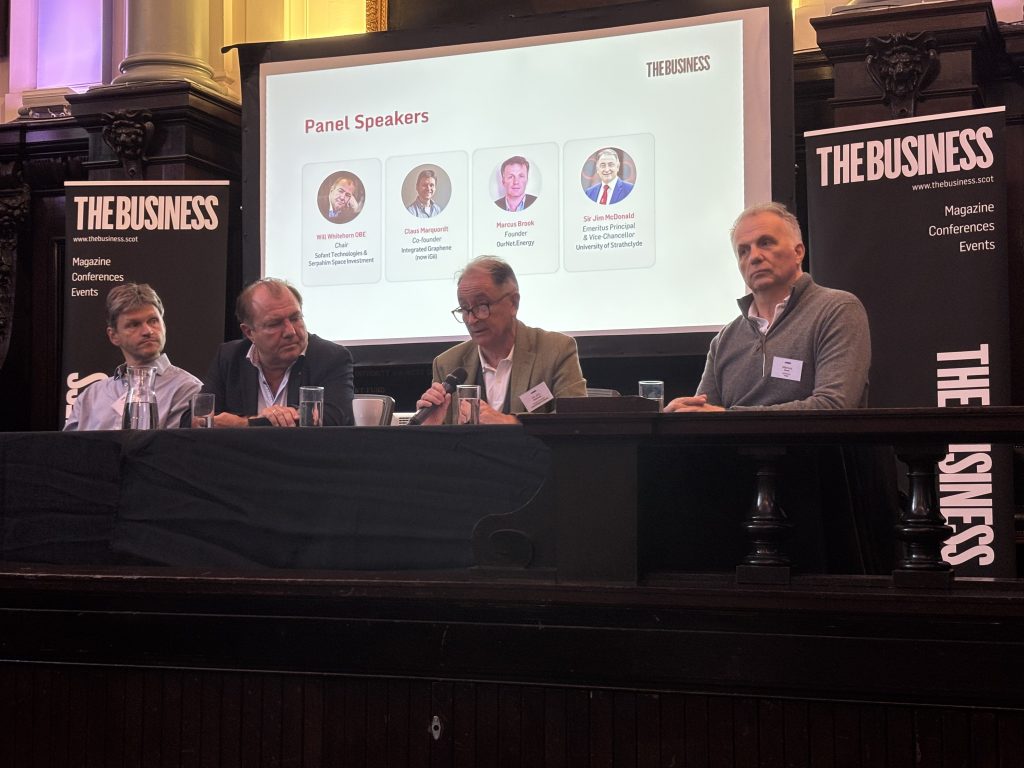
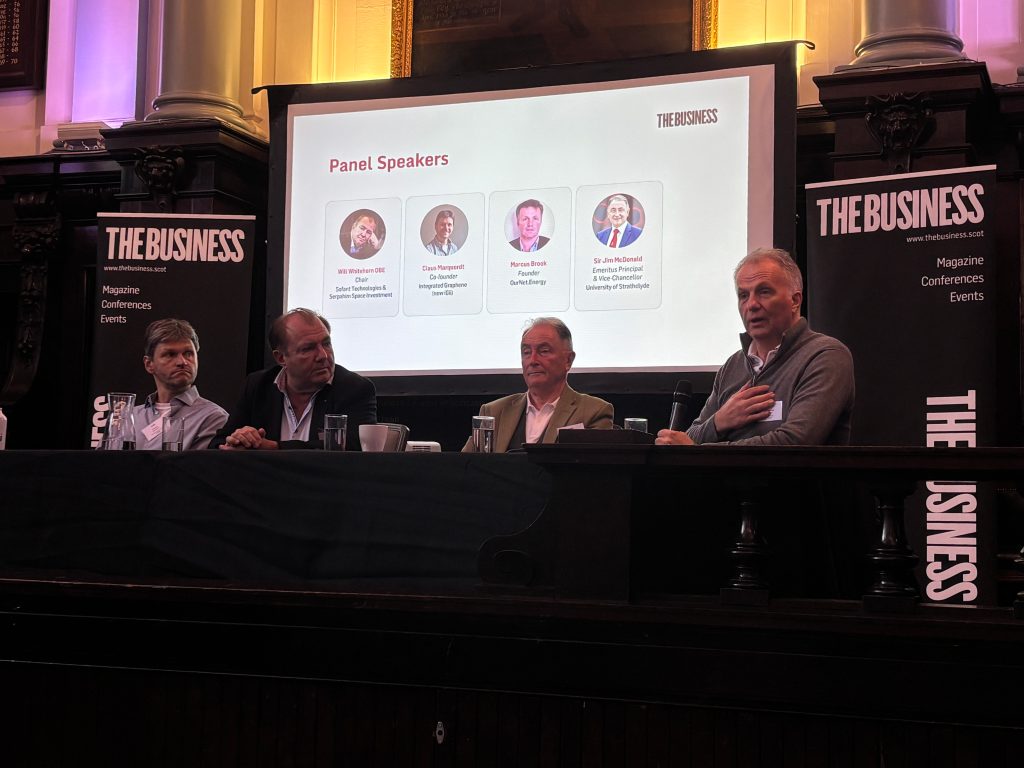
He points to a coming announcement as evidence of momentum. On 10 November, at a scaleup event, the Scottish National Investment Bank, chaired by Willie Watt, will launch a new Scottish Innovation Fund. It starts modestly, at around £75m, with some of that supporting earlier stage, or ‘ignite’, funding that has previously helped the likes of Scottish graphene research [The morning seminar also included Claus Marquordt, who was the co-founder of iGii, the graphene company created in Stirling] get off the ground. He wants it to grow quickly, citing Midlands Mindforge and Northern Gritstone, comparable university linked investment vehicles in England, as the scale he has in mind.
“It’s not big enough yet but it’s a good start.”
He is equally keen that support reaches smaller companies directly, not only through large capital programmes.
“We don’t share enough information and guidance and support for companies, particularly small companies, to get access to support,” he says, a criticism he directs as readily at the wider innovation system as at Scottish Enterprise itself.
Underpinning all of this, in his account, is a broader innovation strategy for Scotland that he chaired the group producing three years ago.
He admits to early scepticism about its fate.
“I thought after a year I hadn’t heard a thing. I thought that’s consigned to where most government reports are, with dust on it on a shelf, and you move on to the equivalent one.”
However, he now says he has been assured, over the past six months, that the Scottish Government intends to use the strategy as a reference point for where public investment is directed.
Of its four pillars, he singles out two: life sciences and health technology, and low carbon and decarbonisation. On life sciences, he offers an example rooted in his own institution. Around 12 years ago, work began at Strathclyde on what became the Continuous Manufacturing and Crystallisation Centre, an effort to modernise a pharmaceutical manufacturing process that had barely changed in two centuries. GSK and AstraZeneca became partners, and the higher readiness level manufacturing work is now carried out at the New Medicines Manufacturing Innovation Centre, near Glasgow Airport, led by the Centre for Process Innovation.
High-value manufacturing is vial in driving Scotland’s growth
He describes the resulting commercial opportunity, still developing around those original partners, as a programme worth around £300m.
Sir Jim speaks with particular warmth about the institutional architecture that Scotland has built around manufacturing innovation, much of it assembled while he was at Strathclyde.
He was one of the original builders of the UK’s High Value Manufacturing Catapult, the country’s first catapult programme, and recalls with some satisfaction that Scotland’s team moved faster than the civil servants in London.
“Our colleagues in Innovate UK say, Jim, you’ve got more catapults than Dennis the Menace,” he says with a laugh.
Scotland now has six catapult centres clustered around Strathclyde and the west of the country, spanning high value manufacturing, offshore renewable energy, satellite applications, energy systems and compound semiconductors.
From Glasgow Airport to Aberdeen: Scotland’s innovation infrastructure
One recent addition is the National Semiconductor Packaging Centre, opened at the National Manufacturing Institute for Scotland at Glasgow Airport. It does not make silicon wafers but packages specialised power electronics and applied electronics for use in space, aerospace, energy and other sectors, a modest but tangible successor to the era when IBM‘s presence in Silicon Glen brought thousands of jobs to Scotland.
The National Manufacturing Institute, which he chairs, now sits within the wider Advanced Manufacturing Innovation District for Scotland, a grouping he concedes is still not widely known outside the sector. It has already attracted engagement from the National Wealth Fund, with hundreds of millions of pounds of investment under discussion across aerospace, defence and energy.
He traces one strand of that architecture back to a conversation with Rolls-Royce’s chairman, who asked whether something equivalent to the company’s Advanced Manufacturing Research Centre in Sheffield could be built in Scotland. With a £16m capital grant from Scottish Enterprise, the university built the Advanced Forming Research Centre, home to what he describes as a world leading forming press that now draws aerospace companies from around the globe to look at new manufacturing processes.
“Scotland showed risk. That’s another thing we’ve not talked enough about. The risk appetite in this country has to rise.”
Further south west, he points to the Prestwick Aerospace Hub, where the break-up of Spirit AeroSystems between Boeing and Airbus has left both companies manufacturing aircraft components on the same site, alongside GE Aerospace. He notes a recent commitment from Ryanair, announced six weeks ago, and a significant Scottish Enterprise investment expected to create 500 new jobs, provided Ayrshire College can supply enough technicians and apprentices to fill them.
In Aberdeen, he points to the Energy Transition Zone, a project he associates with the late Ian Wood, “a good friend of mine who is no longer with us”, whose ambition, as Sir Jim describes it, was to move the oil and gas industry onto an energy transition footing.
The following week, he says, the Energy Works facility near Aberdeen South Harbour was due to open, focused on manufacturing capability for hydrogen electrolysers, offshore wind components and other energy technologies.
Energy investment offers opportunities for Scottish manufacturers
As vice chairman of Scottish Power and chairman of both Scottish Power Renewables and Scottish Power Retail, Sir Jim is well placed to talk about the grid, and here his tone shifts, briefly, from advocator to realist.
“We’re 15 years off where we should be. However, never give up hope.”
He points to the scale of investment now committed under the latest transmission price settlement: around £12b from Scottish Power over five years, with SSE expected to spend £18 to £20bn and National Grid around £30n, alongside further offshore auction rounds that together take the UK total past £100bn.
He describes in detail is the repowering of the Whitelee wind farm, whose capacity of around 560 megawatts could be raised toward a gigawatt through fewer, larger turbines, at a cost of around £1.5bn, with an accompanying opportunity, he argues, for Scottish companies in the remanufacturing and circular economy handling of decommissioned blades and components.
He is careful to say he will not comment on party politics, given his public sector role, but he welcomes what he describes as a new duty of growth placed on the energy regulator, and cites a recent comment from the UK government that major infrastructure projects should be assessed in part on their economic contribution to Britain, in the way, he notes, that France and other European countries already do.
Asked about the tension between openness to foreign investment and concerns over national infrastructure, Sir Jim does not duck the subject, though he is measured.
Chinese investment decision was solvable for Scotland
He refers to the discussions around a proposed Scottish manufacturing investment by the Chinese wind turbine manufacturer Ming Yang, which would have created around 1,800 jobs.
“I absolutely would have been delighted for them to come into Scotland,” he says, while acknowledging the difficulty, in his view a solvable one, of connecting Chinese manufactured infrastructure to Britain’s electricity grid given concerns about critical national infrastructure.
Eleven years ago, he was part of the delegation that welcomed President Xi Jinping to London during what was then described as a ‘Golden Age of Cooperation’. More recently, he travelled with Lord Patrick Vallance to sign a cooperation agreement between the British and Chinese governments covering decarbonisation, aspects of health science and agricultural technology.
His own experience as senior independent director of the Weir Group, which manufactures pumps in China, has taught him that early fears about intellectual property have given way, in that case, to a large-scale manufacturing plant near Shanghai and continued investment in Britain, including a plant near Manchester.
“My judgment is the next five years we’ll start to see a resetting of the commercial relationships and there are bound to be opportunities.”
Regional industrial clusters can help Scottish companies scale
Sir Jim’s final theme is Scotland’s regional geography. He describes a coming devolution of powers over skills, innovation and economic development to Scotland’s city regions, with Glasgow expected to put forward its own proposal in the coming months, alongside Edinburgh.
This not as a rival bid to Scottish Enterprise but as a complementary layer, using the image of an engineering diagram: a national strategy running horizontally, with regional and sectoral strengths, life sciences and data in Edinburgh, energy in Aberdeen, running vertically through it.
He also credits Scotland’s colleges, some of which face acknowledged financial strain, with playing an under-appreciated role in the social fabric of communities with difficult economic histories, even as they train the technicians the manufacturing sector needs.
“We need to serve out hope, don’t serve out dismay because no one buys into that.”
Sir Jim returns to the idea that individual companies, however capable, struggle in isolation. He describes economic clusters, a concept he notes has been part of mainstream economic development thinking for 50 years, as the practical answer: aerospace around Prestwick, energy around Aberdeen, shipbuilding around Glasgow and Rosyth, and photonics, quantum and space running the length of the Central Belt.
Inside a cluster, he argues, even very small suppliers gain the support of Tier One manufacturers and prime companies such as Rolls-Royce, Airbus and BAE Systems, alongside public money to help them through what he calls the “treacherous moments when existential issues face a board or a chief executive”.
He points to programmes closer to home as evidence of how the demand and supply sides of the skills pipeline might be joined up in practice. Strathclyde runs an Engineering Academy and a Power Academy, working with colleges around Glasgow and in Ayrshire, aimed at feeding local industry with technicians trained against a specific plan rather than a generic curriculum. It is a small-scale version of the wider coordination he believes the country now needs.
He also cites a recent report from the Royal Academy of Engineering, an organisation he served as president for five years, mapping the state of engineering and manufacturing across the United Kingdom as a whole.
By his account, the sector employs 8.5 million people across 685,000 businesses, the great majority of them small, and contributes almost £750bn of economic activity. Many of those businesses, he says, sit deep inside supply chains that are otherwise invisible to the public, which is precisely his point about the sector’s poor visibility.
“However, if one plays out the fact that this cluster approach that’s starting to emerge is in the prime’s interest, it’s in the Tier One’s interest to have a healthy and thriving supply chain, and that includes companies, even very small companies.”
It is, he adds, a whole systems way of thinking, the same discipline he says engineers are trained to apply and one he believes policy makers too rarely borrow. Skills policy, industrial strategy, immigration policy and infrastructure investment, in his view, cannot sensibly be designed apart from one another.
Why we requires a coordinated approach for our industrial strategy
“This touches immigration policy, it touches virtualisation, and it touches a coordinated UK approach. It’s a lot to do, but I think the more we decompose it into regional strategies, coordinated from the top, the more likely we are to serve out into the skills activity that Scotland needs.
In Sir Jim’s mind, Scotland has never lacked ideas, shipyards, laboratories or engineers. What it has lacked, more often, is the confidence and the coordinated support to turn those assets into scaled-up companies and durable jobs, and the willingness to say so plainly.
His own brief, as the chair of Scottish Enterprise, appears to be as much about narrative as it is about funding decisions: persuading investors, students and, not least, Scots themselves that engineering and manufacturing remain, in his words, a story worth telling properly.
“I remain optimistic. It’s my natural way, but I think there’s plenty of grounds for optimism in this space.”
To attend our upcoming DealMakers’ Breakfasts including our main morning Edinburgh event, please click here.
THE BIG READ: We must shout more about our engineering prowess, says SE chair Sir Jim
