
Inspired by Chris Dougray, The Business held a morning seminar focused on the issue of temporary housing. Kenny Kemp reports on the problem – and some of the solutions
The UK’s crisis of temporary accommodation – which impacts 17,240 families in Scotland – is being batted from HM Treasury to local authorities in a dire and depressing game of ‘pass the parcel,’ The Business of Housing’s seminar in Edinburgh heard.
Yet, if willing organisations collaborated urgently and more productively, there are genuine solutions able to fix this shocking national tragedy, the audience was told.
The independent real estate consultant Chris Dougray, founder of Dougray and the Round Table Series, was the instigator of an excellent morning seminar supported by The Business, as a prelude to our major housing conference, The Business of Housing in February 2027.
On every score the numbers are grim: last year the cost of temporary accommodation in England topped £2bn, with the London School of Economics calculating that 11 per cent of every Londoner’s council tax bill is going to fund temporary accommodation.
“This affects us all,” said Daniel Brewer, the chief executive of Resonance, who was one of the expert panellists at the event in the Sheraton Grand Hotel.
“Too much focus to date has been on just saving the state money. The Treasury are proud, sadly, that capping local housing allowances saved the taxpayer £1.6bn, they claim, in a letter that I got back from them.
“But the truth is, if the Treasury has saved £1.6bn, the local authorities are paying out £2.2bn, then have you really saved the taxpayer money?”
As one panellist commented: “We must stop the washing machine cycle of local politics,” where elected members making promises to fix local problems, then shy away from making hard decisions once they are elected.
Housing can be the platform from which people address other problems, rather than a reward at the end of the process
— Chris Dougray
Why Scotland’s temporary housing crisis demands urgent action
The seminar, which was sensitively chaired by Dougray, needed no reminding that we are in a housing emergency, declared in Scotland on 15 March 2024, and within this there is the temporary housing crisis.
“The average stay in temporary accommodation is 238 days, and a lot longer when it included children in the family. The spend by local authorities in Scotland across the period last year was in excess of £100m in hostels and bed and breakfast,” said Dougray.
This was an increase of 125 per cent on the proceeding four years. Dougray, an independent real estate consultant, raised the point ‘was temporary accommodation, genuinely temporary?’
“Housing can be the platform from which people address other problems, rather than a reward at the end of the process,” he said.
The morning session heard from industry leaders and from public sector political leaders who have been genuinely trying to resolve a deep-rooted issue.
They were politicians Cammy Day and Ruairi Kelly, Paul Garner, an expert in social housing, Susan Aktemel, the entrepreneurial founder of Homes for Good, and Lisa Borthwick from Shelter Scotland.
If this is an emergency, then emergency action needs to be taken. We can’t continue to do the same as we’ve done previously
— Ruairi Kelly
The housing emergency across the UK and in Scotland is a combination of crises rolled into one larger ‘poly crisis’ but at the sharpest end is the pressure on emergency housing.
While the solution appears simple: build more homes, repurpose the existing housing stock and use under-utilised premises, the defenestration of local authorities across both the UK and Scotland, the complexity of planning and building legislation and impotent political leadership make this a very difficult problem to solve.
Some stark statistics set the scene. In England, there are now 136,000 families in temporary accommodation, a number that is stubbornly rising and rising fast. In Scotland, there are over 17,000 families which is actually higher per capita in Scotland than in England.
Borthwick, head of advocacy at Shelter Scotland, told the seminar about the terrible human cost of a failure to deal with this.
Many people on no or low income, or in poor health, are stuck in the emergency housing. They feel forgotten with some spending years in cramped conditions, often with children who are unable to sleep, sharing rooms with siblings.
We are not going to build our way out of this crisis. We have to address access as well as supply.
— Daniel Brewer

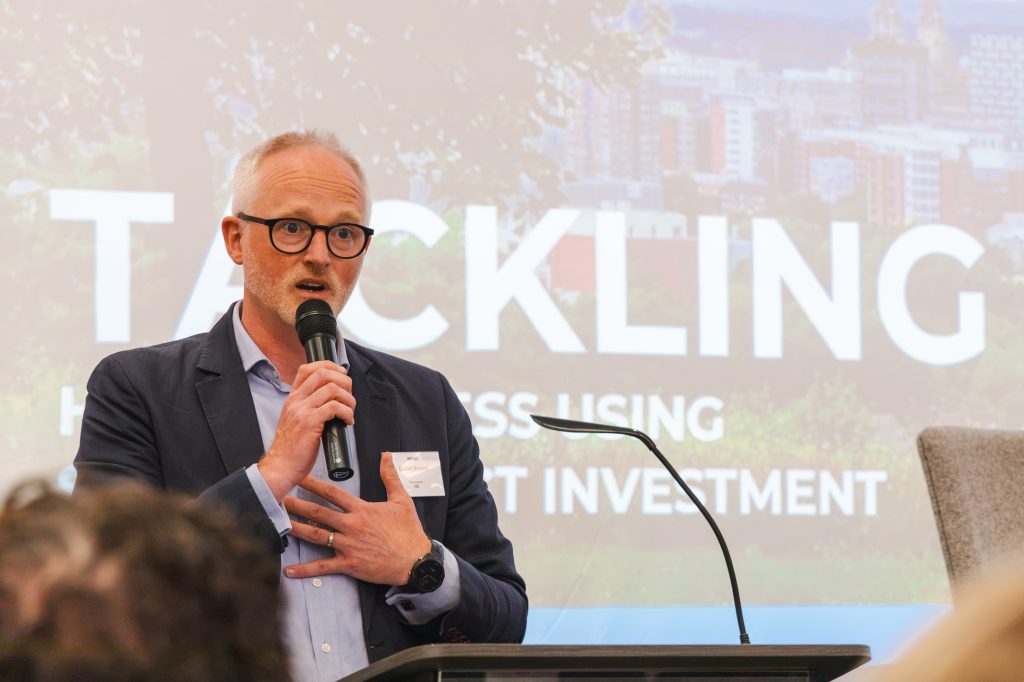
Funding solutions that are real and provide settled homes for families
Daniel Brewer is the chief executive of Resonance, which he set up in 2002, as impact investment fund manager.
“We raise capital from institutions like foundations, local authorities, pension funds, and then we buy refurbished homes, lease them to high-quality housing providers who make these homes available to people facing crisis.”
He set up the organisation after working in food manufacturing as an engineer, and he observed money chasing money.
“Everything was about maximising core profits at the expense of everything else, including product quality, customer satisfaction, the environment, the staff, the community. I thought this is going to blow up at some point. And it set me on a path, intrigued to see whether capital could actually chase after purpose.”
He still believes in generating risk-adjusted returns and wants to find sustainability. But can we harness it to purpose, and avoiding boom, busts and other bubbles.
Resonance grew slowly to start with but now has under £500m of funds investment under management.
“My chair says, don’t mention that to any of the pension funds because they’ll have written you off. You’re still too small. And I wrestle with this. What is scale? What matters? And certainly we’re not chasing scale for the sake of it, but we do need to respond to what is out there. So our main focus is on providing settled homes for families out of temporary accommodation.”
Resonance operates with social purpose, private sector landlords serving low-income households. He said there was now a growing number of such landlords.
“My view is we are not going to build our way out of this crisis. We have to address access as well as supply. There are far too many family homes that do not have a family living in it. There are 90,000 empty homes in Scotland. 80 per cent of the homes that we will have in 2050 are already built.
How catalytic funding works for social housing
“We need to focus on outcomes not just on cost savings. We’ve been backed by some fabulous organisation in Scotland, but we have to go faster,” said Brewer.
He cited the Esmee Fairbairn Foundation, a not-for-profit organisation, which lent £100,000 to prepare and launch a fund. This led to L&Q, a London housing association, backing Resonance with £10m, taking a real risk.
This has become a £400m pot across Bristol, Milton Keynes, Oxford, Greater Manchester before coming to Scotland. The Greater Manchester Combined Authority pension fund put in money which started to unlock ‘risk-adjusted’ returns which meet fiduciary standards for pension funds, while staying true to its purpose.
The company supports 25 social housing providers, including Cyrenians in Edinburgh. This was ‘catalytic capital’ in action.
The key to this is unfreezing the local housing allowance, which is being championed by many third sector organisations.
“It is currently 20 per cent lower than it should be. If you starve people of the ability to pay their rent, guess where they end up?” he said.
Only two per cent of homes across the UK are below the level of a local housing allowance, and more and more people are being driven into homelessness. The Empty Homes Team in Scotland point to homes available in towns across Scotland.
He spoke about the French solidarity fund model, which has unlocked €30bn in the last few years from French people with defined contribution pension funds. This was achieved by pension funds being required to ask pension savers the question: do you want 10 per cent of your savings to be invested in social sector organisations such as social housing, even if the return might be a small amount less.
The answer was ‘yes’ and this meant €30bn was streamed towards social projects in France. There are four countries in the EU trying to roll out this model. Suddenly, the pension fund managers had to find the money to do the deals. A straw poll of the seminar was almost unanimous in supporting such an idea.

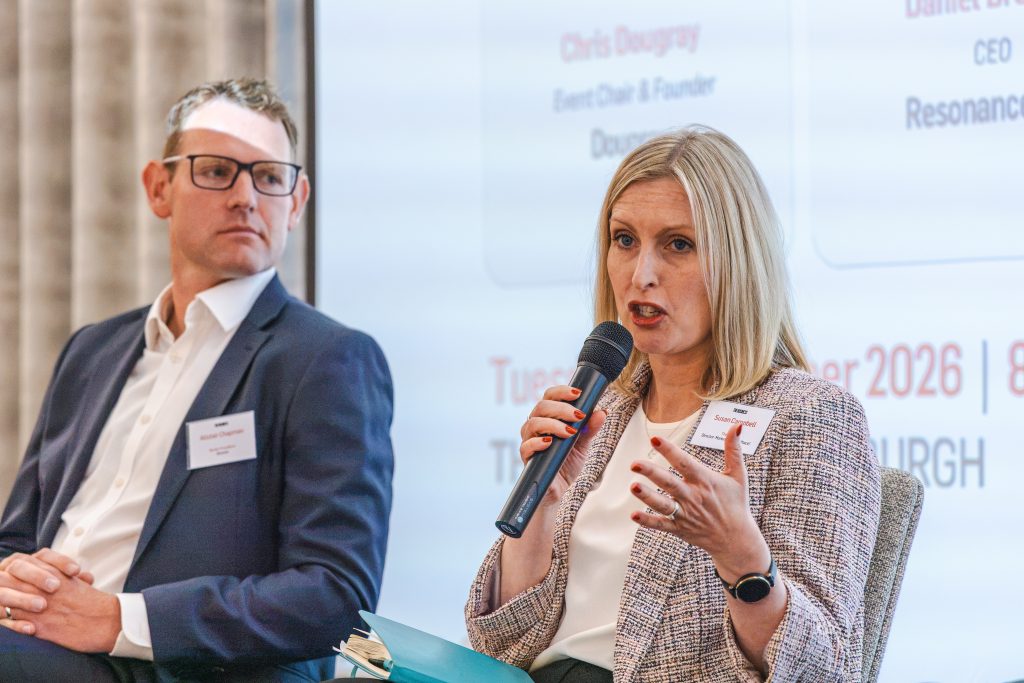
A banking perspective in tackling the housing emergency
Susan Campbell, director of market creation at the Scottish National Investment Bank, said part of the bank’s role was to help tackle place-based inequality across Scotland, and this involved investment to alleviate the housing emergency. She pointed out that the bank was involved in the supply of ‘patient capital’ to help increase housing stock of all tenures in Scotland.
“The human cost of homelessness and of people being in temporary accommodation, and the instability impacts on education and employment prospects, on physical and mental health. There is the human cost and also the wider cost to the public purse,” she said.
The bank has invested in Social and Sustainable Capital’s social housing fund providing loans to third sector organisations who can buy homes to become rented properties.
She explained that in a commercial sphere, investors need to see ‘risk-adjusted’ returns, creditworthiness and a track record of the investee. The bank would look for strong co-investors, to crowd in private capital and share the risk.
“Investors need a stable policy and regulatory environment and a sense of longevity in investment solutions. Importantly, for commercial investment, you are looking for product with strong – and increasing – demand. You’re looking for growth. That’s the main tension here, because none of us want to base an investment proposition on the idea that there will be an increase in the numbers of those in temporary accommodation,” she said.
She said we all want to see better prevention of homelessness and an increase of permanent housing supply instead. The bank will be part of making this systemic change.



Scotland must be stitching together finance, expertise and leadership
Alistair Chapman, a development and regeneration director at Barker Proudlove, and chartered surveyor, has been an adviser to local authorities across the UK.
He has witnessed a rise in council chief executives and leaders saying the major issues are temporary accommodation and the rise of adult social care. He said the crisis has been lost in different places with pockets of expertise in different places trying to do the same thing.
Budgets across the UK since 2010 have been slashed completely. “The only costs that have been going up are temporary accommodation and adult social care. I was looking across the table to chief execs and leaders of councils who looked absolutely lost.”
Striking a positive note, Chapman said there were some incredible project that are doing brilliant work, and he singled out Homes for Good as a prime example.
“Coming from a consultancy point of view, I see different parts that just need stitching together, with money, expertise, drive and leadership.
“We can make a massive difference in this space, really really quickly.”

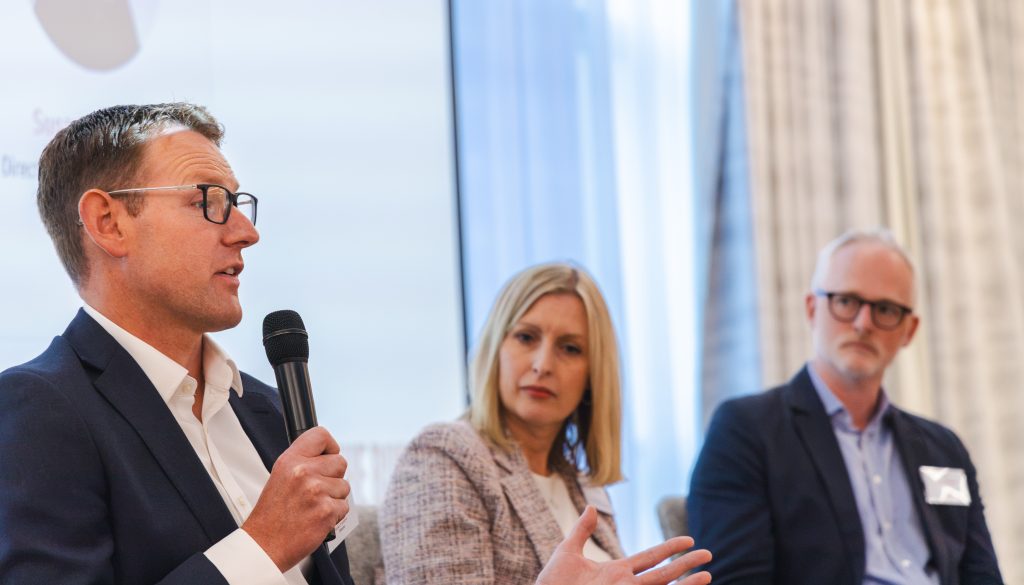
Political imperative: Action needed to end temporary accommodation
Scotland’s metropolitan places are under pressure. Kelly, convenor for housing with Glasgow City Council, spoke about 10,000 people who were homeless in the city and 60,000 more on the housing waiting list.
“If this is an emergency, then emergency action needs to be taken. We can’t continue to do the same as we’ve done previously. We need to fundamentally revisit how we address, fund, and procure.
“We need to look at standardisation, and the requirements of whether this is Section 75 on public housing,” he said.

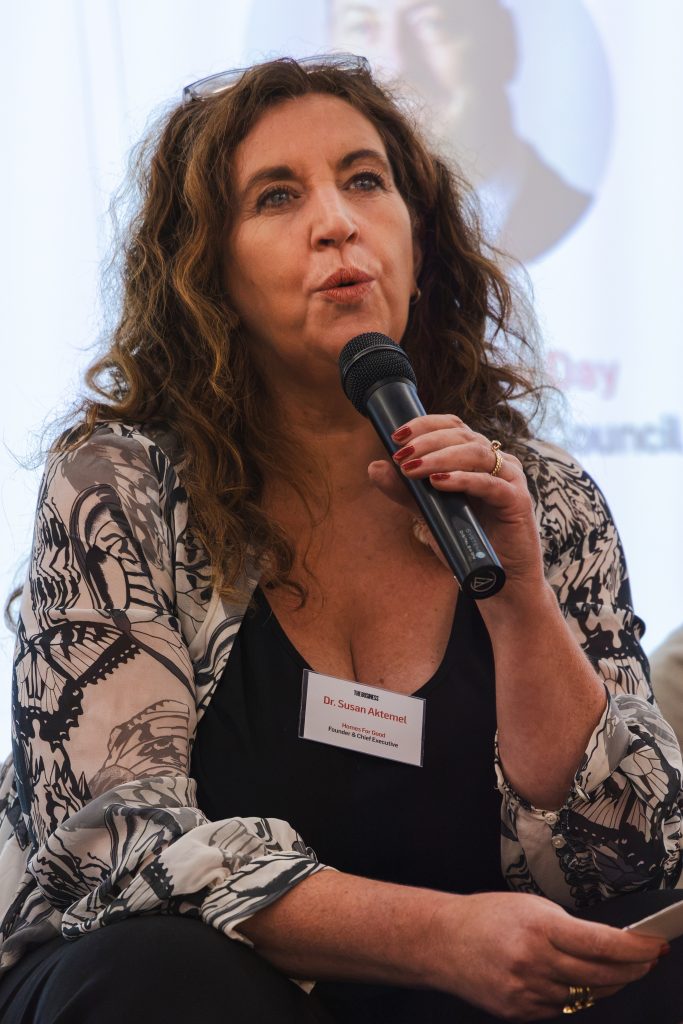
Susan Aktemel, of Homes for Good, which has created a number of affordable social housing projects across Scotland, says we have to stop talking about providing temporary accommodation for a ‘few nights’, but that everyone needs a home.
“We need to plan housing access now as we plan for supply for the future,” he said.
Aktemel spoke about how the third sector has shown its capability in delivering homes and there was ‘market maturity’ built on a strong record by housing associations and others of delivering decent homes.
New homes being built are unsuitable for affordable housing needs, so we need to tap into a massive programme of regeneration of older stock. The increasing cost of building new homes for affordable rental is an unattractive asset class for many commercial investors, so more must be done with the existing housing stock in Scotland.
Lord Willie Haughey, making a contribution from the floor, said: “We need to get people like Ruairi, on the ground locally, who have got the bit between their teeth to make a difference.
“What I have seen in Glasgow is an appreciation of the severity of the issue, and we need a ‘local housing minister’. I’d say, ‘Don’t drop the baton’. We need local leaders to drive us on this.”
Day, the former housing convenor of Edinburgh City Council, was also clear about what councils need to do. He pointed to developments in his own ward of Granton where the issues of homelessness are being tackled head on.
Five key takeaways for tackling Scotland’s temporary housing crisis
-
Political leadership and funding
There needs to be political leadership at the highest level with a dynamic Scottish champion to tackle emergency housing. The Scottish housing minister needs to ensure funding is unlocked for local councils to deal with the crisis. Investors also need assurance about the future of the local housing allowance.
-
More Homes Scotland must deliver
The proposed More Homes Scotland agency must be shaped to deliver and address the barriers of emergency housing. It must focus on reducing affordable housing needs.
-
Rethink building specifications and costs
On the specification of buildings. A public sector built unit costs 40 per cent more than a private unit, why is this the case? Scotland should look at different versions of decent homes to help give families the chance to have a secure future. We need to ‘cut our cloth’.
-
Give the third sector a stronger voice
Ensure the third sector, which deals with the sharpest end of the housing crisis, is given more say and support as a key stakeholder. Too often, the third sector is told how to make something happen, rather than being consulted at the start.
-
Unlock patient capital for housing
There is a need for more ‘patient’ capital to be crowded in at pace. Pension funds need to be encouraged to set a defined percentage to be invested in social capital for homes in the UK.
FAQs
How many households are living in temporary accommodation in Scotland?
There are 17,240 households in temporary accommodation in Scotland, with many families spending prolonged periods in unsuitable or insecure housing.
Why is temporary accommodation so costly for councils?
Councils face substantial spending on hostels, bed-and-breakfast accommodation and other emergency housing because the supply of affordable permanent homes has failed to meet demand.
Could private investment help tackle Scotland’s housing emergency?
Yes. Impact investment, patient capital and partnerships involving pension funds, public bodies and third-sector housing providers could fund settled homes while generating appropriate risk-adjusted returns.
What measures could reduce reliance on temporary accommodation?
The seminar identified stronger political leadership, a stable Local Housing Allowance, investment in existing and empty homes, greater support for the third sector and faster deployment of patient capital.
Visit our Conferences page or for our morning business events click here.
Read more Commercial Property & Housing.