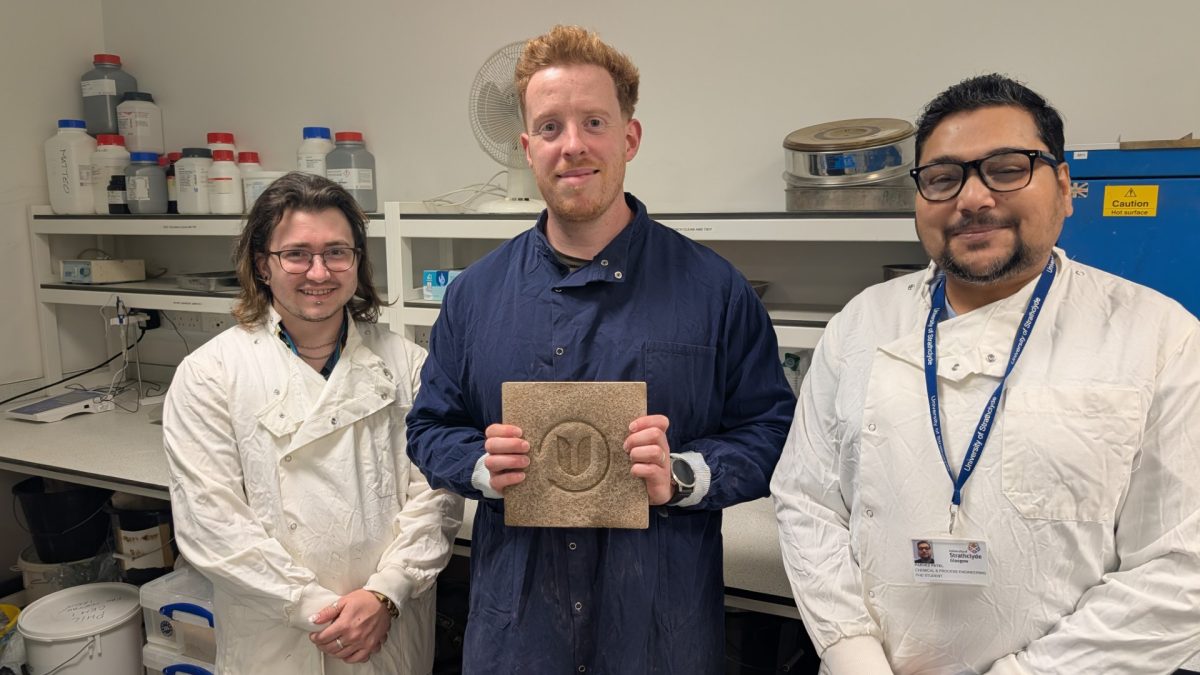
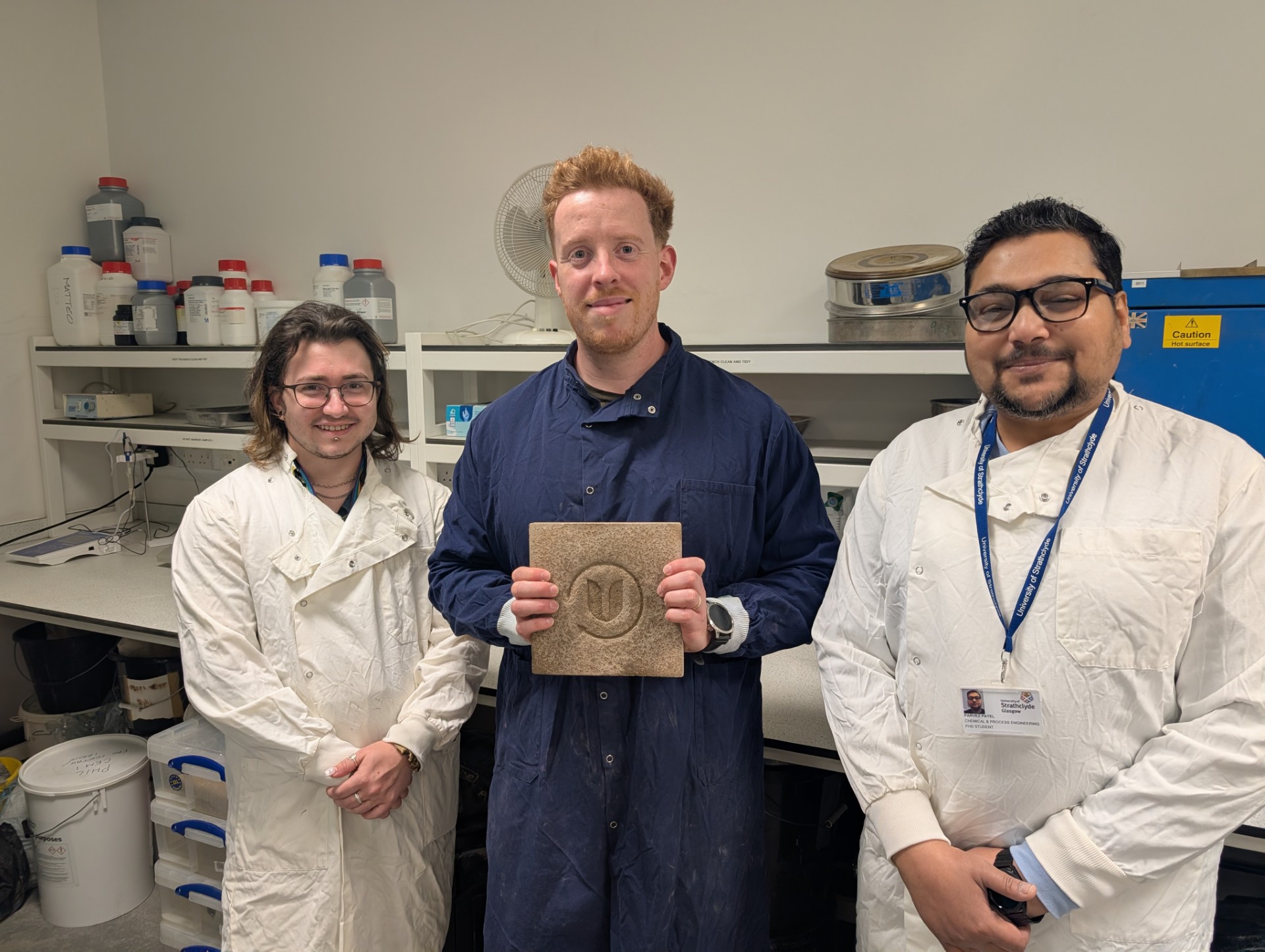
A Scottish university spinout has invented a process which turns low-value mineral waste into carbon-negative materials and can replace a percentage of cement used in construction.
The approach, by a team at the University of Strathclyde in Glasgow, could help cut emissions from cement production while permanently storing captured carbon dioxide (CO2).
Founded by scientist Dr Philip Salter, Ureaka is combining circular chemistry with mineral processing to create supplementary cementitious materials (SCMs) from waste streams. These materials are designed to be used alongside traditional cement in concrete, reducing the amount of cement needed without requiring changes to existing manufacturing processes.
Supported by the Industrial Biotechnology Innovation Centre (IBioIC) Spin Out Fund, in collaboration with researchers at the university, the project is moving from laboratory research towards commercial application, including factory-scale modelling and plans for product testing and validation.
Cement and concrete production account for around 8 per cent of global CO2 emissions due to the energy-intensive nature of manufacturing and the underlying chemical reactions involved, making decarbonisation challenging for the sector.
Ureaka is focusing on converting waste mineral streams, including demolished concrete, into new cement replacement materials. The process recovers useful elements such as calcium and silica and uses captured CO2 to form stable carbonate minerals, locking the carbon into a solid form.
The resulting SCM is designed as a drop-in powder that can be added to standard concrete mixes, allowing manufacturers to reduce their use of traditional cement without changing existing production methods. By using waste materials instead of virgin raw materials, Ureaka also aims to offer a lower-cost route to more sustainable construction inputs.
The company’s earlier work in biocementation suggests further potential applications, including strengthening soil for construction projects and repairing existing concrete structures through mineral formation.
Looking ahead, Ureaka is now focused on progressing its carbon-negative SCM towards commercialisation. The IBioIC-supported project has helped move the technology beyond lab-scale experiments into factory-scale modelling and early-stage product validation.
The company is now seeking additional grant funding and preparing for a seed investment round to support team growth and further development. It is also planning third-party testing of its material in a live manufacturing environment – a significant step towards market readiness.
Dr Philip Salter, founder and chief executive of Ureaka, said: “Cement is one of the hardest industries to decarbonise because, even if you electrify production, a large share of emissions still comes from the chemical reactions involved. Ureaka is taking a fundamentally different approach: starting with the mineral value already present in waste concrete, reacting it with captured CO2, and turning it into a cement-replacement material that can work within existing supply chains.
“A key priority for us has been ensuring the process can plug into existing manufacturing systems. The supplementary cementitious material we’re developing is designed to work with current concrete production methods, so manufacturers don’t need to change how they operate, but can still reduce the carbon footprint of their products.”
Caroline Kewney, senior impact manager at IBioIC, added: “Construction materials are a significant contributor to global emissions, so there is a clear need for scalable alternatives that can support decarbonisation across the sector. This project demonstrates how industrial biotechnology can turn waste streams into valuable new materials, while also supporting carbon capture and more circular approaches to manufacturing. We’re excited to see what’s next for Ureaka as it progresses towards commercialisation.”