
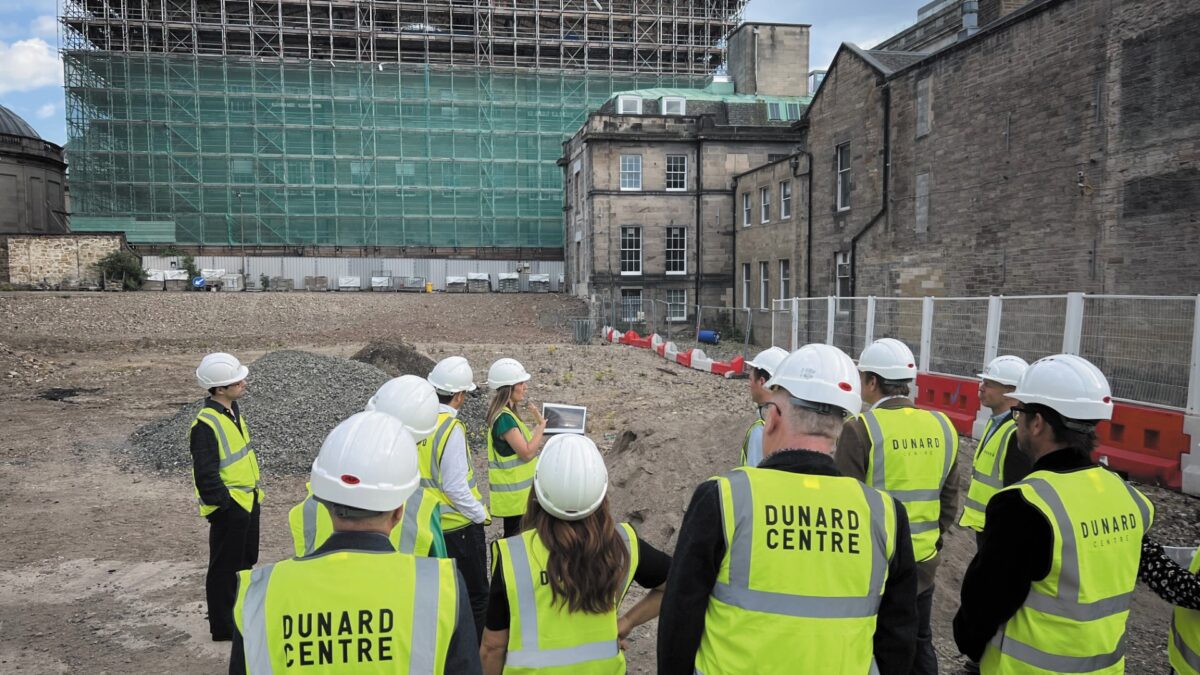

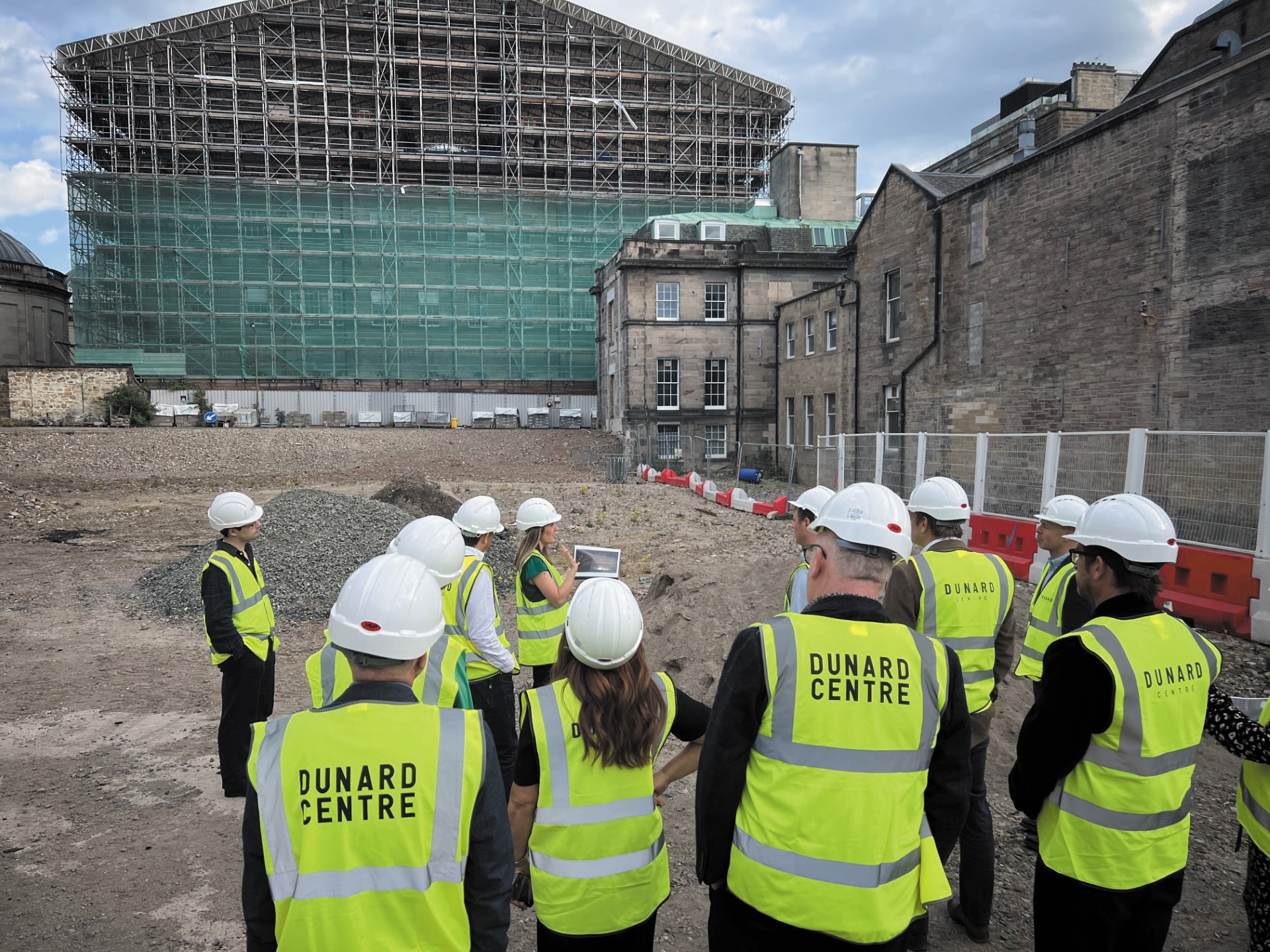
A posse of casually dressed visitors wearing hi-vis jackets and hard hats stand surveying a scene of broken concrete and piles of gravel behind the RBS’s historic branch in St Andrew Square, Edinburgh.
This is the site of a 1,000-seat concert hall for the Festival City, supported by a combination of philanthropic giving, the Scottish Government and Edinburgh & South East Scotland City Region Deal funding.
The hard-hats were viewing the site of the Dunard Centre, the capital’s first new concert hall in 100 years. It has not been an easy birth, with costs rising from the original £75m to now more than £114m.
David Chipperfield Architects and Nagata Acoustics have joined forces to create a venue of exceptional sound and natural acoustics. Nagata has created many modern concert halls, including the Suntory Hall in Tokyo and the Pierre Boulez Saal in Berlin. The Dunard Centre will be the UK’s first Nagata hall.
The civil engineering firm, Sir Robert McAlpine, has completed the pre-construction work, but with costs spiralling, there are now negotiations with another construction company to finish the project.
Many wealthy individuals internationally as well as successful Scottish business figures have remained passionate about this unique project and have given generously.
It is a development which excites and drives Jo Buckley, chief executive of the Dunard Centre, the charity running the project.
“These projects would simply not exist without philanthropic support. Why? Because our governments either can’t afford them or won’t prioritise them,” she says, pointing out that the UK’s funding of culture ranks among the lowest in Europe despite the creative industries generating £126bn a year in economic value and supporting 2.4 million jobs.
Generous kickstart funding for the project has come from Carol Colburn Grigor, the recipient of the prestigious Carnegie Medal of Philanthropy, awarded in May at Edinburgh Castle – the first time in 12 years that the honour has been awarded outside the United States.
Wealthy individuals internationally as well as Scottish business figures have remained passionate about this project
“Mrs Grigor is a transformational force in the UK’s cultural scene, especially in Scotland. A former professional pianist in her own right, she has been a long-time supporter of the Edinburgh International Festival and the Scottish Chamber Orchestra,” says Buckley.
Grigor’s foundation has donated £35m, while the City Region Deal has contributed £25m towards the construction. A further £15m has come from private donations.
Grigor was raised in Chicago, taught music and played in a chamber orchestra before marrying an entrepreneur who loved classical music. Her family business, Edmundson Electrical, which owns Holland House, is the largest electrical distributor in the UK and a private company.
Family businesses are the cornerstone of the economy in Scotland, accounting for approximately 90 per cent of private enterprises, and they are not just about financial gain but Environmental, Social and Governance (ESG) concerns and philanthropy, says Turcan Connell family business Director, Kirsty Ross.
The Dunard Fund is one of the most generous trusts supporting the arts in Scotland, including the Edinburgh International Festival and the National Library of Scotland.
The Grigors have pledged a further £40m to turn the former Royal High School building on Calton Hill in Edinburgh into the National Centre for Music. The process has not been easy for Grigor, now in her 80s, but she has hopes of standing on the stage on opening night in 2029.
Mark McKeown, Legal Director at Turcan Connell, who works with high net-worth individuals wanting to ‘give back’, said:“Philanthropy can be a lonely business but philanthropists who are involved in major projects usually understand that they’re part of a team effort involving multiple parties.”
People such as Carol Grigor, are driven by a strong purpose and tend to be collaborative, sharing goals from the outset and maintaining clear communication, he says.
“Within the sector there is also increasingly a trust-based approach where philanthropists have done their due diligence on the parties involved beforehand and so are willing to hand control over to those closest to the work being done.”
