

There is no doubt that AI is going to transform law in the coming years. But in what way exactly? Leading figures in the legal world give their predictions
Eric Schmidt, the former head of Google, states that the artificial intelligence (AI) revolution is underhyped. Yes, underhyped. He says the arrival of this intelligence is the most important thing in approximately 500 years, maybe 1,000 years, of human society.
“It’s happening in our lifetime: so don’t screw it up,” he urged in his TED talk earlier this year.
Schmidt says that the computer will soon run all business processes. The only brake on the massive rise of AI is the insatiable demand for power from the world’s massive data computing centres, each of which can soak up 10GW of energy, representing the combined output of 10 nuclear power plants. So AI is now defining how the legal profession in Scotland must frame its future.
The computation required for this ‘recursive self-improvement’, where the computer is driven by the algorithm, is mind-boggling. What will keep this revolution in check is the establishment of the regulatory guardrails, which is where the legal profession will play its part as guardians.
The rule of law is the bedrock of civil society and the essence of fairness and justice. And a rule that cannot be broken is that there must be no AI systems that are outwith ultimate human control. This is a red line for technology which cannot be crossed.
Across the conference room tables in Scotland’s major corporate law firms, partners, associates and younger lawyers are wrestling with their responses to the AI revolution, and the all-encompassing might of machine-learning, which Schmidt positively predicts could bring an epoch of super-abundance.
“Do you really think you’re going to get rid of lawyers? No, you’ll just have more sophisticated lawsuits,” says Schmidt.
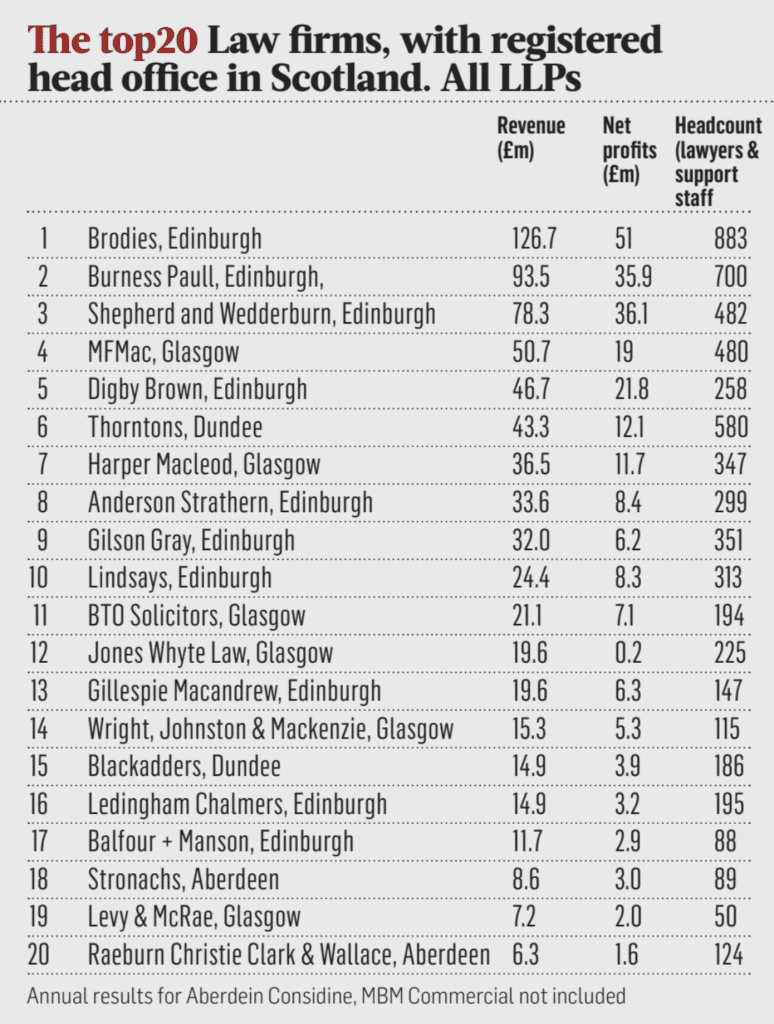
The Business asked a dozen senior legal figures in Scottish firms to scan the future, giving their company’s thoughts on how the industry will be reshaped.

Peter Lawson, chair of Burness Paull, predicted a wall of private equity investment bringing legal technology to the forefront.
“Many lawyers view AI and the transformational change it will have brought to the sector by 2040 with trepidation.
“Largely because the legal profession has, for a long time, made a lot of money from being very good at managing processes, such as document production and management. However, in the future, those processes will be almost entirely automated.
“The lawyers and firms who succeed will be those who best adapt to the change, harnessing AI for the benefits it can provide and maximising the opportunities it creates through the ability to work more strategically, commercially and efficiently in support of their clients.
“While AI will undoubtedly replace some of the work lawyers do, it will also create significant demand for legal advice arising from the need to regulate AI and disputes that stem from AI and misinformation, as well as the great wave of investment and M&A that will flow from the exponential growth of AI.”
Lawson says the need to fund AI solutions and technology upgrades will result in further consolidation of the sector, fuelled by private equity investment.
“We are already seeing this in England, where investment by private equity into law firms has exceeded £1.2bn over the last five years. This has led to M&A activity, primarily at the lower end of the market thus far, that has brought together multiple smaller-scale firms to create larger regional outfits poised for growth.”
External investment is not currently an option open to Scottish firms. However, the legislation that allows it to happen exists and the Law Society of Scotland has said it is looking at 2027 for implementation of the regulatory framework required to facilitate it.
“Some firms will remain independently owned by the partners, but by 2040 they may well be on their way to becoming a minority,” says Lawson.

The last 15 years have brought constant change and turbulence to the Scottish profession, says Andrew Blain, managing partner, Shepherd and Wedderburn.
“Throughout that period S+W has prospered, consistently growing headcount, revenues and profits. We have achieved that by embracing change and adapting, and the next 15 years will require much more of the same,” he says.
“Looking ahead 15 years to 2040, embracing technology (specifically AI) and adapting how legal work is carried out and delivered, will be vital if a firm is to be successful. Technology will change some roles and create new roles. Lawyers will need to focus even more on their experience, judgment, and relationship management skills. Greater use of technology should also help support even more flexible working.”
Blain says the competitive landscape will likely be shaped by external investment, a developing feature of the industry, particularly in England and Wales. This trend may become more significant in Scotland, especially in volume legal work, although many might have made this same prediction in 2010.
He says the partnership model for “all its flaws, has proved a resilient trading model over a very long period and I expect it will still be a feature of the market”.
He adds: “We are well-prepared and optimistic for this future.”

Stephen Goldie, managing partner at Brodies, has been considering the positive aspect of machine learning technology.
“The rise of generative AI remains one of the big opportunities for the legal sector, and having tech that will help free up our colleagues to focus even more on our clients is something that is not only making an impact now, but, we believe, will play a fundamental role in our firm’s future.
“At Brodies we have already assessed and adopted new ways of working that involve the latest technology, including use cases established through immersive AI labs. When appropriate, AI can be used in tandem with lawyers to summarise information and assist with diligence exercises
“Our evaluation will continue as new and improved products come to market but we also see people as being key to unlocking more use cases.
“The challenge lies in identifying and using AI in a way that creates efficiencies, freeing up lawyers to do the parts where clients require and benefit from human judgment, insight and interaction.”

Alan Shanks, head of Scotland at Addleshaw Goddard, shares Schmidt’s cautious optimism, but is not complacent about what lies down the track.
“The fact that we are about to move into new, much bigger offices in both Edinburgh and Glasgow tells its own story about how we view the future at Addleshaw Goddard. We’ve had another year of strong growth both here and internationally and have ambitious growth plans.”
He says a combination of a clear commitment to the Scottish market and an ever-increasing international scale presents a compelling proposition for his firm’s clients.
“However, we are not complacent. Scotland has a first-class, competitive market with some successful firms operating in it, so we are always striving to offer more. That’s why tech is ever more closely integrated into our and our clients’ businesses – and this year we were named one of the top 10 most innovative law firms in Europe for the sixth year running.
“Looking ahead in law can be tricky, but I would expect that over the next 15 years the profession will have changed significantly. The impact of AI will be known and understood and will be a great democratiser of legal services as everyone will have access to the same information.
“Clients will be looking for lawyers who can help interpret and apply legal advice, who really understand their businesses.”
Stuart Hendry, managing partner at MBM Commercial, has looked into his crystal ball for a prediction.
“In 2040, after a wave of PE deals, you will see new national firms that have invested heavily into systems, marketing, AI and people. The lawyers will be tech savvy trusted advisers, using AI for all document preparation tasks whilst checking the AI outputs are correct and appropriate for their clients.
“The next generation of lawyers will be more risk adverse, less interested in partnership and more focused on their flexible lifestyles and wellbeing, leaving others to take on the financial risks and professional practice loans. This means traditional firms will struggle and only those that are large-scale full service or value-add sector specialists like MBM Commercial are going to remain.
“Small firms will only operate under new revenue share umbrella platforms giving access to new technology and compliance. The next 15 years will be transformational for the legal sector so please buckle up for the ride.”
Caroline Colliston, Scottish partner with DWF, sees agile thinking as the bedrock of a strong legal future.
“The future at DWF is bright. Guided by a strategy centred on technology innovation and environmental, social and governance principles, we are building an agile, modern legal services business. By embedding sustainability and technology into our client service and people strategy, we’re driving meaningful change and operating as a responsible business.
“DWF is leading on technological transformation. Our legal operations business is utilising the latest tech to automate key processes including contract review and due diligence to deliver up to 60 per cent faster, more accurate results, which allows our lawyers to focus on complex, strategic client-focused work.
“The legal landscape of 2040 will be very different. With new challenges in AI, cyber security, and data protection, the way we work and develop future talent will continue to change. The future legal workforce will require strong digital skills, an interdisciplinary client centric outlook with resilience to adapt. As the market evolves, business structures, talent attraction, retention and reward may need to be re-imagined.”
Allan Wernham, managing director of CMS Scotland, is also confident but predicts the legal profession will look very different in the next few years.
“I feel confident about the future, both in terms of my firm and the Scottish legal profession more generally. There are challenges for the sector going forward but, amid this landscape, we need to do two things: remain close to our clients and the issues that affect them, and ensure that our service lines and skills of our people evolve. This is particularly important in relation to the adoption of new technology and AI.
“The legal industry in 2040 will look different, perhaps even more so than it looks today compared to 15 years ago.
“The big change will be in the skillset of our lawyers who will very likely be working hand in hand with AI to deliver legal services. Much of the routine processing will be managed by technology with the human focus on adding value and commercial insight.”

Lesley Larg, managing partner of Thorntons, believes investment in innovation is the best way to stay ahead of the competition in the legal world
“The Scottish legal sector is transforming rapidly, and we are firmly focused on the future, investing in people and technology. We’ve committed £3.2m to digital innovation and developing the legal skills of the future, including Scotland’s first dedicated legal tech skills hub, but our ongoing success also depends on building great careers for our colleagues.
“We’ve introduced industry-leading family-friendly policies to ensure we look after our people during the moments that matter in life and offer an inclusive, rewarding and thoughtful place to work.
“Our client-first approach to legal services follows the same principles of listening, understanding and providing tailored support to navigate business and life.
“As consolidation continues at pace, we have decades of experience of successful mergers and remain open to partnering with firms and people that share our vision of creating opportunity for clients, colleagues and communities and crafting exceptional customer experiences.”

Grant Hunter is the managing partner at BTO, whose firm is in the second year of a five-year plan aimed at driving sustainable and profitable growth.
“Diversification in the legal services we provide is crucial to delivering the aims of our plan and targeting additional sectors is designed not just with growth in mind, but to mitigate the risk of exposure to challenging economic circumstances.”
Legal firms are also facing an evolving and increasingly demanding regulatory landscape in Scotland.
“This is causing us to put in place a greater number of internal policies aimed at compliance and maintaining best practice. We have embraced both the opportunities and the challenges presented by AI and, following consultation with our fee earners, we have rolled out an AI policy regulating its use in the delivery of our legal services.
“As a consequence, we have updated our letters of engagement and terms of business to specify how AI is being used within the firm.”
Martin Darroch, chief executive of Harper Macleod, says innovation is driving his firm.
“Our strong brand and financial performance, driven by client and colleague focus, positions us well for the future. Growth is evident across all areas, thanks to our responsiveness to opportunities and client expectations.
“Innovation remains central to our culture. Technology and AI will continue shaping how we work, with professionals increasingly embracing tools that enhance advisory capabilities. At the same time, cyber security is a growing concern, prompting significant investment to protect against evolving threats.
“Assuming the Budget introduces change, the sector must adapt swiftly. The impact remains to be seen, but smaller firms may face consolidation due to client demands and regulatory shifts such as the UK government’s push for Financial Conduct Authority oversight of anti-money laundering. While regulation can be beneficial, added layers may increase costs and delays.
“Finally, we’re committed to creating growth opportunities for our people from modern apprentices to graduate trainees. This is a responsibility we’re proud to uphold.”
David Beveridge, managing partner of Macdonald Henderson, leads a boutique deal-making firm which has been able to punch well about its size from its offices in central Glasgow.
He says technology has already allowed the profession to become ‘beautifully streamlined’ with a flow of documentation which make it easier for draft contracts to be sent by ‘hyper-speed’ between lawyers. He sees this accelerating with AI to include specialists, such as tax and accountancy experts, which will enable the management of the processes more productively and effectively.
“This will only get faster and more reliable: it will allow the legal expert to focus on the salient points which require the human brain to consider and resolve.”
Fraser Gillies, managing partner of Wright, Johnston & Mackenzie, says: “We have seen major growth in the last two years with investment from Irwin Mitchell, the acquisition of McAndrew & Jenkins and most recently joining forces with Davidson Chalmers Stewart.
“We have made no secret of our ambitions to be market leaders in our expert areas and in the not-too-distant future want to operate under one single brand. We have real national strength and continue to attract quality individuals looking for a platform to build their practice in and beyond Scotland.
“Looking ahead to how the industry will be in future, the nature of the job is changing we will see some elements of legal work being automated or utilising a combination of AI and a solicitor.
“The key to sustainable success amid these changes is having an agile leadership team that is ready to be flexible and challenge the way things have traditionally been done.”

Andrew Diamond, managing partner of Lindsays, sees a distinctive Scottish identity as a key.
“We are proud of, and clear in, our identity as an independent Scottish firm, working with Scottish businesses and families. We have no intention of that changing. As the legal industry evolves, we believe this to be a strength which will only grow.
“Our path over the coming years will follow that which we have built in our recent history – steady, strategic, sustainable growth.
“We are in a strong place to achieve that. We will make the most of opportunities which emerge when they arise in the right circumstances, whether they be through mergers or strategic hires.
“Last year was our best ever and this year is going well. One of the greatest assets we have is that Lindsays has the soul of a smaller firm, but with all the benefits of scale and being a full-service firm. We pride ourselves on our culture. Our people really matter.”