


Fifty years of tumultuous change has transformed the face of banking, from handsome stone edifices to snazzy apps on smartphones. But beneath the surface a resurgence in old style relationship banking is taking place in Scotland
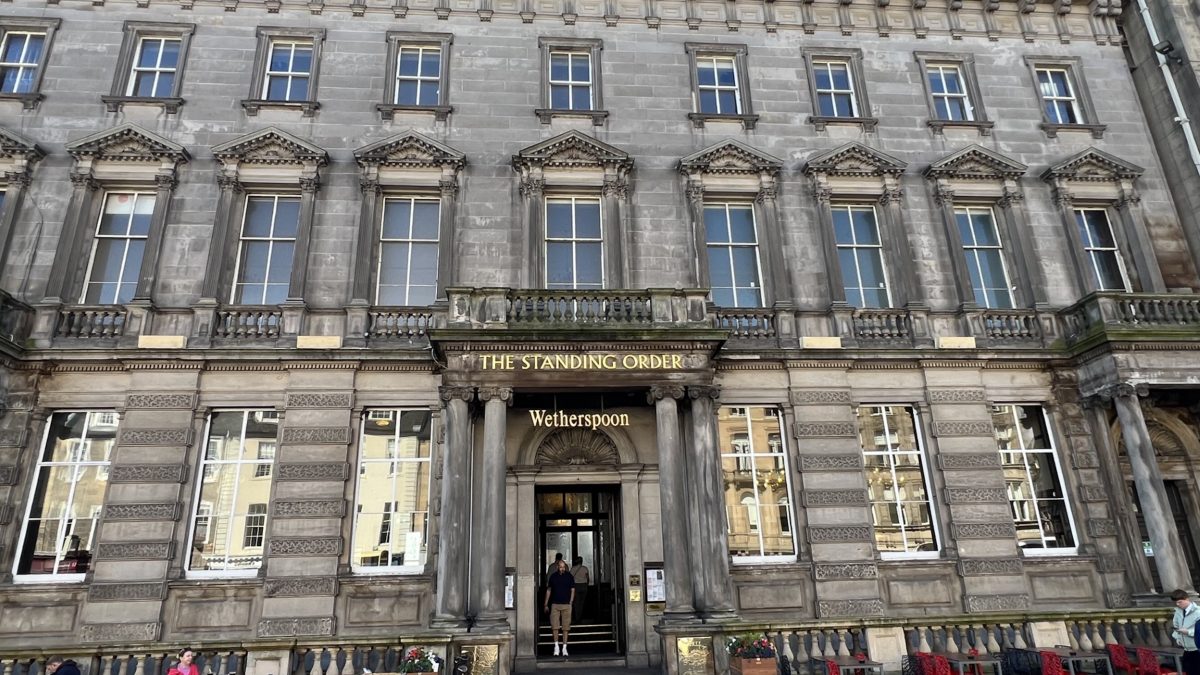
The former Bank of Scotland’s George Street branch and, before this, the former Edinburgh head office of the Glasgow-based Union Bank of Scotland.
When times are tough, it’s natural to hark back to what appeared to be better times.
Fifty years ago, in October 1976, with Joan Armatrading’s ‘Love and Affection’ high in the pop charts, No. 64 George Street was a proper place for standing orders. Not the popular Wetherspoon’s watering hole that it is today.
This handsome building, designed by architect David Bryce, was the Bank of Scotland’s George Street branch and, before this, the former Edinburgh head office of the Glasgow-based Union Bank of Scotland. Prim and proper Mr Coull was the veteran bank manager and Mr Duncanson, his urbane bespectacled deputy.
Mr Coull wore a morning suit to the office, and he greeted the New Town customers with charm and courtesy, a firm handshake before he took his place behind an expansive mahogany desk while customers sat in well-worn leather chairs. The main banking hall had a glorious ceiling and cornices supported by the ionic pillars. In the vaults were the silver golfing trophies of the Royal & Ancient championships.
Those well-heeled citizens of the Capital and elsewhere – they were not called HNWs or high-net-worths in the 1970s – were looked after by the bankers who were genuine pillars of society. Mr Coull and his senior banking colleagues knew their customers and had the authority to make decisions based on their experience, knowledge and understanding of risk.
Across Scotland, with Clydesdale Bank (now Virgin Money) in Glasgow and in Aberdeenshire, and the Bank of Scotland vying with its younger rival, the Royal Bank of Scotland, commemorating its founding next year in 1727, there was a lull before the great storm of reform.
Of course, there had already been an era of bank consolidation, with the British Linen Bank, with its head office at 39 St Andrew Square and branches across Scotland, becoming part of Bank of Scotland. For working-class savers, the Trustee Savings Bank, with its Edinburgh head office in Hanover Street, a bank guaranteed by an Act of Parliament in 1983, was omnipresent in every town in Scotland. TSB has sadly disappeared, its main offices likely to become another eatery.
In the intervening 50 years, banking in Scotland has undergone revolutionary change. The banking crisis of 2008 was one of our nation’s defining moments which forced a reset in banking. Hundreds of branches across Scotland were swept away, leaving empty sites in our towns; business cash dropped into night safes gave way to online banking and electronic points of sale (EPOS).
Those well-heeled citizens – they were not called high-net-worths in the 1970s – were looked after by the bankers who were genuine pillars of society
Banking habits were changing: Why Scotland’s traditional banking relationships disappeared
The Mr Coulls in banks throughout Scotland were replaced by credit committees sitting in open-plan office blocks far away from those customers sitting on the other side of the manager’s desk. Decisions were made using generic data and statistics with less interest in the actual customer’s circumstances. Banking experts concluded such change was vital, sweeping away the ‘romantic nonsense’ of relationships which, they argued, could be flawed and infected by bias.
While people have become accustomed to the ease of digital transactions, relationships with bank professionals withered away
Widespread disillusionment with how the big banks treated customers in the aftermath of the banking collapse has resulted in a shift in customer choice. The damage done to bank customer confidence and trust has been a brooding issue for many people in the intervening years.
While people have become accustomed to the ease of digital transactions dependent on internet connectivity, relationships with bank professionals simply withered away.
The resurgence of relationship banking in Scotland
Yet beneath this major banking trauma in the UK, there has been a resurgence in relationship banking in Scotland.
Private banks are enjoying something of a boom.
In Scotland, there is Hampden & Co, and Handelsbanken, a Swedish bank which bloomed after the failure of Royal Bank of Scotland (now NatWest group) and HBOS (Lloyds Banking Group) during the 2008 financial collapse. However, Adam & Co, set up by the great Gaelic advocate Sir Iain Noble in 1983, has now become part of Canaccord Wealth, part of Canaccord Genuity investment bank, with its private investment portfolio managers in offices in Princes Street, Edinburgh, and Glasgow.
Handelsbanken, now with 2,900 employees in the UK, has won over many HNW customers and increased its operating profits in the UK by 11 per cent, offering loans to households and corporate customers, lending £24.4bn in the UK, while its deposits have increased to £26bn.
New and established banks target Scotland’s growing wealth market
More recently, there are newcomers such as Union Bancaire Privée (UBP), part of the Swiss group, headquartered in Geneva, and Weatherbys, with its roots in horseracing. In East Kilbride, there is Alba Bank, which has rekindled a banking licence once used by the Airdrie Savings Bank, and is aiming to support small and medium-size business customers.
Recently, NatWest CEO Paul Thwaite, at a reception in Glasgow, spoke about the Royal Bank of Scotland’s revival, and looked ahead to 2027 as the 300th anniversary of the Scottish bank’s foundation, while explaining NatWest’s focus on core banking services in the UK. Coutts private banking brand remains a valuable aspect of NatWest’s high-net-worth client base with substantial firepower.
Who are Scotland’s new high-net-worth clients?
There is a fresh wave of new entrepreneurs: wealthy sports people such as Gen Z athletes, footballers, golfers and tennis players, music artistes and computer game designers with liquid assets. They need advice on what to do with their money, particularly in Scotland where taxation on higher earners is greater than in the rest of the UK.
They require more than a banking app on their smartphone.
There are also new arrivals in Scotland who have landed interests or property, and have offspring studying at Scottish universities. They want banking people who are accessible, present and know the lie of the land.
Why younger wealth creators want trusted advisers
Njideka Lorimer, head of wealth planning at UBP UK, agrees young wealth creators are looking more towards private banks. “They tend to be more driven by a strong relationship with a trusted adviser. They want one point of contact to act as the ‘composer’ and co-ordinate their entire financial life.”
Lorimer explains this is about pulling in expertise from in-house teams in investments, lending, wealth structuring, philanthropy and cross-border planning, and externally from lawyers and tax advisers.

A member of its senior leadership team, with 14 years’ experience in wealth management, and a chartered financial planner, Lorimer shapes and delivers the bank’s UK wealth-planning strategy.
She advises UK-based and international clients on tax-efficient structuring, intergenerational wealth transfer and global mobility, aligning complex personal and family objectives with long-term financial plans.
“These founders and entrepreneurs can have complex needs; concentrated equity positions and liquidity events, high-risk business strategies and cross-border issues. My experience is that they want someone who can understand all of this,” he says.
“For athletes, in particular, they need someone who understands how to plan for the short peak in earnings, image rights and post-career transitions. Dealing with a full-service private bank gives founders, entrepreneurs and athletes the right specialist teams, institutional-grade investment, tailored credit solutions, wealth structuring — all with an overlay of robust education and guidance.”
Graeme Mann, the business development director of Hampden Bank, has been in banking for 25 years, and is a newcomer to Hampden, joining around four months ago. He says the assumption that younger, newly-wealthy clients only want digital relationships is misleading.
“There is wealth, and then there is new wealth from a host of new opportunities in business that did not exist even ten years ago,” he explains.
Many clients have been building and selling their businesses much faster than in previous generations and are left without professional guidance when they need it most.
“The feedback I get is that it would be great to have spoken to somebody. It would have been great to get a bit of advice,” he says.

How private banking relationships are evolving in Scotland
Chris Thomson, head of northern UK private banking, at UBP UK, says: “The offering is becoming increasingly bespoke as people with complexity in their affairs often struggle to find realistic solutions to their financial needs. A good private bank can offer a full service and simplify what can otherwise be an incredibly time-consuming set up.”
Read more about how UBP combines private banking, wealth planning and asset management expertise to meet clients’ complex financial needs in Scotland and beyond here.

Increasingly, the key people in the private banks are experienced bankers with years under their belts. For example, Mann worked for three and a half years with Coutts, but spent the bulk of his early career at Royal Bank of Scotland where he worked as a branch manager in Aberdeen before moving into corporate and development roles.
“I think from a private banking point of view, relationship banking is massive. We are growing our team. We have grown over the last five years with more bankers and we’re doing that with some new additions already. I’m one of them. So we’re really investing in that relationship-led banking.
“We already have nine banking directors in Scotland, and we will be growing our presence in Scotland in the coming months. We want to sit down with people in Perth, Stirling, Glasgow because there are successful families and business owners all around Scotland,” he says.
He says Hampden Bank, with its newly restored townhouse office in 20/21 Charlotte Square, wants to become the ‘Bank of Business Exit and Support’, building an ecosystem of events and professional contacts for people going through a sale or a growth phase.
Why entrepreneurs need support before and after a business sale
A new auditorium in Hampden’s offices has been an innovative way of bringing people together face-to-face in the age of artificial intelligence.
“Interestingly, we’ve got this magnificent auditorium in this office, and we’ve had a lot of people come in, even during the Edinburgh Festival, but we’re looking to do added-value events. We’re holding business growth seminars, sessions on how to exit successfully, and events for emerging entrepreneurs to give them the opportunity to meet people that either have done it and sold, or are thinking about doing it,” says Mann.
Increasingly, there is a realisation that running and building your own business is a solitary sport, which means that entrepreneurs have a different way of looking at life’s challenges. When it comes to selling a business, excitement is often dwarfed by fears and trepidations about the outcome.
“This makes it a lonely journey. It’s intense and there is a lot of legal paperwork, which makes them nervous. Is it going to happen? Is it going to fall through? So having a network of professionals that they know they can go and say, ‘Is this normal? Is this going to happen?’ I think that’s important.”
Hampden, he says, is working alongside existing accountants, lawyers and wealth management managers rather than replacing them.
“We’re not taking away any of that. We want there to be an ecosystem for those selling, so they can say, ‘Everything’s here. I know who I speak to’.
From horse-racing to banking: How Weatherbys is growing its private bank in Scotland
A relative newcomer to Edinburgh is Weatherbys, which is one of the UK’s oldest banks, with roots in the coarse art of horseracing. Founded in 1770, Weatherbys is a seventh-generation, family-owned business.
The banking group includes Weatherbys Private Bank, Weatherbys Racing Bank, Weatherbys Business Bank and Arkle Finance.
Weatherbys Private Bank is a relatively modern outfit, founded in 1994. It strives to offer clients a one-to-one relationship with a knowledgeable banker who is always easy to contact and quick to respond. The banking group has more than 20,000 clients, a flagship office in Mayfair, headquarters in Northamptonshire, as well as offices in Edinburgh and Manchester.

Duncan Gourlay is deputy head of private clients at Weatherbys Private Bank. He heads the bank’s Edinburgh office, located in neighbouring Georgian townhouses in Rutland Square.
“We opened this office in 2015. We expanded the premises within a year, and two years ago we took on an adjacent building to accommodate a growing team and create even more space for clients. That alone illustrates the health of the market for private banking in Edinburgh and in Scotland as a whole.
“In particular, there’s an ever-increasing appetite for high-quality, cost-efficient, expert advice.”
The banks’ clients come from a wide range of backgrounds – owners of large estates, farmers and entrepreneurs. Typically, clients earn more than £300,000 a year or have assets worth more than £5m.
“Weatherbys provides all the services you would expect of a bank, as well as specialist financial planning, tax planning and investment management. It is also able to arrange short- to medium-term loans to clients – for themselves, children or grandchildren – against assets such as land and will consider applications from borrowers over the age of 70,” he says.
Weatherbys has spent more than £5m enhancing and strengthening its digital service. Gourlay says the bank is investing in a vital combination of people and secure digital technology.
While there has been great expectations about new entrants into the banking market, heritage still plays a strong part
“Our clients value a ‘best of both worlds’ approach that combines highly-personalised, relationship-driven service with innovation,” he says.
As a seasoned banker, Graeme Mann of Hampden agrees that the blend of people and technology has to fit with the customers’ needs.
“I grew up managing bank branches. That part, the footfall of customers in branches, has changed.
“Within a private banking world, technology makes the banking easier, but the relationship remains incredibly important for clients making those decisions. Increasingly people want to use technology for convenience, and we all need to embrace that, but it doesn’t replace that personal relationship.”
A special relationship: What makes private banking successful?
So what are the essential ingredients of good private banking today?
Mann is clear that integrity and trust, and the strength and longevity of the relationships, is a basic building block.
“I think it is having trust in the bank, knowing who they are and what they do. I’ve always been in a client-facing relationship-led role and the relationship is central.”
He believes there’s nothing better than listening to somebody’s journey, understanding what they have done, how well they’ve done, and the areas where they might struggle.
“Good listening gives me the knowledge and experience to go and speak to others who can help. And then that helps me potentially introduce the right type of professional partner, the right banker.”
Weatherbys’ clients include landowners, entrepreneurs and retirees, as well as professionals in sports and entertainment. The number of clients relocating to Scotland from the United States is also notable.
“Estate owners are among our biggest clients. They’re significantly entrepreneurial in terms of what they do, and we continue to see that as an area where we’re able to add real value,” he says.
“We’re also seeing a steady stream of American clients coming here. Some are setting up home because of ancestral links with Scotland. Some are establishing second homes. Some have children at university here,” he adds.
While there has been great expectations about new entrants into the banking market, heritage still plays a strong part.
“Our business can trace its roots back more than 250 years, so one lesson we’ve had plenty of time to learn is that the demand for highly engaged advisory services exists in many places and in many forms,” says Gourlay.
The group’s overarching goal for the next few years is to double in size by 2030.
“We’re already ahead of schedule. However, at Weatherbys, we are unusually cautious in how we look after cash held in the bank, which appeals to many clients.”
In its annual report in May, the bank declared a liquidity coverage ratio of 896 per cent, far exceeding the Bank of England’s regulatory minimum.
The bank says it has a very conservative loan-to-deposit ratio, with lending accounting for just over half of the client deposits. The majority of the bank’s surplus liquidity is kept with the Bank of England.
Swiss Style: How UBP is serving Scotland’s high-net-worth clients
How has Union Bancaire Privée (UBP), as a relatively new name, been able to settle into the banking landscape in Scotland? UBP is a family-owned independent Swiss private bank and wealth management firm based in Geneva.
“In a word, seamlessly,” says Chris Thomson. “The continuity of our client service and our expanded offering has reinforced the essence of what we do for our clients who seem to appreciate that we will do everything in our power to find and deliver the best solution to their needs,” he says.
What challenges do customers face living and working in Scotland? Those who are wealthier pay more tax. That’s an accepted and incontrovertible fact of life in Scotland, but it requires specialist help to ensure all the income and expenditure boxes are ticked carefully.
Njideka Lorimer, at UBP UK, says HNW individuals in Scotland face a mix of policy, market, and lifestyle complexities.
“There is the shifting tax landscapes such as evolving Scottish income tax bands, the additional dwelling supplement, and uncertainty around UK reliefs like Seed Enterprise Investment Scheme (SEIS) and Enterprise Investment Scheme (EIS), business relief, and capital gains tax complicate planning and the timing of exits, this is something we are continuously guiding our clients through.
Many clients are living increasingly cross-border lives which in turn adds a layer of complexity around reporting challenges
— Njideka Lorimer
“Finding a prime property is constrained in some key postcodes with high transaction costs and fierce competition. Scaling companies can encounter gaps in late-stage and secondary capital locally, alongside uneven liquidity pathways for founders.
“Many clients are living increasingly cross-border lives which in turn adds a layer of complexity around residency, reporting challenges, plus financial exchange risk on earnings, endorsements, or asset purchases.”
Finally, spare a thought for those athletes. For example, a Scottish professional footballer, aged 25 and earning £35,000 a week, requires specialist advice to make sure their short-term windfalls last long after they have retired from the game.
When you factor in market volatility and higher-for-longer interest rates on bond and stock holdings and the impact on loans for homes or personal assets, this can be a cause of individual worry and concern.
“For athletes, for example, the compressed earnings window, sponsorships, and injury or selection risk create acute income volatility. There are complex insurance needs if a player is injured and out of action for some time, and an increased need for disciplined cashflow planning.
“These challenges can feel acute, and clients want to work with advisers that really understand what they are going through.”
Private banking in Scotland in its variety of guises looks certain to enjoy a rosy future. The ghost of Mr Coull might be pleased that his way of business still has a value in this digital world.
FAQs
Why is relationship banking returning in Scotland?
Clients increasingly want a trusted adviser who understands their personal circumstances and can coordinate banking, investments, lending, tax planning and other specialist support.
Who are Scotland’s new high-net-worth clients?
They include entrepreneurs who have sold businesses, younger wealth creators, athletes, entertainers, computer-game designers, landowners and international families with property or educational connections in Scotland.
Which private banks are growing their presence in Scotland?
Banks serving Scotland’s private clients include Hampden, Weatherbys, UBP, Handelsbanken and Coutts, alongside wealth-management businesses such as Canaccord Wealth.
What do high-net-worth clients expect from a private bank?
They increasingly want a combination of accessible personal advice and secure digital services, supported by tailored lending, investment management, wealth planning and cross-border expertise.
Scotland’s private banking market is growing as Hampden Private Bank, Weatherbys Private Bank and UBP combine trusted personal relationships with modern digital banking.
Read more Private Banking, Wealth Management, Banking & Finance & Accountancy.
