Supply in Glasgow and Edinburgh lags behind unprecedented demand for flexible accommodation
An enduring axiom among real estate investors is that commercial property is subject to the vagaries of cyclical change. It is probably more relevant in this business sector than any other.
It’s a challenge that was noted by Colin Smith, a director at commercial property estate agent CBRE, who commented on the cost of funding and construction on the economic rollercoaster we have experienced over the past few years.
‘Viability’ he said would be a term that would gain more prominence in the future – and another designation to have gained currency is the ‘flight to quality’ that’s gathering pace, a trend that that has pushed rents in Edinburgh and Glasgow to new heights this year despite the economic uncertainty, according to analysis from Knight Frank.
New or Grade A accommodation accounted for approximately 66 per cent of last year’s take-up in Scotland, with a particular emphasis on high-quality, amenity-rich, and well-located environments with flexibility in both lease terms and space usage.
The independent commercial property consultancy’s Scotland Report 2025 found that while deal volumes in Glasgow and Edinburgh rose 30 per cent and 13 per cent during 2024, respectively, transactions below 10,000 sq ft accounted for 91 per cent of the Scottish market, as flexibility has become a bigger priority than total square footage [see panel].
Flex leases, sales, or deals involve spaces designed to be easily reconfigured to suit a tenant’s changing needs, combining for example elements of office, warehouse, and light industrial space.
Occupiers are acting decisively when the right product becomes available, withtransactions reflecting pent-up demand
– Alasdair Steele
Toby Withall, office agency partner at Knight Frank, points to“a trend in occupier requirements toward buildings that offer amenities and flexibility … From a landlord perspective, anticipating and responding to those needs with the best possible location and high-quality, flexible, and sustainable spaces is essential.”
Meanwhile, Alasdair Steele, head of Scotland commercial at Knight Frank, said: “Leasing activity has continued to show resilience, particularly in the major commercial centres where performance is increasingly concentrated within a limited pool of high-quality assets.
“Occupiers are acting decisively when the right product becomes available, with standout transactions reflecting pent-up demand from organisations that can no longer delay commitment.”
However Steele concedes that: “The markets don’t like uncertainty and there’s a lot of that currently – so there’s a sense of caution.”
He is though generally optimistic, and believes the sentiment is one of general improvement, which would be helped by further interest rate cuts.
Another area experiencing a degree of uncertainty is the student accommodation sector, which is subject to several ‘push and pull’ factors involving the number of overseas student numbers in the future and general affordability.
CBRE recently published its H1 UK Flex Market Update and despite economic and political uncertainty, the volume of CBRE flex transactions has remained robust and consistent with 2024 levels.
Ashleigh Corbett, head of flex, Scotland, at CBRE said that Scotland’s flexible office market is experiencing unprecedented demand, yet supply lags well behind competitor cities.
“The flex sector’s rapid 150 per cent post-Covid inquiry growth highlights a huge opportunity for expansion – particularly in Glasgow, where occupancy averages 80 per cent and Edinburgh, where it soars to 95 per cent.Professional services are leading the demand, and the market’s maturity is poised for a major leap if operators and landlords can step up to meet it.
“Landlords are increasingly recognising the value of flex space, with 72 per cent realising that occupiers will need more flexible, amenity-rich space in the coming years.”
“Ultimately, though, there still aren’t enough student beds in quite a few of the key university cities such as Edinburgh, Glasgow and Dundee and we still think this is a very strong investment class.”
David Orr, a partner in Aberdein Considine’s real estate team based in Glasgow, agrees that the market experienced a slow end to the last calendar year but is showing signs of gaining momentum.
“There was a massive spike in activity that followed the rise in the main rates of capital gains tax in October which was a major driver to get sales and purchases done,” he says.
“People really wanted to complete these prior to those increases and we then confronted something of a lacklustre outlook in January this year. However, what we have seen as the year progresses is a lot of activity across the board and are just now working on industrial and logistics properties for a couple of clients.”
With the rise of companies such as Amazon Web Services there is a growing demand for digital storage and distribution facilities in Glasgow and in the Central Belt according to Orr, while there is a significant degree of refurbishment going on in the hotels sector. The decline in interest rates, he concurs, will fuel confidence in doing deals.
There’s been a cultural shift in the way that people view the office
– Michael Gallacher
Michael Gallacher, construction director at Abstract Group, and mental health representative at BCO Scotland, agrees that occupiers want to maximise flexibility, not just in terms of their lease structure, but within the facility itself.
“There’s been a cultural shift in the way that people view the office and there is obviously a contrast between the office space and people working from home. We now see that buildings can perform as intended but with the occupational density reduced. It’s healthier and you can include spaces that are not available when you’re working from home,” he says.
Collaborative spaces and different types of work environment, Gallacher adds, can be much more positive than working from your kitchen or bedroom.
“There’s now a recognition that if you create such a work area it facilitates what you want your business operations to achieve – but also lets your staff perform at their best and in a way that’s better for their physical and mental health.”
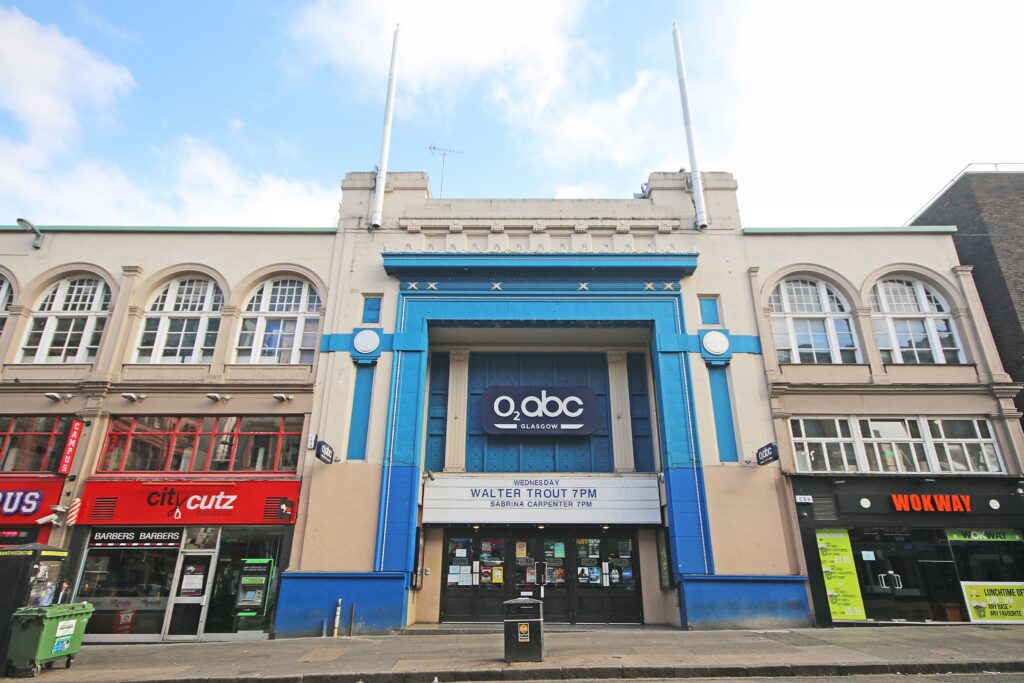
The old ABC building on Sauchiehall Street, Glasgow, one of the key sites earmarked for development by Vita Group. Photo Credit: Alastair Wallace / Shutterstock
‘Another vote of confidence in glasgow’s future’
One of the most prominent real estate transactions of 2025 has been the Met Tower in Glasgow, which faced an uncertain future after the withdrawal of Bruntwood and Legal and General who stepped back from a £60m regeneration.
Vita Group, which has been investing heavily in Glasgow, has acquired the Met Tower, one of Scotland’s most recognisable landmarks, for an estimated £40m.It plans to introduce its award-winning Union co-living concept to Scotland for the first time. Projects under consideration include revitalising the Met Tower, the former Glasgow College of Building and Printing, creating high-quality communal spaces, and improving connections between existing and new structures, as well as the surrounding streets.
Stuart Patrick, chief executive of Glasgow Chamber of Commerce, said: “We’re pleased to see Vita Group recognise the opportunity that Glasgow’s growing economy presents, particularly through its continued investment in key sites across the city, including the ABC building on Sauchiehall Street and India Street.
“The acquisition of the Met Tower, given its prime location, scale, and prominence, is another welcome vote of confidence in Glasgow’s future. As the city’s innovation economy continues to expand, supported by the city region’s innovation districts, developments like this have the potential to play a significant role in driving forward the Glasgow City Innovation District and the wider city centre economy.”
Read more Commercial Property Review articles featured in Autumn 2025 issue of The Business magazine, distributed with The Sunday Times Scotland here.