
Turmoil in international trading leads to weakening expectations for the future performance of the Scottish economy
Amid a backdrop of global uncertainty and turmoil in international trading conditions, data of business and consumer confidence were bleak for this quarter. There was a sharp uptick in inflation in April although this is expected to be a one-off jump caused by regulatory decisions on the prices of water and energy bills.
And the UK recorded the highest quarterly GDP growth of anywhere in the G7 – although this might come at the expense of growth later in the year.
Businesses have slowed hiring as the impact of the increase in National Insurance contributions makes its mark on the labour market.
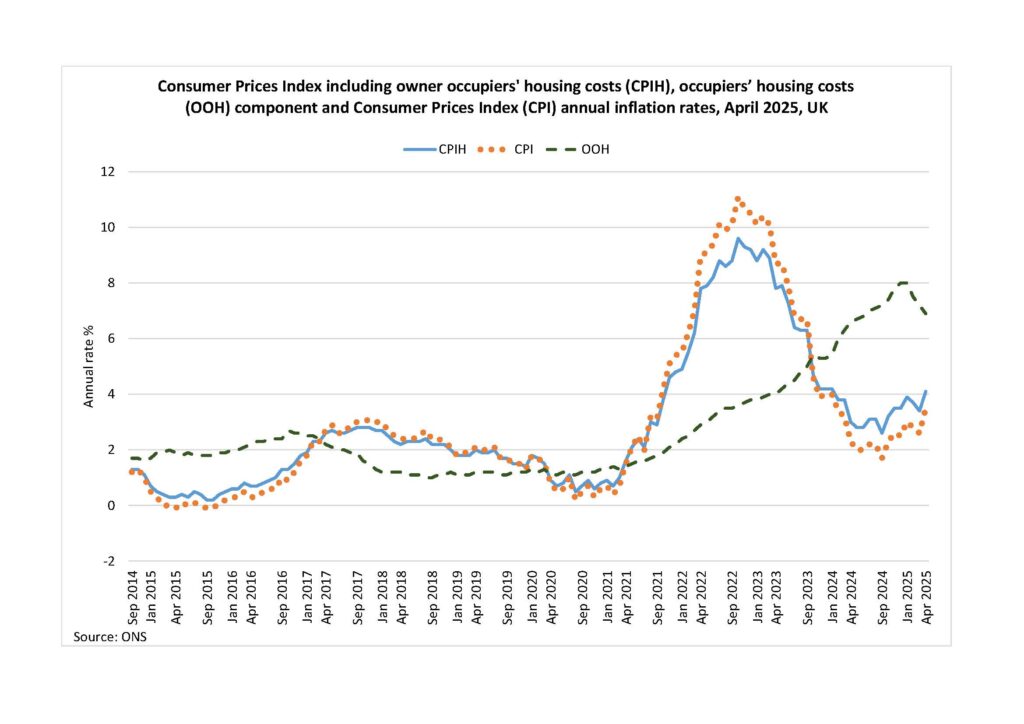
The UK rate of inflation, measured on both a 12-month rate and month-on-month, rose sharply in April. On the measure that includes housing costs (CPIH), inflation rose by 4.1 per cent in the 12 months to April, up from 3.4 per cent in the 12 months to March, and by 1.2 per cent compared to the previous month.
Excluding housing costs, the Consumer Price Inflation rate (CPI) accelerated to 3.5 per cent in the 12 months to April, compared to 2.6 per cent in March, and there was a monthly increase of 1.2 per cent.
The most significant contribution to upwards inflationary pressure came from housing and household services, where annual inflation was 7 per cent in April compared to 5.1 per cent in March. A large increase in the regulated prices of utilities in part explains this spike.
The cost of household energy rose as the Ofgem energy price cap for the period between April and June rose by 6 per cent, to an annual average equivalent of £1,849, up £111 over a year. On top of this regulators have raised the price of water and sewerage, which rose by 26.1 per cent in April, compared to March – this was the largest monthly increase since February 1988.
The cost of owning or renting a house is still rising but at a slowing rate. In Scotland house prices increased 4.6 per cent in the 12 months to March, down on February (5.3 per cent) and at a slower rate than the UK average increase (6.4 per cent). The average price for a house in Scotland is now £186,000 compared to £271,000 in the UK.
Private rents averaged £999 in Scotland in April, an increase of 5.1 per cent on the year, slightly slower than the 12 months to March. Across the UK, monthly rents increased by 7.4 per cent in the 12 months to April, also reflecting a marginal slow down. Data for Scotland reflects mainly advertised new lets so comparisons with the UK should be made with caution.
In May, the Monetary Policy Committee cut interest rates by a quarter of a per cent to 4.25 per cent, the fourth cut since the summer of last year. The temporary nature of the factors driving recent inflation means that the Bank of England is confident that CPI will fall back close to the 2 per cent target by the end of next year, with the peak annual rate of 3.7 per cent expected in September.
Consumer worries about prospects
After turning negative in the second half of 2024, the Scottish Consumer Sentiment Index (development data) declined to -6.5 in the first three months of 2025, a fall of 1.6 compared to the previous quarter. Weakening expectations for the future performance of both the Scottish economy as a whole and household finances were the main drivers of the fall.Despite the bleak mood expressed in consumer surveys, Scottish shoppers took advantage of the sunny weather making April 2025 the best monthly retail performance for almost two years. Total Scottish sales were up by 4.6 per cent on the year (adjusted for inflation) and footfall increased by 6.9 per cent. However, this also reflects the later timing of Easter compared to last year and followed a difficult March where footfall was down by 6.9 per cent.
Scottish shoppers took advantage of the sunny weather in April
Business activity in Scotland falls sharply
ncreasing domestic costs and global uncertainty continue to create headwinds for businesses. The Royal Bank of Scotland regional growth tracker, an index which measures the month-on-month change in manufacturing and service output (a score above 50 means month-on-month growth, below 50 a contraction)
dropped to 45.9 in March, from 49 in February.
This was the sharpest monthly fall since November 2022 and put Scotland second last across UK regions and nations. Market uncertainty and budget constraints were given as reasons for lower levels of new orders that have fallen for six consecutive months.
Firms responding to the Fraser of Allander Institute (FAI) Scottish business monitor in the first quarter of 2025 were more pessimistic about the economy. All survey measures – including business activity, employment, capital investment, and exporting – were negative for the second consecutive quarter.
The FSB small business index score for Scotland increased to -15.3 in the first quarter of 2025. Although that means more Scottish small businesses expect performance to worsen rather than improve over the coming quarter, this was a significant improvement on the previous quarter and is better than the UK score of -40.7.
A tougher overall economic environment was reflected in a cooling labour market. According to HMRC PAYE data (subject to revision), the number of payrolled employees living in Scotland declined over the 12 months to April by 0.5 per cent, and across the UK overall by 0.3 per cent. This was the fifth consecutive month of falling payroll employment in Scotland.
The number indicating they would like to work but can’t find work has also gone up slightly. The Scottish claimant count for those unemployed and seeking work was 3.6 per cent in April, an increase of 1.7 per cent across the previous 12 months, although this was still lower than the UK (4.5 per cent).
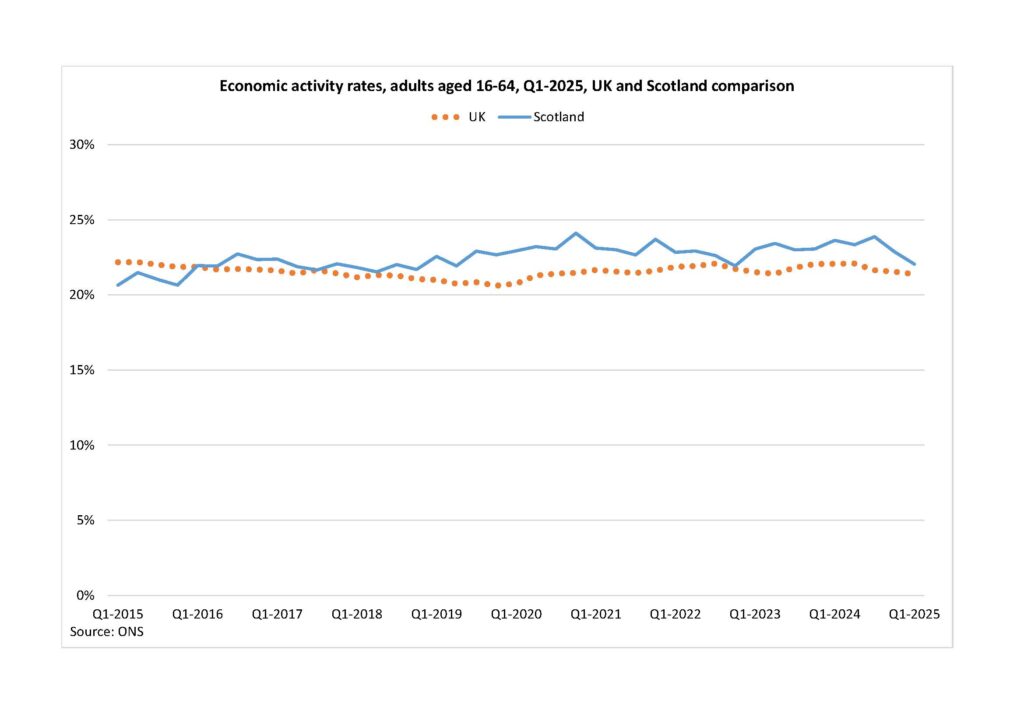
There was an increase in Scottish unemployment, to 4.3 per cent, in Labour Force Survey (LFS) data from the first three months of 2025, marginally below the UK rate of 4.5 per cent. Just over one in five (22 per cent) of Scottish adults aged 16 to 64 years were not working and not seeking or available to work, very marginally higher than the UK rate (21.4 per cent). Data should still be interpreted with caution due to ongoing volatility within the LFS estimates.
Recruitment indicators also indicate looser labour market conditions. The number of newly advertised jobs in Scotland posted online fell by 5.9 per cent in January compared to the year before.
Looking ahead, data from the Scottish Government Business Insights and Conditions Survey (BICS) shows that two thirds of businesses expect employee levels to remain flat whereas 14.5 per cent expect staffing to increase and 9.3 per cent expect to cut employees – indicating a slowing in hiring.
As a result, fewer businesses reported recruitment difficulties (down from 23.1 per cent to 19.9 per cent from February to March) and worker shortages (from 24.4 per cent to 22.6 per cent).
Despite weakening market conditions, median monthly pay rose by nearly 6 per cent in the 12 months to April in Scotland (compared to 6.4 per cent in the UK), ahead of inflation and ensuring that real terms earnings increased. Median monthly pay now stands at £2,546 in Scotland, very slightly above the UK (£2,521).
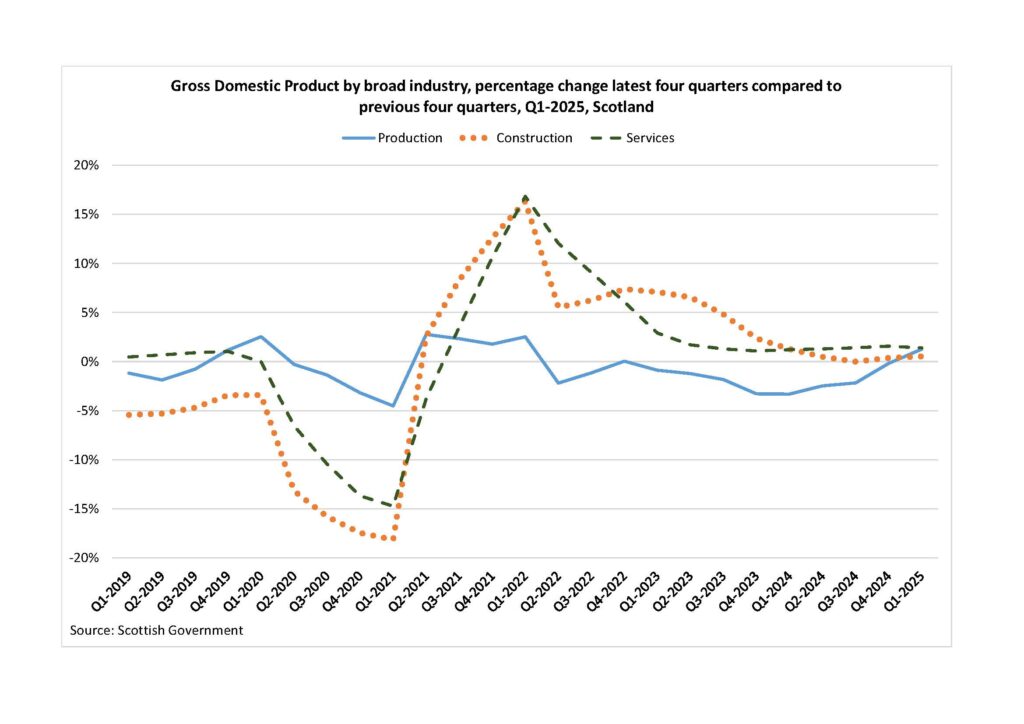
Initial estimates (subject to revision) for GDP over the first quarter of 2025 indicate that the UK economy grew by 0.7 per cent, up from 0.1 per cent in the final quarter of 2024 and ahead of Scottish GDP (0.4 per cent).
Compared to the same quarter a year ago, real UK GDP (taking into account inflation) has increased by 1.3 per cent, slightly ahead of Scotland (1.1 per cent). UK growth in the first quarter was supported by a stronger performance in the services sector (0.7 per cent) and production (1.1 per cent) whereas there was no growth in construction.
Despite strong UK growth in the first quarter, some forecasters have revised down their forecasts for 2025 in the face of global economic uncertainty. In May, the Scottish Fiscal Commission lowered its forecast for Scottish GDP in 2025-26 to 1.2 per cent (down
from 1.6 per cent in December) but revised up its forecast for 2026-27 to 1.8 per cent (up from 1.5 per cent in December).
Fewer businesses reported recruitment difficulties and worker shortages
The FAI cut its forecasts for both 2025 and 2027 in April, to 0.9 per cent and 1.1 per cent (from 1.3 per cent and 1.2 per cent). The latest Bank of England forecast indicates UK GDP will grow by 1 per cent in 2025 and 1.25 per cent in 2026.
In an international context, the UK had the highest growth in the G7 across the first quarter of this year. Both the IMF and OECD forecast that UK growth in 2025 will exceed France, Germany, the Eurozone, and Japan, but lag behind the US, China, India, and Brazil.
However, analysis of the data since before the pandemic suggests UK GDP is now 4.1 per cent higher than at the end of 2019,
the lowest rate of expansion in the G7 except Germany and Japan.
Celebrating Business Excellence in the Highlands and Islands
Entries are now open for Prosper’s Highlands & Islands Business Excellence Awards. The awards celebrate the positive impact that businesses in the region have on their communities and the wider economy. Hosted by Stuart Mitchell, the awards ceremony will take place on Thursday, September 11, at the Kingsmills Hotel, Inverness, and features seven categories that are designed to highlight the success stories of the nominees.
For more information on the event see Prosper’s website below.

In association with Prosper www.prosper.scot