

The mantra of Chancellor Rachel Reeves to ‘invest, invest, invest’ in her first Budget and the imperatives of sustainable economic growth are a definite rallying call for Scottish business entering 2025.
However, growth must not come at “any cost to society and the environment”, the Scottish Deals and Dealmakers Breakfast, organised by The Business magazine, in conjunction with Sunday Times Scotland, in Glasgow heard.
When discussing the new Labour government’s post-Budget plans to grow the flatlining economies, the panellists in the Merchant’s Hall agreed that growth and the encouragement of more deal-making activity was vital to ensure the taxation to allow public services and civic society to prosper.
Sellers are waiting on better conditions and buyers for greater uncertainty, so there is a ‘stand-off’, says Ally Scott, of EY
Nevertheless, growth must fall within the parameters of being ethical and environmentally sound, following the rules of ESG [environment, social and governance], and could not be at any costs.
Further concern about environmental issues has arisen after the election of President Trump and his economic promise to ‘drill baby, drill’, turn on the oil and gas taps and throw up trade barriers to ‘Make America Great Again’.
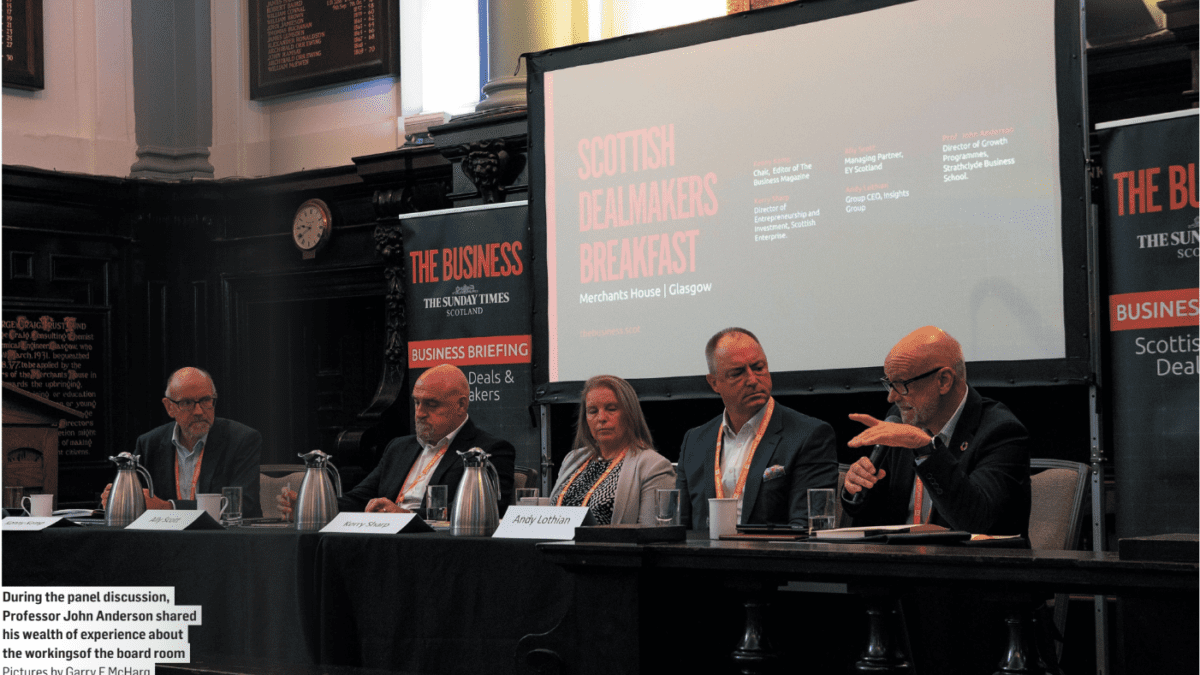
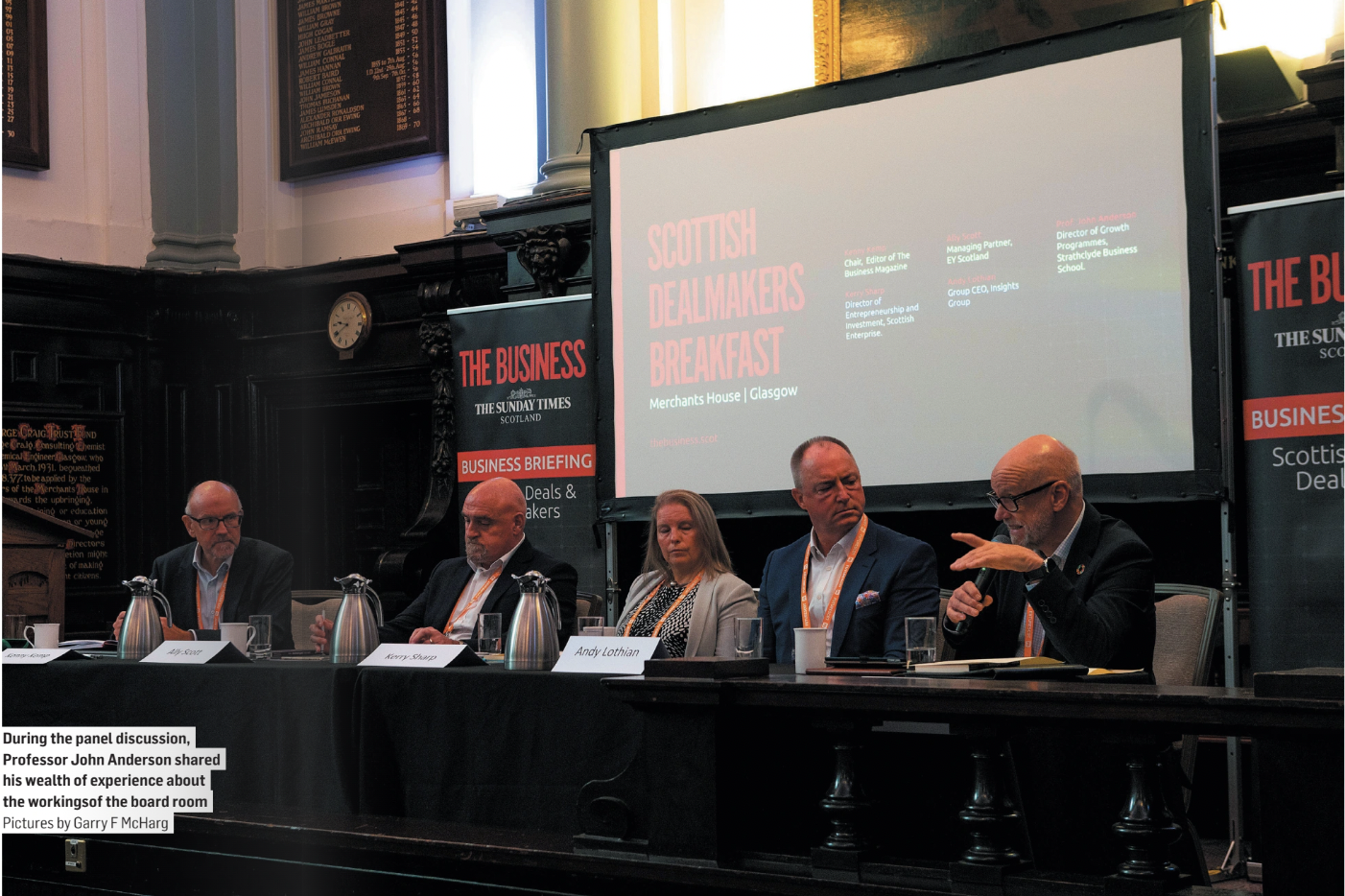
The panellists, introduced by The Business editor, Kenny Kemp, were: Ally Scott, managing partner of EY in Scotland, and co-lead of the Entrepreneur of the Year programme and awards; Kerry Sharp, director of entrepreneurship and investment at Scottish Enterprise; Andy Lothian, the chief executive officer of Insights Group; and John Anderson, formerly the CEO of the Entrepreneurial Exchange, and now a professor at Strathclyde Business School.
“It shouldn’t be about growth at any cost – we should think carefully about the growth we want to see and that it is inclusive, fairer and greener,” said Sharp, who has been recognised as Scotland’s Dealmaker of the Year.
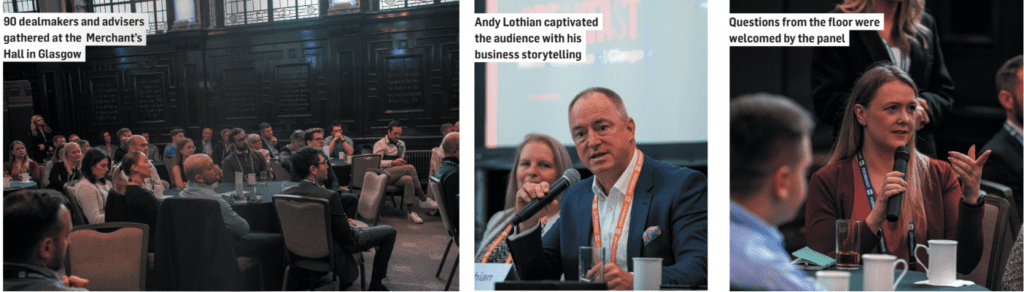
The gathering, of 90 dealmakers and advisers, heard that a cyclical economic environment is still holding back Scotland. A prolonged slowdown caused by poor national productivity, higher interest rates, cost of living inflation, and the continuing impact of Brexit, along with tight labour markets and trading restrictions has made life difficult.
There was concern that hefty changes in National Insurance contributions for businesses and capital gains taxation, all confirmed in the first Labour Budget on October 30, could indirectly hamper deal flows.
“I’m not an economist but I am a big advocate of stronger public and private sector collaboration,” said Scott.
“I’m a firm believer that the entrepreneurial minds in our economy – and I’ve spent a lot of time with them – can help unlock growth if we respect them and give them access to think tanks and policymakers and don’t just pay lip service to the voice of business and create a tangible industrial strategy that has meaningful business input and backing,” he said.
Scotland needs to encourage fresh private sector capital and new models to help with infrastructure and investment given the high level of UK public sector debt. Scott said it was important to shrug off the stigma that private sector is here to make a killing from contributing to a more prosperous economy
Sharp explained that deal completion was taking a lot longer but that Scottish Enterprise, as a patient investor, had been involved in several major deals where the financial return is recycled to help stimulate new start-ups through the likes of the Scottish Co-Investment Fund which supports Scotland’s angel and venture capital community.
Her colleagues were involved in eight deals of over £10m this year, while there were five in the whole of 2023.
There is concern that investors are increasingly canny about ‘follow-on’ money to support growing businesses.
“Our assessment of the first half of 2024 is £415m of equity deals, which compares with £575m for the whole of 2023. We have seen one ‘mega deal’, over £50m, this year already, which was the £87m from Build Rocket Boy. There were none during the whole of 2023,” she said.
Andy Lothian, who became the EY Scottish Entrepreneur of the Year in 2016, spoke with verve and passion about the cultural side of building great companies.
He took the audience on a journey of the development of the Insights Group, speaking about integration within his organisation including Vidatec, the group’s technology company, and the creation of the Insights Foundation.
“Everything you do in business is about the people. We spend a great deal of time and energy ensuring that everyone understands their job, the expectations, and we trust them to get on with their tasks. It is all about creating a combined sense of purpose.”
Ally Scott reminded the audience that deal flow was a cyclical matter. In 2022, EY was lead M&A adviser on nine mid-market deals in Scotland. “Which was a record year for us. By contrast, 2023 was painful,” he said.
The first half of 2024 had seen very challenging conditions, with the UK deals market 20 per cent down year on year. “Sellers are waiting on better conditions and buyers waiting for greater certainty: so there is a ‘stand-off’ – which shows up in a valuation gap – and this has been a barrier to deal completions. This results in a ‘lock-up’ – capital isn’t recycled – with private shareholders deferring their exit plans and private equity portfolio companies don’t trade.”
EY’s State of UK PE Report in Q2 surveyed 300 PE leaders with 85 pr cent saying they were holding assets for longer than the historical average. The average hold period has increased to 5.8 years from 4.7 years. 2021 was a high waterline for valuations so it is a balancing act for PE – the need to return capital to investors against the valuation and underlying trading dynamics.
However, Scott said there were reasons to be cheerful.
“I think we are emerging from the trough as we look into the last quarter of 2024. The bid:ask spread between buyers and sellers is now converging – mainly as sellers’ expectations are moderating and becoming more aligned with current environment.”
