

Sir Brian Souter is an extraordinary entrepreneur who has always broken the mould. Now a sprightly 71, what continues to drive this contrarian challenger?
T
urbulence in the Middle East is nothing new. And for shrewd investment firms who are opportunistic, new vistas often open up. Moments before The Business sat down with Sir Brian Souter in Edinburgh, he had been reminding his investment management colleagues that this Gulf crisis was not the first.
“I remember being a bus conductor during a previous fuel crisis in the Middle East. We only had enough oil for three hours in the morning, and three in the afternoon to get people to work and back,” he explained.
“We’re a bit more relaxed about what’s going on. I think there is a hysterical tone by some of the younger commentators. You sometimes think they haven’t lived long enough,” he says.
Sir Brian Souter has always been an entrepreneur who has broken the mould. A contrarian challenger who with his sister Dame Ann Gloag changed the face of public transport across the UK and elsewhere in places such as the United States, New Zealand and Hong Kong.
Ann and Brian — an agile 71-year-old with five young grand-children keeping him fit — set up the Perth-based bus group Stagecoach in 1980. It remains one of the most successful and enduring start-ups in Scottish business history.
This was undoubtedly the most significant business decision of my life
- Sir Brian Souter
“This was undoubtedly the most significant business decision of my life, as without it none of my future partnerships would have been possible,” he explained recently in his annual investment review.
He is an astonishing Scottish character who freely admits that Providence has shined on his life. Of course, many years back Souter poked his tin-hat above the parapet in a battle with the Scottish Government over the matter of Section 28, and the teaching of gender issues in schools. He was the Malcolm Offord of his time, a successful business figure despised in ‘liberal’ circles for daring to offer an alternative narrative. Since that bruising time, Sir Brian has refused to speak in public about his personal beliefs but is prepared to discuss his entrepreneurial inclinations.
His family office investment company, Souter Investments, has reached its 20th birthday. It has invested over £800m in more than 100 private equity deals in this time. This is a combination of direct funding of companies, off their own bat, and leveraged deals with larger private equity partners. Pretty impressive for a team of only 12 people.
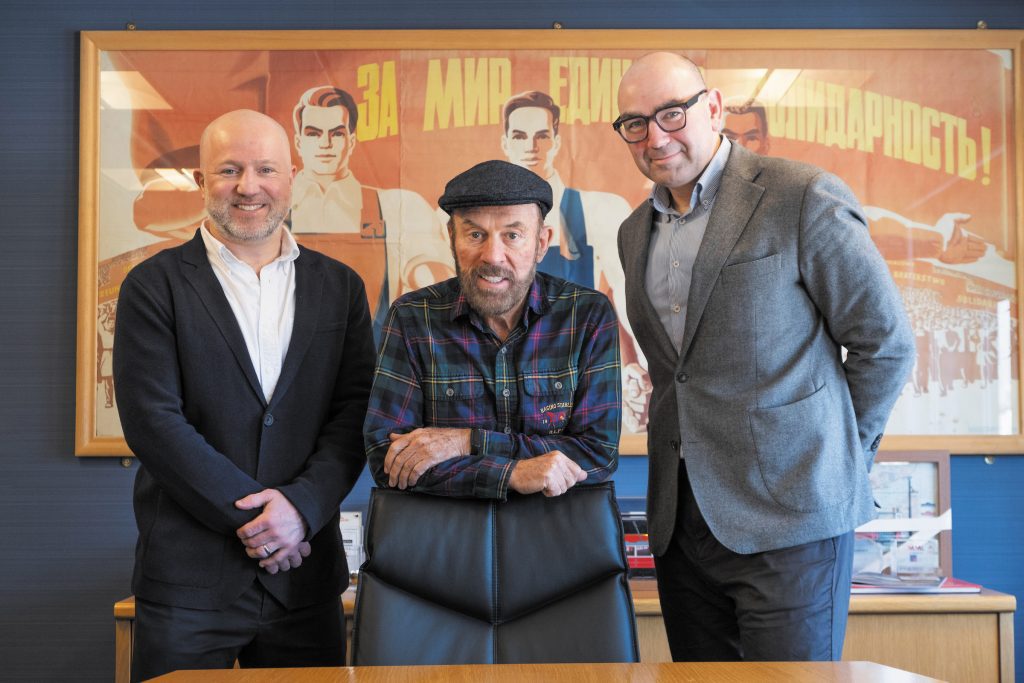
After photographs on the roof of his George Street office, he’s ready to explain his purpose.
“When we started Souter Investments in 2006, the Stagecoach holding was 76 per cent of our net worth. And when we sold the Stagecoach stake in 2022, it was around 17 per cent. So our objective was to diversify, but there was another reason.”
He smiles, weighing his words, and his gentle Perthshire burr becomes a rougher busman’s tongue.
I meet folks in the street who say, ‘Whit you still working fae, ha’ you nae goat enough money?'
- Sir Brian Souter
“I meet folks in the street who say, ‘Whit you still working fae, ha’ you nae goat enough money?’” I say the reason why we do this is because Stagecoach and now Souter Investments funds the Souter Charitable Trust (SCT), run by my wife, Elizabeth, which is engaged in the relief of human suffering in the UK and more than 80 countries. That’s our raison d’être.”
Over the last 20 years, SCT has provided grants and charitable giving of more than £160m, with between £10m and £12m a year of cash funding coming from the successful operations of Souter Investments.
“I wanted to find another way of funding the charitable trust. Trusts can survive beyond the life of the founders, if they are set up properly!”
Souter was also deeply irritated that the steady income from Stagecoach’s profits was not being well invested. Presbyterian stewardship was risk averse — in low-interest environments rather than active and riskier fund investment — and so it was not making proper use of the monies generated by the transport company.
In 2006, Souter met with Andy Macfie, who is a founding partner with Souter Investments, and now its chair. Macfie is a low-profile Scottish financier who prefers to stay out of any limelight but had great experience in running another Scottish private family office and many prior years in private equity.
“He’d worked for some very big banks, and he had all the credentials I was looking for.” Andy said at the start: the one thing a family office cannot do is run out of cash, and that’s the advice we’ve followed. You can only progress with an opportunity if you have the liquidity,” he says.
The management of liquidity, meaning ready access to cash, is the fundamental heartbeat of private equity funds, allowing a private equity investor to either support its portfolio companies and take out new positions or be forced to withdraw.
Souter Investments prefers a blend of old economy businesses which are cash generative, often trading at lower multiples, alongside a few bleeding edge businesses with high growth prospects which trade at higher multiples, but also, in theory, a higher risk profile.
“These newer businesses tend not to generate cash: they tend to suck cash. So you have to keep the balance right between the two,” he adds.
Alongside Macfie, Souter Investments has two co-managing directors in Calum Cusiter and John Berthinussen, who joined Sir Brian for his conversation with The Business.
“It’s a very irregular structure, but it works incredibly well,” says Souter.
Cusiter and Berthinussen, former teammates from international schoolboy rugby some 30 years ago , and who joined on the same day in 2008 after working at Bank of Scotland, are viewed as the engine room of the investment business, with Souter admitting his greater appetite for risk is delicately channelled by his managing directors and his investment team.
“John and Calum are a fantastic team. They don’t let me out on my own without supervision!” he laughs heartily.
“For a house of our size, there are a lot of investments and a very diversified portfolio,” admits Berthinussen. “Our model has been designed to be opportunistic. The co-investment or independent sponsor model [See panel] we use allows us to generate operating leverage through accessing the skills, networks and deal flow of others who look to us to provide capital. Not being over-committed to any one position is also important to us.”
Furthermore, Souter Investments wants to remain firmly in the market. Having spent 20 years honing company knowledge and wisdom, stepping out even for a short time would make it harder to rebuild relationships with co-investors and other private equity players.
“If you’re out of the market you lose access pretty quickly, so we try to be as consistent and reliable counterparties as possible.”
Souter, who was president of the Institute of Chartered Accountants of Scotland in 2017, explained that with private equity markets and IPOs [initial public offerings] going through peaks and troughs, stepping back impacts portfolio performance and risks missing buying opportunities or the upturn in cycles.
If you invest through the cycle, you will iron out the returns
- Sir Brian Souter
“If you invest through the cycle, you will iron out the returns,” he says.
While initially Souter Investments made several investments in public transport businesses, these days activity is much more varied.
“Sadly, I think the age of the public transport entrepreneur is over. In the last few years we have harvested most of our public transport assets, which was fortunately before Covid, because transportation was not a good place to be at that time. Timing was good to us,” he explains.
“For us, opportunities come along and themes emerge. In hindsight, you can allocate labels to our activity, and if you did so the inter-related plays of infrastructure services, healthcare, AI, energy electrification and more recently aviation would be the themes behind which we’ve placed our funds,” adds Berthinussen.
The portfolio is light on property holdings, around 8 per cent, although the firm does work on local projects with property developers Chris Stewart and Square & Crescent, who are based in Scotland.

What about the rest of the portfolio?
“Alongside Duke Street, one of our co-investment partners, we completed a deal in diagnostic imaging with Agito Medical, a very interesting company providing much needed MRI, CT and Cath Lab capacity to the healthcare market, but also starting to use data and AI to help clinicians remotely read and detect cancerous tumours more quickly, and with ForLife, managing long-term health conditions in the ostomy market.
In the sphere of industrials and aviation, there have been two transactions with MEL Aviation Components (MAC), alongside Averna Capital, and the carve-out acquisition of the aerostructures business of Senior plc, now rebranded as Zenix Aerospace, for £200m.
“The Zenix deal— which is about putting new planes in the air — has been completed with Sullivan Street Partners. Our investment in MEL Aviation, who are involved in supplying safety-critical, rotable components which keep existing aircraft fleets in the air, and Zenix happened in quick succession, and there were other aviation deals in the offing too. It’s amazing that by happenstance you see similar things at the same time,” says Berthinussen.
“We just kick the balls as [they] come on the pitch,” he says. “However, we know the UK’s national infrastructure does require massive upgrading, modification and modernising, and this means investment,” says Berthinussen, pointing out a recent deal in marine engineering, Ancora Group, is about preparing harbours and seawalls for future climate events as well as upgrading the UK’s marine infrastructure. Recently exited Octavius Infrastructure, another Sullivan Street deal, and Buckthorn Partners’ Cardo Group play into similar themes.
“There are big macro themes that are referenced all the time, but we are playing into these themes in different ways. We have invested alongside our partners Duke Street in Suir Engineering, which is a Northern European specialist in regulated high-voltage engineering, helping to build the new data centres needed for the computing power of big data and AI as well as the grid connections supplying much needed new renewable electricity generation and storage.”
Turbulence has generally been good to us when doing deals
- John Berthinussen
“Turbulence has generally been good to us when doing deals,” says Berthinussen.
As long as you have cash!” chips in Souter.
Why there are not more Scottish investments on the books?
“That’s a shame in a sense. But we can only kick the balls that people put on the pitch. If there were more balls coming on the pitch in Scotland, we’d love to have a kick at a few more, but there is not the number of transactions that we would need,” sighs Souter.
Sadly, some of the firm’s global oil and energy related investments once based in Scotland have relocated their operations with several recently upping sticks and moving to the Emirates. “This is pretty sad actually because they came out of Aberdeen and central Scotland and are now moving their head offices to other places, which is really unfortunate.”
So what keeps Sir Brian motivated?
“I’m an entrepreneur at heart, and I enjoy working with other entrepreneurs. Here there is the opportunity to meet like-minded people. It keeps me engaged and interested; we’re always out meeting great people running good businesses. We want to continue to fund the charitable trust too.”
He is also driven by the prospect that Souter Investments evolves as a management meritocracy working well enough to survive into the next generation and beyond.
“That would be a fine achievement. Every year, these guys are putting £10m to £12m into the charitable trust. Then the rest of the money is re-invested in the business. We enjoy doing it, it’s all about people at the end of the day,” he says before heading off to enjoy lunch with the Heart of Midlothian FC chairman, Calum Paterson, whose firm Scottish Equity Partners Souter has backed since 2000, “Hopefully he’ll have another ball for us to kick”.
IINSIDE THE PRIVATE EQUITY CYCLE
Souter Investments’ investment strategy involves two strands.
The firm has its ‘direct’ programme, where they are the only or main investor and normally hold a majority stake. It has capacity for about ten investments in this format at any one time.
“This usually involves a larger cheque with us involved directly with the management,” says Berthinussen.
The stable includes specialist alloys and engineering business Premier Hytemp, with operations in Scotland, Singapore and Malaysia; legal firm Winn Solicitors; New Zealand based travel and tourism operator Fullers360; and Likezero, an AI enabled counterparty risk intelligence and data platform used by financial institutions.
In total, Souter Investments has 45 ‘big’ positions. The firm sees around 400 to 500 potential deals a year.
The co-investment side – now known as the ‘independent sponsor market’ – has also been a significant part of Souter Investments’ activity since 2008.
“The rationale is that with a small team in a relatively small family office we can’t access all the deals and process all the deal flow we’d like to see. We work with a range of trusted partners, some of whom we’ve worked with for more than 15 years, plus some newer colleagues, and they give us more, better quality deals to look at.”
Souter’s co-investment partners, such as Buckthorn Partners, Penta Capital and Scottish Equity Partners, will have sifted through their own deal flow, investing their time, money and research capabilities, before asking Souter Investments if they’d like to join the party.
We get all the benefits of those individuals and teams, but the investment decision remains our own
- John Berthinussen
“We get all the benefits of those individuals and teams, but the investment decision remains our own,” says Berthinussen.
The capital is then managed by the co-investment partner.
“This allows us to do more without having to create a team of twenty or thirty people here” he adds.
The numbers, according to Souter’s 2025 triennial review, are an IRR [Internal Rate of Return] of 22 per cent, with a multiple of invested capital (MOIC) return of 1.8 times invested capital. The firm believe that strong growth values over 18 years will lead to a possible IRR of 24 per cent, and a MOIC of 2.4 times invested capital, the majority invested in the past four years. Souter believes that Berthinussen, Cusiter and the team are getting better and wiser as they learn more and the deal flows increase.
Read more of The Big Interviews for The Business by Kenny Kemp here.