

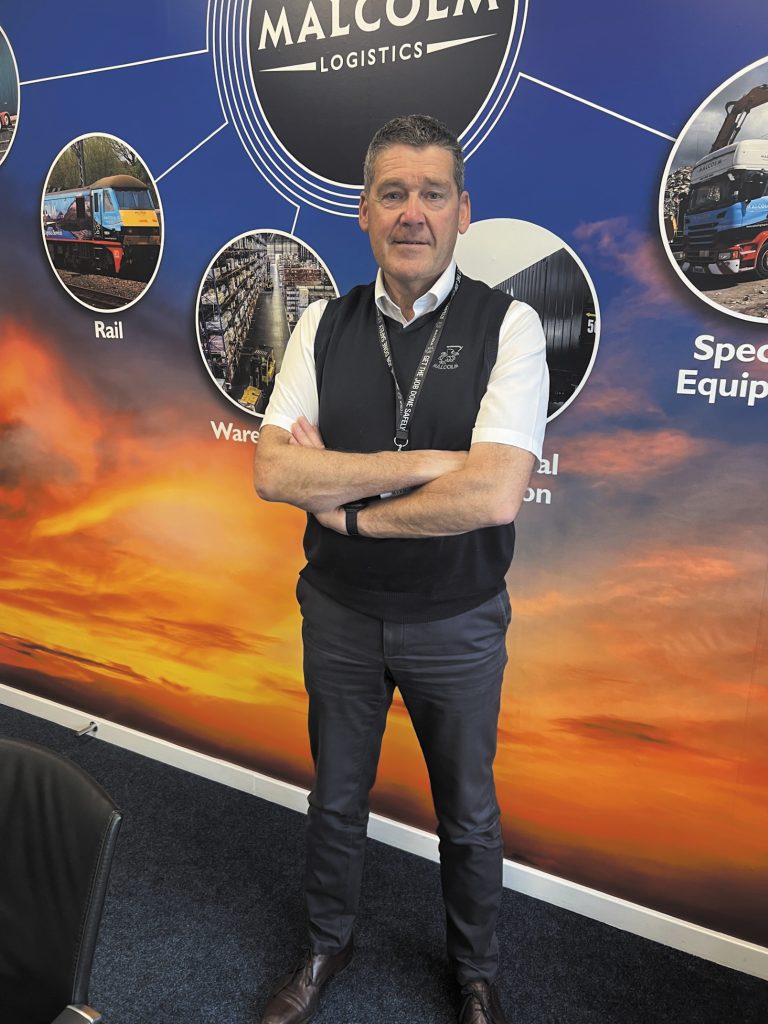
According to Andrew Malcolm, chief executive officer of The Malcolm Group, one of Scotland’s most recognised businesses, it has never been tougher for businesses like his. However with the straight-talking 64-year-old at the helm, you know the company will be on the right road
The haulage companies that ply the highways and byways of Britain are the unsung heroes of our national economy. And it’s as tough as it’s ever been, according to Andrew Malcolm, chief executive officer of The Malcolm Group, one of Scotland’s largest independent family-run logistics and construction companies.
Malcolm, 64, has a straight-talking, no-nonsense approach to work. He must be doing something right because the next generation are now following in his footsteps.
“The business is 104 years old and I’m third generation, along with my brother Walter, managing director of the construction division. There are five family members of the next generation in the business, so that’s five of the fourth generation.
“And we’ve got many, many third generation employees across the business,” says Malcolm, sitting in an office which overlooks the busy warehousing and freight complex at Newhouse, just off the M8.
The Malcolm Group is one of Scotland’s most recognised businesses. It is virtually impossible to avoid the blue or yellow livery of Malcolm 44-ton trucks cruising down our motorways. But The Malcolm Group is much more than a trucking company with a fleet of 450 vehicles.
Malcolm Logistics offers integrated road, rail, warehousing and bonded warehousing services across the nation. Current warehousing facilities encompass around six million square feet of space over key locations, three with railway hubs.
Malcolm Rail’s service was launched in 2001 and provides daily and overnight transit between various locations. This service offers a substantial range of intermodal services providing a link between ports, production facilities and distribution terminals.
We talk about The Malcolm Group employees as being our extended family. We have about 1,800 employees in the business
Malcolm Construction serves the construction industry including civil engineering and groundworks, waste management, landfill, recycling and quarrying. The group’s turnover was £247.6m in 2025, with profit after tax of £15.6m.
“My brother and I are 50-50 shareholders in the business. Walter mainly sits in the construction division and his eldest son, Donald, has just joined the main board. Donald will be the managing director of the construction division in the next few months. Walter’s youngest son, James, has been working in the business for the last two years. And my eldest son, Euan, is also involved in running all non-civils parts, such as tippers, plant, landfill, recycling, quarry and aggregate to re-processing,” he explains.
The Malcolm Group, headquartered in Linwood, was once the logistics fleet of the great Scottish conglomerate Grampian Holdings, chaired by Bill Hughes, acquired from Andrew’s father, Donald Malcolm, in 1960. The enlarged group also owned Edinburgh Woollen Mill.
In January 2002, the company was renamed Malcolm Group PLC and fully listed on the stock exchange. Edinburgh Woollen Mill was bought out by clothing entrepreneur Philip Day.
But when the corporate fund managers started to desert small-cap industrials, the undervalued company returned to private ownership. That was just over 20 years ago in May 2005.
“We talk about The Malcolm Group employees as being our extended family. We have about 1,800 employees in the business today.”
Malcolm says having such a family-orientated company is something to be proud of, but it’s very hard to manage in a constantly changing business environment.
“It’s very challenging running a company like this in Scotland today. Whether it is politicians, our customers or ourselves, there is frustration and uncertainty over decision-making. There are so many issues impacting our ability to run a successful company.”
Malcolm attributes his company’s continuing success to an instinct for making the most appropriate decisions to suit the prevailing circumstances.
“If I was relying on stats or policymakers’ new rules, you’d make no decisions. We invest heavily back into the business. A lot of what we do is instinct, backed by experience and a seasoned management team. Beyond this, it’s about our drivers who understand the needs and the values of the business,” he says.
“We are a private company, and while turnover is important, profit and cash are more important. We’ve never been shy to invest in the business and, ever since Covid, we’ve invested a significant amount of money back into the business. Every bit of investment, we’re always saying, is for the future, not for today.”
A lot of what we do is instinct, backed by experience and a seasoned management team
But instinct can only take you so far when the wider economic conditions are so fierce, and Malcolm is frustrated by unnecessary roadblocks. A downturn in sectors, such as the Scotch whisky industry, has an impact on the bottom line. The Malcolm Group carries not only the finished spirits but also the glass for bottling plants. The annual fuel bill for the fleet peaked at an increase of £15m per annum during the spike caused by the US-Iranian conflict.
“The whole sector is very challenging. When a lot of our customers are quieter and influenced by the world economy, not just the UK economy, it turns more focus and pressure on their spend. This in turn, puts more pressure on us and the logistics industry. Our industry works on a very low margin.”
Running a fleet of state-of-the-art vehicles and trailers for freight trains requires reams of regulation, including reporting on Scope 1, 2 and 3 CO2 emissions for the fleet, and security surveillance, that’s before a loaded truck heads out onto the road.
“The amount of money we pay out in local authority rates, taxation and employers’ national insurance raises questions on what we get in return.”
The extra NI cost for The Malcolm Group, which came off the bottom line, was an extra £2.2m in tax.
Since 2008, Malcolm Rail has been the operator of the Daventry International Rail Freight Terminal (DIRFT), in partnership with Prologis. The terminal handles more than 100 trains per week, including international rail services through the Channel Tunnel.

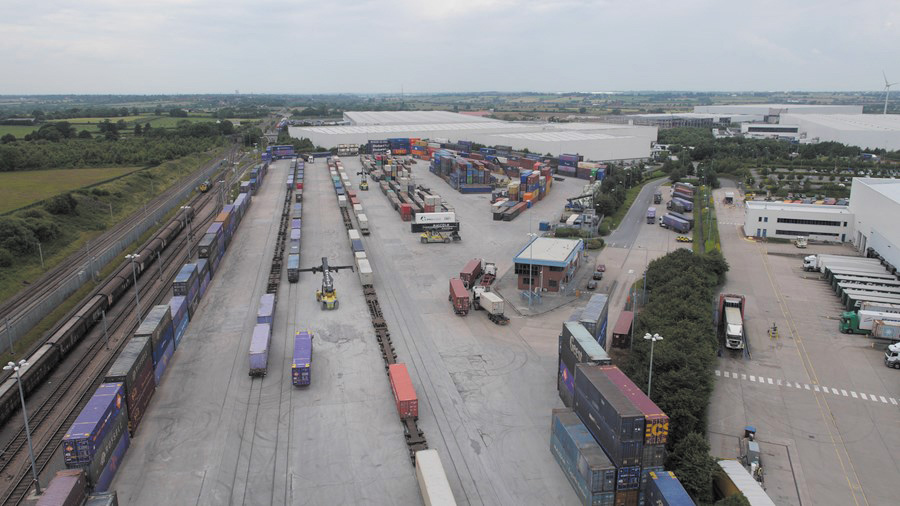
The hub in Daventry, in Northamptonshire, just off the M1, and near to the M6 and M45, has been a boon for the company. Two trains a day go from Grangemouth and Mossend to Daventry, moving 800 lorry-equivalent loads per week.
“Hopefully, we’re going to move into the new DIRFT 3 rail hub during the last quarter this year or first quarter next year. It’s a massive development.”
Surely the Labour Government, committed to getting to net zero, are keen to help get more freight onto rail?
Malcolm points out the previous rail subsidy was discarded. “Rail, unfortunately just now because of supply and demand, has gone the other way. The market is down, because there are too many road hauliers. We’ve lost some work from rail to road due to cheaper rates on the road.”
Yet road hauliers are hitting the wall every week. Several haulage companies have run out of road. Sunhill Transport, headquartered in Deeside, which ran approximately 30 vehicles, recently went bust, and this followed Martyn Barratt Transport, which entered administration in April. That firm had over 25 years of expertise and ran a fleet of more than 60 vehicles.
The quality of driving on the UK roads today can be questionable and almost every day there is a near miss
The lorry driver shortage, which was viewed as an impending crisis five years ago, is not getting any easier either.
“A lot of our guys are getting older. But if you look at work-life balance, driving is an unsociable job. I started my career in the workshop and worked my way up, and can still drive a lorry, so I understand what it’s like.”
Yet some facilities for long-distance drivers outside of The Malcolm Group are a national concern.
“We put a lot of money into our own facilities nationwide, trying to create a more restful environment for our driving colleagues when they are parked up safely for the night.”
The Malcolm Group has invested in global positioning tracking with up to five cameras on each truck, while he says the biggest danger today for a driver parked up on the roadside is fuel theft. “The single biggest theft going on in the transport industry today.”
The Malcolm Group are members of industry bodies the Road Haulage Association and Logistics UK.
“They have quite a strong voice with the UK Government. Yet every day, there is more regulation and legislation. Even the Highway Code nowadays, re-written a couple of years ago, seems to place greater responsibility on drivers of larger vehicles. It is really hard for drivers.”
The drivers were initially dubious about all the cameras but now appreciate that this is the ‘silent witness’ of the roads. On more than 90 per cent of complaints about Malcolm hauliers, the cameras support the proper action of the driver.
“The quality of driving on the UK roads today can be questionable and almost every day there is a near miss.”
“The quality of driving on the UK roads today can be questionable and almost every day there is a near miss.”
With Andrew and Walter now in their sixties, the internal discussion is about succession planning, but the Labour Government’s inheritance tax regime for private companies is causing concern.
“My brother and I have had a long debate about this with some government officials about what they are doing. We have told them they are compromising the future of family businesses. No matter what Walter and I do with our shares, the next generation will have the same problem.”
The family business dilemma will keep on going.
“I said to an official, who told me they had no alternative but to raise taxes, if you want any inheritance tax value, why not wait until the business is sold. For example, if somebody dies, the business is sold. This works on two counts: firstly you know the true value of the business, and, secondly, the family get cash for the business to pay some form of death duty.”
Instead, HMRC puts a value on the business, and the families have six months to pay for this tax, desperately trying to get bank funding and leaseback to pay the sum. This ends up with the next generation having to put their business into debt.
“It’s a tough time for those with high debt, with the current lack of support on offer.
“I’m a great believer in looking after the workforce. Those who can’t work, you look after them, those who won’t work should be encouraged to find employment. We all need the whole economy to stabilise. As the economy improves, conditions generally become more buoyant.”
On concerns about construction, he points to the financial crisis in 2008 when the whole industry lost a generation of workers, which is also mired in layers of new legislation.
“Additionally, we now have the challenge of a generation who have lived through Covid coming into the workplace.”
Despite the frustrations, The Malcolm Group remains one of Scotland’s best-run family companies. “We did not chase the low prices, and we are seeing some early signs of green shoots. In 2027 and 2028, the market has to return to something more sustainable, when it does, supply and demand will move.”

Cash flow remains the number one issue in every business today, he says.
“We’re a family business with very strong family values. We’ve got a legal obligation but I always say that bigger than Malcolm’s, we’ve got a moral obligation as well.
“We’re far from perfect. We’re always open to learning new things and we want to take our workforce on the journey with us. It’s been a tough last 18 to 20 months, but I’m cautiously optimistic that the second half of 2027 will see better times.”
FOR THE LOVE OF THE ROYAL HIGHLAND SHOW
For Andrew Malcolm, the Royal Highland Show is more than an annual jamboree, it is part of the fabric of his family’s life. “My mum and dad both came from farming backgrounds; my wife Fiona’s parents, also came from farming backgrounds. We’ve always attended the Highland Show.”
A love of horses and competitive riding has enhanced the family’s connection with appearances in the main show ring.
Fiona is “the real horse person within the family” while their daughter, Nicola, has competed at eventing level.
His involvement in the Highland Show’s fundraising came via a connection with Sandy Wilkie, who is involved with the Maggie’s Centre in Lanarkshire. “Sandy brought me on board to try and help raise funds for the Royal Highland Show, and probably more for the Young Farmers part of it.”
His conviction is that Scotland’s agricultural and rural life are often forgotten yet vital parts of the economy. “The Highland Show is something we’ve got to keep going for our whole industry. Farming has to get its due recognition and support for what it does for the whole of the Scottish economy.”
That same spirit runs through The Malcolm Group’s broader charitable activity, work overseen largely by Andrew’s daughter Nicola. The flagship is the Donald Malcolm Ball, held every second December at the Donald Malcolm Heritage Centre: around 780 guests attended the most recent event, raising approximately £373,000. Across six balls, the total now stands at £1.25m.
Meanwhile, the Donald Malcolm Foundation matches pound for pound all charitable donations made by colleagues throughout the year. The principal charity partners are Beatson and Maggie’s, the latter chosen because, as Malcolm notes, it “virtually touches every location we operate in through the UK”.
The Royal Highland Show is an annual event, showcasing the best of food, farming and rural life at Ingliston in Edinburgh. Thursday 18 – Sunday 21 June, 2026.
Read more from our Royal Highland Show 2026 section here.