

‘Vibes’ is now firmly in the political lexicon, but sentiment and feeling have long been an invisible hand in our economy. Can reform proposals shift the mood?
“There are decades where nothing happens, and weeks where decades happen.” This quote, often misattributed to Lenin, feels particularly poignant as the year draws to a close. As Scotland looks towards 2027, public-sector reform, local-government reorganisation, industrial strategy and regional empowerment have moved rapidly from the margins of political debate to its centre.
Weak growth, strained public finances and rising demand for services are driving these ambitious, and sometimes controversial, proposals from Holyrood and Westminster.
But success will not be measured by announcements alone. It will depend on whether reform delivers tangible results and creates a sense among businesses and taxpayers that Scotland is moving forward.
The economic context to these reforms is marginally encouraging but hardly comfortable. Positive signs from the UK Government’s industrial strategy quarterly update provide some initial reasons to be cheerful that macroeconomic headlines may overlook: it points to more than £6.5bn in investment commitments and over 27,000 jobs linked to investment and export activity in these key sectors.
Scotland has seen an impressive share of these benefits. The repowering of Whitelee windfarm represents a £1.5bn investment in East Renfrewshire, East Ayrshire and South Lanarkshire, which will create hundreds of jobs and £500m in supply chain opportunities, according to the owner and operator, ScottishPower.
Investment in the life sciences sector tells a similar story. Chemify, a University of Glasgow spin-out which pioneers Chemputation, a universal ‘chemical programming language’, will triple its highly skilled workforce to over 450 in the next three years. Founded in 2019, this expansion will be driven by nearly £90m in public and private investment.
These examples reflect strengths in Scotland’s mature sectors.
Scotland has also been well positioned to capitalise on investments in emerging sectors, such as the expansion of the Lanarkshire AI Growth Zone, which will support more than 3,400 jobs, and the development of the SaxaVord Spaceport Shetland with £30m in matched investment to support Scotland’s first ever orbital launch.
However, these positives in cutting edge sectors sit alongside persistent structural weaknesses which paint a very different story, one felt by many.
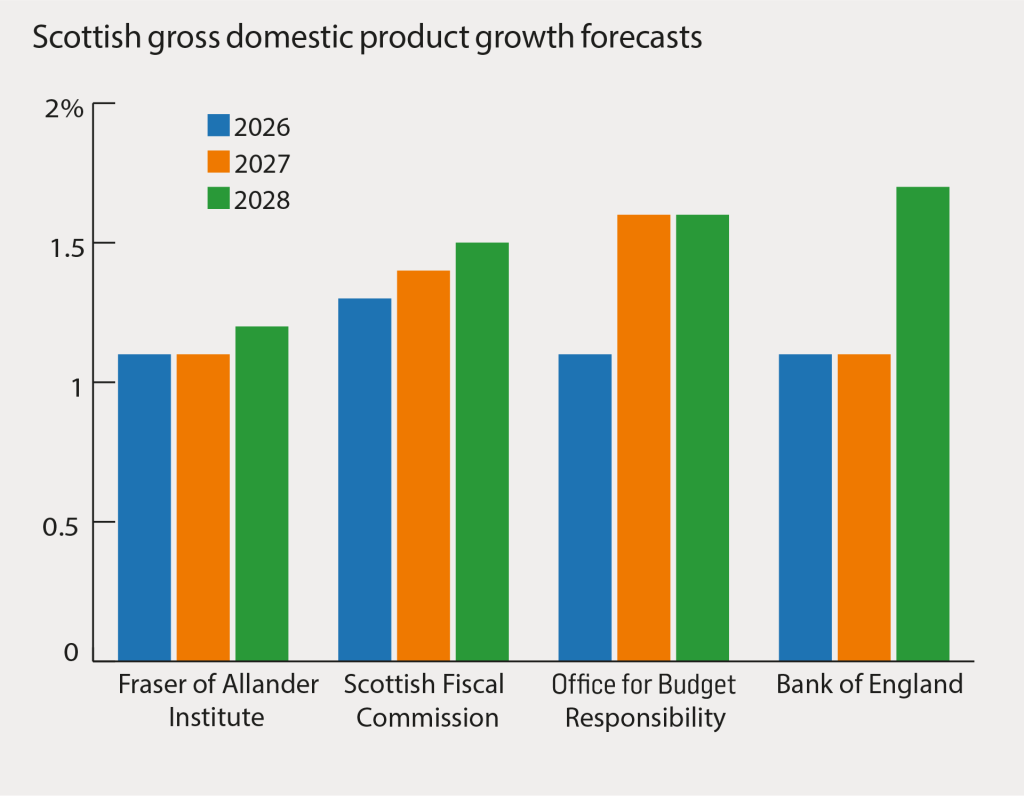
Real GDP growth in the UK is expected to be only 1.2 per cent this year, falling to 1 per cent next year. Whilst this is marginally improved on the near-stagnation in recent years it is modest by historical standards.

Forecasts will need to be beaten for years before many households feel a meaningful difference
The Chancellor, John Healey, suggested in this budget speech that Britain has “beaten the forecasts this year… and we can beat the forecasts again”. But after two decades of tightened belts, forecasts will need to be beaten for years to come before many households feel a meaningful difference.
Meanwhile, the Institute for Fiscal Studies (IFS), the independent UK economics research institute, has highlighted that future spending settlements depend on productivity gains that would exceed many recent historical trends. That does not make reform impossible, but it does raise the stakes considerably.
If productivity improvements fail to materialise, many of the ambitions currently being articulated in both Edinburgh and Westminster will become significantly harder to deliver.
For Scotland, the challenge is particularly acute. A House of Commons report calculated that from 2010 to 2022 Scotland saw annual average real terms growth of 1.2 per cent as compared to the UK’s 1.6 per cent.
The Fraser of Allander Institute (FAI), the independent economic research institute focused on the Scottish economy, projected this would likely be 1.1 per cent for 2026.

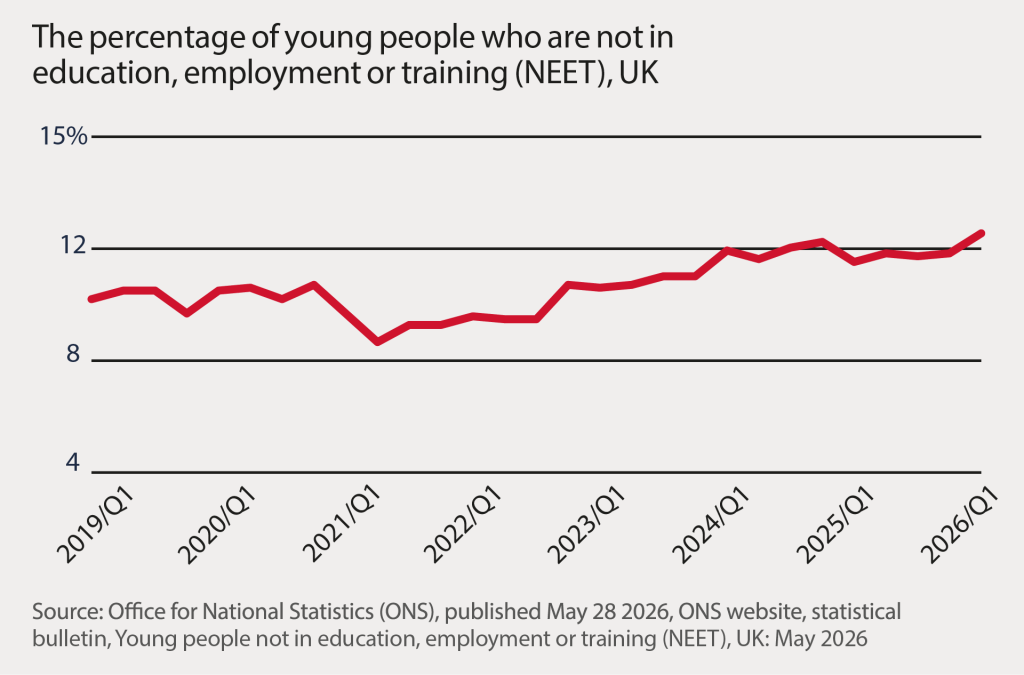
Looking ahead, shifts in labour market participation suggest challenging workforce supply issues by the end of the decade. Across the UK, there were 981,000 young people not in education, employment, or training (NEET) as of latest Office for National Statistics between April and June 2026.
The interim Young People and Work report, commissioned by the Department for Work and Pensions indicates that of those NEET today six in 10 have never had a job, up from four in 10 in 2005. Driving these figures has been a rise in work-limiting health conditions, which has increased by 70 per cent over the past decade according to the same report.
In Scotland, progress on closing the disability employment gap has slowed. The IFS estimates that Scotland’s disability employment gap has stalled at around 31 percentage points, compared with 26 percentage points in England.
A recent briefing for the Scottish Parliament forecasts that more than 1 million people will be receiving disability benefits via Social Security Scotland in 2030.
These challenges will explain why encouraging investment announcements can feel remote
These challenges will explain why encouraging investment announcements can feel remote from households and small business.
Scotland’s businesses are sending mixed signals. FAI found that all six of its headline activity indicators improved in the third quarter, with more firms reporting rising than falling sales for the first time in over two years.
Yet investment remained negative, 75 per cent expected weak or very weak Scottish growth, and 99 per cent regarded economic uncertainty as a concern.
Diffley Partnership, an independent research and consultancy agency, detected a cautious improvement in sentiment in its quarterly survey, with 38 per cent expecting economic conditions to improve and 37 per cent expecting them to deteriorate.
The Royal Bank of Scotland Growth Tracker recorded employment as rising for the fourth month in a row, but this was alongside another fall in private-sector activity and new business in September.
Reading these tea leaves is challenging but as NatWest Group’s Scotland board chair Judith Cruickshank [featured in The Business as one of the 35 most influential women in finance in Scotland for 2026] warned, it was “difficult to see how the current trend of rising employment will be sustained unless activity and sentiment improve”.
This caution contrasts with Scotland’s international appeal. Consultancy firm EY found that Scotland remained the UK’s leading destination for foreign direct investment outside London, securing 108 projects in 2025. One-third of investors planning UK investment were considering Scotland, even though the number of projects secured fell by 20 per cent overall.
That contradiction should sit at the heart of reform. Overseas investors recognise Scotland’s potential, while many firms already operating here remain reluctant to invest. Closing the gap will require greater stability, better skills and infrastructure, and a more responsive public sector.
Accessing and unlocking this potential will need to remain at the centre of reform proposals
How, then, will the increasingly ambitious programmes of public-sector, local government and economic reform address the structural weaknesses that continue to hold back growth, productivity and living standards?
Done well, these reforms should reinforce one another. Better childcare and more responsive health, skills and employment services could help more people enter or remain in work.
Greater regional control over policy and fiscal revenues, as Prosper will argue in a forthcoming report, Unlocking Growth in Scotland’s Regions, could align training, transport, housing and infrastructure more closely with the needs of local economies.
A more productive public sector could, in turn, release resources for the capital investment on which future growth depends. But this will require system-level thinking for the full benefits to be realised.
Successive governments have often treated these as separate policy problems, a challenge stated plainly in the Christie Commission on the future delivery of public services more than 15 years ago.
Reform offers an opportunity to organise services around the needs of people and places rather than the boundaries between institutions, but this will need to be a conscious decision to choose this path.
That path is littered with difficult choices and trade-offs. Expanding childcare, for instance, could be achieved with the additional £790m from in-year adjustments under the block grant calculations. But as the IFS highlights, much of that money is one-off, while health and social-care budgets may require substantial top-ups simply to prevent services from deteriorating.
Achieving the £1.5bn in savings by 2028/29 set out by the Scottish Government will require difficult changes across local government, health and social care, where much of the detail remains underdeveloped.
This detail will involve more difficult decisions beyond carving up the map. Audit Scotland reported this summer that councils face a combined budget gap of £529m, while capital funding had fallen by 15 per cent in real terms.
Structural reform alone will just shift financial pressure rather than solve it. Local government reform could and should be the opportunity to look again at both business and council tax, as well as the wider fiscal framework.
And still, success is more than the sum of these changes: they will need to be felt. For households, meaningful reform would mean services that are easier to navigate, decisions made more quickly and public bodies working together rather than passing people between them.
For businesses, it would mean more responsive planning, better links between local skills provision and employment opportunities, and greater certainty over the costs of operating and investing.
Scotland has an abundance of resources, talent, and ideas. It continues to attract investment and international attention despite international uncertainty. Accessing and unlocking this potential will need to remain at the centre of reform proposals.
Whether Scottish firms can access the opportunities they create, whether workers have the necessary skills and transport connections, and whether successful projects produce wider benefits for the places in which they are based will be essential yardsticks. But these reforms must be felt to be realised. To be seen is not enough.
In association with Prosper
A cross-sector economic alliance that aims to strengthen Scotland’s economy
This article is featured in the Winter Edition of The Business magazine published on 29 November 2026 in association with The Sunday Times Scotland.