
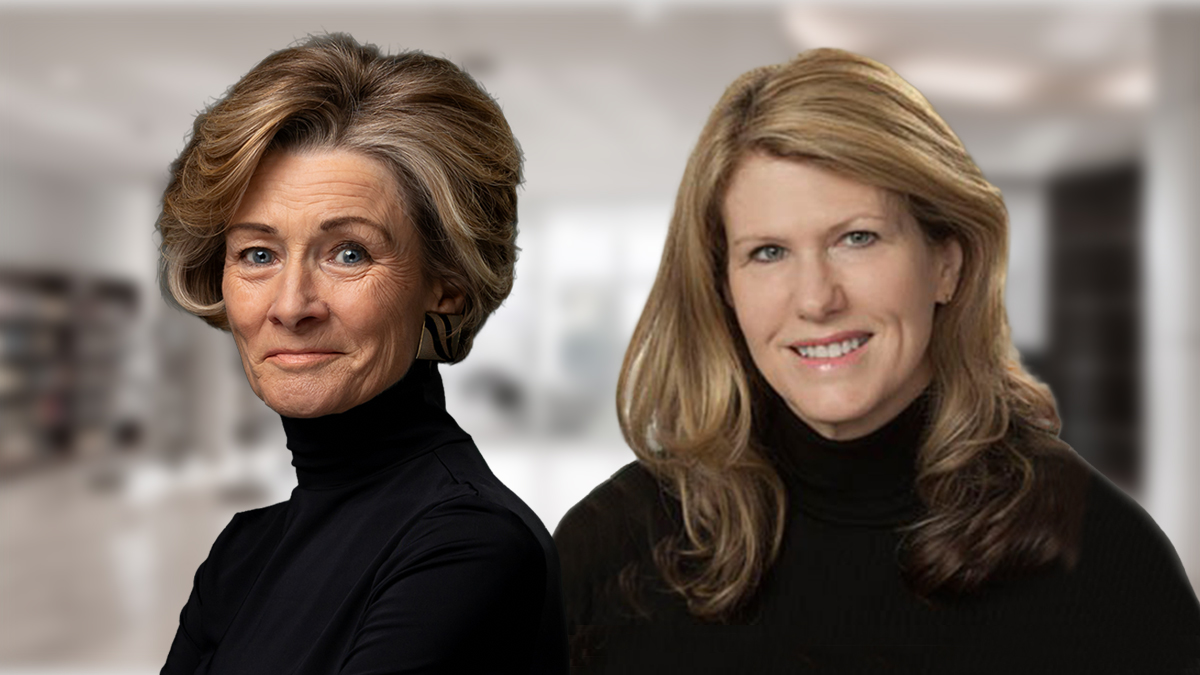

Building confidence and delivering executive change: A decade of the Executive Leadership Programme (ELP) at the University of Edinburgh Business School. Founders Professor Susan Murphy and Judy Wagner of FWB discuss their success story with Kenny Kemp, The Business Editor
Shortly after American-born professor Susan Murphy arrived in Edinburgh in 2013, she was introduced to Judy Wagner, then a non-executive board member on University of Edinburgh Business School.
The duo, with shared experiences yet complementary skills, hit it off and between them set about creating a programme that is still going strong after a decade.
They both recall the creation and their pride in their achievement in an interview with The Business as a preview to their forthcoming Gala Dinner.
Wagner, a chartered accountant and the co-founder of FWB, a leading executive search and selection company set up with partners Scott Black and Willie Finlayson, had initially raised the concept with Ian Clarke, then the Dean of the University of Edinburgh Business School in the early 2010s.
Prof Murphy’s arrival from the West Coast of the United States, was an accelerator which gave the idea its vital academic empowerment. Today, the network has more than 500 alumni across its two programmes and, in September, it will be marked at the dinner.
In the early years, the Executive Women in Leadership Programme, known as EWLP, was open only to women across the corporate, public and third sector. Since then, its success has led to the inclusion of both women and men. It is now the Executive Leadership Programme (ELP), delivered in partnership with the University of Edinburgh Business School.
The original concept was to promote gender balance on boards and senior leadership shortlists.
“I didn’t know Edinburgh that well, when came in 2013 and that’s where I met Judy on the board. I thought, ‘What is this lady? She’s like larger than life and in charge in Edinburgh. She knows everyone. She has great ideas. She knows the business community. She’s passionate about the business school as well. I was really impressed with her,” says Murphy.
Wagner had already discussed the need for a leadership programme in Scotland with Ian Clarke.
“There were you and the Dean, and a colleague from the business school. I brought two of my colleagues from FWB and outlined the thoughts that I had around it. And I think you thought, Susan, that it was a ridiculous idea and it would never work. Or so you told me anyway,” laughs Judy.
Murphy agrees she had early reservations about what a women-only leadership programme would look like in Scotland, and whether it might be met with resistance.
“I think even some of the women we got into the early programme were a little concerned, a little leery about, does this look like we need special training compared to men,” she recalls.
Once Wagner began talking to leaders within Scottish firms and to women in Edinburgh’s business community it was clear there was an appetite for such a programme.
“You could see that there was a need. The idea of having it away from their companies, instead of something that was really highlighted internally, seemed like a great idea to many people,” says Wagner.

The starting point had been Leslie Sawers’ Womenomics Report, commissioned by the Scottish Government. Leslie Sawers, who was head of Scottish Council Development and Industry, now Prosper, found that the proportion of women in senior management across the UK remained low. Wagner was struck by such findings, given that FWB had spent more than two decades pushing for gender balanced shortlists for senior management positions.
“I was thinking, is the rest of the UK really not making any inroads here?” she recalls.
Conversations with women in management convinced Wagner that the barriers grew more acute the higher up the organisational ladder.
“Up to a certain level, I think the ratio was quite good. But as you got more senior, obviously there were fewer positions. Competition was fierce. A lot of the competition was male. By and large, the men could throw everything at going for that role,” she says.
Wagner was speaking with female executives who were talking about child and family responsibilities, about ageing parents, and male partners in business who were travelling a great deal. She heard women say they could not put the same effort into going for a role as a male counterpart.
The programme’s aim was to help women reach senior roles and board positions as quickly as possible, and then assist them in being effective once they were there.
Murphy brought an academic grounding to that ambition. Her doctoral research had touched on the differences between how men and women performed and how confident they felt about that performance – a subject she said her male supervisors had shown little interest in at the time. A later study she carried out with the Washington State Department of Transportation in the United States found that women were receiving performance ratings from their teams that were equal to, or in some cases higher than, their male colleagues, yet their scores on a self-efficacy scale she had developed were consistently lower.
“What’s going on there? They’re performing just as well and sometimes much better in some areas, but they still have this low confidence. So what goes into making somebody confident or not confident?” she pondered.

HERO OF EVERY EPISODE
One answer, she found through her research, lay in how successful men talked up their own careers. She pointed to the genre of chief executive autobiography, citing Jack Welch of GE, who tended to appear as the ‘hero’ of every episode, glossing over any moments of doubt.
From the outset, EWIL took a different approach, inviting senior figures from business to speak candidly about the parts of their careers that had been most difficult.
“The women in leadership talked about points where they felt a lack of confidence and they talked about why they went for positions. Rather than having this canned glossy talk, now you were hearing the nuts and bolts of how people made moves.”
Murphy and Wagner came to describe the effect as demystifying success.
Among the speakers, they singled out some women who had stepped up to become chief executives. An early speaker was Barbara Cassani, the former British Airways executive, who sold Go, the low-cost airline to EasyJet for £374m, and then worked as CEO of the successful London Olympic bid.
The CEO of a major Icelandic bank told delegates that she had not set out to take the top job, but realised by looked at the field of candidates, she was as good, if not better, than anyone else.
“She didn’t say it that way, but you could just tell. And then she kind of went for it,” recalls Murphy.
The calibre of speaker was central to the design of the programme and remains so for the mixed gender version.
“We get what I would call Tier One people; chairman and chief executives who are actually still doing the job. It’s not a range of retired executives reminiscing. The people we have still have responsibility for the areas that they’re involved in,” says Wagner.
The pairing of FWB and Business School, she added, allowed the programme to combine academic credibility with commercial contacts, an academic from the business school sitting alongside a business leader who could speak about their own career.
“So it was very, very interactive. A key element of learning for the delegates has always been what they hear from other delegates.”
That mix of sectors was deliberate too. While delegates are drawn mostly from the private sector, they also joined from the public and not-for-profit sectors, and from every functional area of business.
“You could be the CEO of a tech business sitting at the same table as the sales and marketing director from a financial services company to the manufacturing director from a food and drink company,” she says.
ACTIVE LEADERS GIVING ADVICE
Each cohort has become part of a growing alumni network; the EWLP now numbers around 225 graduates, and the mixed gender ELP, which followed it, has taken that combined alumni total past 500.
Advisory boards drawn from each year group keep the network active between formal sessions. “It’s very powerful, and people have built powerful relationships. People have got successful jobs through it, although that’s not why it was set up,” says Wagner.
Cohort sizes have grown gradually since the programme began.
“I think we started on about 45, and then it’s built up. So the most that we’ve had, on last year for the ELP, was 65. I don’t think we’d want to go above that,” she explains.
Delegates sit around the tables at Surgeons’ Hall on the Bridges in Edinburgh, and are encouraged to move between different groups so that they get to know everyone on the programme over the course of the year.
One deliberate choice has been the decision not to circulate a delegate list in advance of each cohort meeting.
“If you did, you would look up LinkedIn and you’d work out who everybody was, and you would form opinions on people before you met them. All you do is turn up, you get a list of names, and a photograph beside the name. You don’t know who they work for or what the position is, and you get to know people as human beings, as individuals,” says Wagner.
That simple approach, she believes, is part of what has produced such durable relationships among alumni.
The format has also changed over time. Last year the number of sessions was reduced and each one lengthened by an hour, giving delegates more time to work through case studies and present their conclusions to the wider group.
Both Murphy and Wagner believed the programme offers a safe space for people who might otherwise hold back.
“Women particularly, if they’ve got something to say – they’ll maybe think about it for 20 minutes in the board meeting before they say it. And then somebody down at the other end of the table, quite often a guy, says it (and not always as eloquently as they would have said it!). That’s not the kind of place this is. It’s safe, say what you think, there’s no such thing as a stupid comment, and no room for ego’s or talking over others. Everyone is there because they deserve to be, and everyone is equal ,” says Wagner.
A PROGRAMME WITH IMPACT
On the programme’s impact, Murphy is candid about the limits of what has been formally measured. Survey studies carried out over the years have looked at promotion rates, confidence and which elements of the programme delegates found most useful, and a final survey was undertaken at the end. The university’s own impact case study drew qualitative interviews with chief executives and heads of human resources about the changes they had observed in the women who had been through the programme.
“They talk a lot about the changes they saw, and how the women modelled some of new behaviours. They were able to help others in the organisation, and they just brought new ways of thinking,” says Murphy.
Ahead of the Gala Dinner, FWB and members of the advisory board have carried out a series of profiles of alumni, alongside short video interviews.
“I would say that most of the alumni from the women only sessions have done really well in their careers. The impact that the programme has had is very positive and gives us a sense of pride in being able to help this progression,” says Wagner.
Looking back on ten years of the programme, Wagner said the choice to stop the women only version after four years, moving to the mixed gender ELP, had been the right one, and that the strength of the two alumni networks combined was proof the model worked.
Politicians are increasingly keen to engage with the alumni because the cohort represents a concentration of Scotland’s current and future business leaders, people who are passionate about the creation of strong organisation in Scotland, good jobs, and a healthy and sustainable economy.
For Murphy, who spent almost 20 years in Los Angeles before moving to Scotland, it has established a Scottish network of her own.
“When I started talking to Judy, I was just so impressed with who she knew and how she knew people on such a detailed level. I feel like she knows everyone’s birthdays, everyone’s names and things like that,” says Murphy.
What impressed her most was the way Wagner approached companies when the programme was first being built, not as a finished product to be sold, but as something to be shaped together.
“We didn’t go to the companies and say, here’s this programme, sign up some people. Not at all. It was basically, could we co-create this programme with you? How could we help them be more effective and progress their careers faster? ”
Murphy said any scepticism dissolved once they were drawn into that conversation.
WHAT BUSINESS SCHOOLS SHOULD BE DOING
For her, the collaboration reflects what a business school ought to be doing.
“We study businesses, we work with businesses, we prepare students for positions in those businesses. I can’t think of better partners to be partnered with than somebody who founded FWB,” she says.
Wagner’s reflection also centres on relationships, particularly those built up with individual alumni. She is still in regular contact with the alumni, and meets regularly to discuss career opportunities and challenges, and points to those ties as the clearest measure of what the programme has achieved.
Asked what surprised her most about the last ten year, she says the value of the programme was never really about the sessions themselves, but about what people carried out of the room and into their working lives, and about the network that has kept growing quietly around them ever since.
The dinner on Wednesday 23 September at 6.30pm will include over 100 delegates and past speakers. Former Conservative leader Ruth Davidson, the first to undertake an online session with the group during Covid lockdown, is returning in person to give the keynote address. Murphy and Wagner will chair a panel discussion looking back across the ten years and what comes next. The panel includes Lady Susan Rice, Lesley Sawers, whose report first prompted Wagner’s thinking; and Sarah Millar, the chief executive of Quality Meat Scotland, a woman in her thirties forging a successful career in the public sector.
For further information on the executive and/or non-executive development contact: elp@fwbltd.com
Useful links:
Executive Leadership Programme (ELP)
