
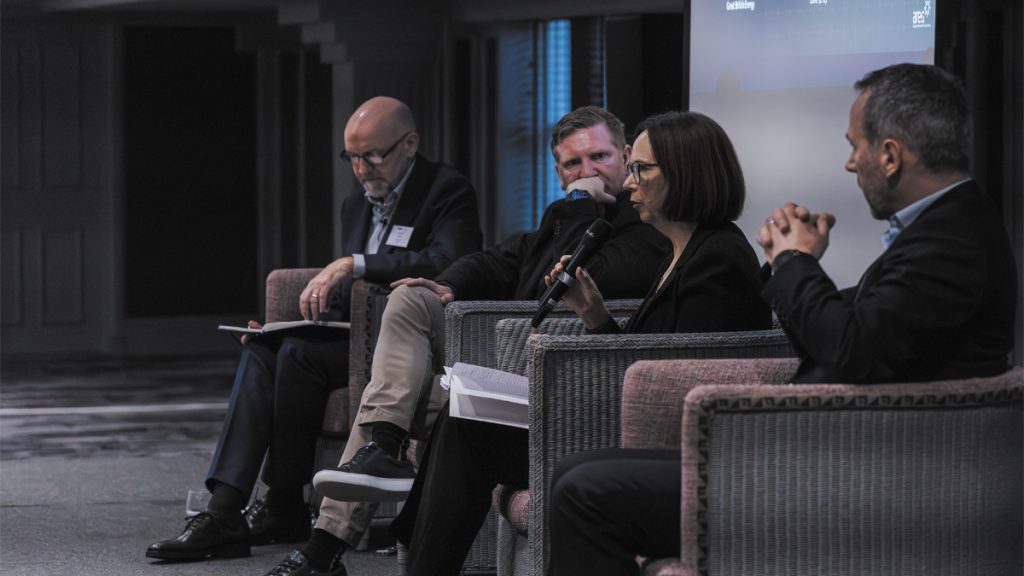
While there are multiple reasons to be optimistic about the North-East of Scotland as the nation’s green energy powerhouse, there is a need for some cold and stark realism.
So stated Maggie McGinlay, the chief executive officer of ETZ Ltd, the company leading the region’s energy transition, at The Business Dealmakers’ gathering in Aberdeen, on a panel including GB Energy’s CEO Dan McGrail, and former BP vice president of projects, and CEO of Rockall, Gerry McGurk.
“While the offshore wind opportunity is vast, and we’ve seen progress with the AR7 [Auction Round] round, it has been four years since the ScotWind bidders were announced, and we’ve not seen one gram of steel in the North Sea, let alone a project connected to the National Grid,” said McGinlay.
Much of this, she admitted, is for understandable reasons related to geopolitical uncertainty, escalating costs, investment uncertainty, and policy hold-ups, but meantime the population of the North-East of Scotland is suffering.
The biggest risk to achieving Scotland and the UK’s clean energy goals is losing our existing highly valuable industry and skills base.
- Maggie McGinlay
“It is hugely challenging and despairing in equal measures to see job losses in the region. We are eroding the very supply chain, capability and talent that the energy sector in the UK has been built on …
“The biggest risk to achieving Scotland and the UK’s clean energy goals is losing our existing highly valuable industry and skills base. This must not be allowed to happen.”
McGinlay also urged that the distinct polarisation between traditional oil and gas and renewables must be halted.
She quoted GB Energy’s chairman Juergen Maier who said: “Oil and gas is our foundation: this isn’t about oil and gas or renewables. It is about oil and gas, and renewables.”
Hydro carbons and renewables
McGinlay said: “I couldn’t agree more. My biggest frustration right now is that energy policy has become so politicised. We have both renewables and oil and gas, and they are being stigmatised by one quarter or another.”
“Very few countries are blessed with an abundance of hydro carbons and renewables. Let’s embrace them both and ensure the former is an enabler for the latter. It’s not a competition. The prize on offer is so vast, we have to get this right.”
Earlier, she spoke about how Scotland must build on the region’s energy excellence, knowledge and know-how, and a global reputation which has been built-up over the last 50 to 60 years on the back of the oil and gas industry.
In March, Scottish Enterprise and ETZ Ltd agreed a strategic partnership valued at up to £20m to help accelerate Scotland’s energy transition, with £2.8m set aside for EnergyWorks, ETZ’s flagship low carbon energy incubator and scale-up hub.
We’ve not seen one gram of steel in the North Sea, let alone a project connected to the National Grid.
- Maggie McGinlay
Carbon capture and storage potential
“For Scotland and the North-East in particular, there is huge opportunity around floating wind which makes best use of our world-class subsea and offshore engineering excellence,”
“It’s great to see the investment that GB Energy has made in the Pentland project, which was successful in the AR7 round. This, as well as Berwick Bank, are proceeding in Scottish waters.”
McGinlay’s other reasons to be optimistic are the potential of carbon capture and storage with the potential of £17bn, the employment of over 10,000 people in the construction, and a further 4,000 operational jobs, while hydrogen projects have a potential of £7bn by 2030. The Kintore hydrogen project is underway, via the Aberdeen Hydrogen Hub.
She also spoke about the decommissioning of assets in the North Sea, including oil rigs, platforms and connecting pipework.
“Right now, for the supply chain, this is probably one of the biggest opportunities.”
Reliable projects for companies and contractors
The North-East’s well-hub advancement makes up around 50 per cent of this and is vital to the engineering expertise of the region. But companies and contractors need reliable projects now.
“I’ve every confidence that we will get there, but it is hard for supply chain companies to diversify if these opportunities don’t yet exist.”
“We see no lack of ambition from the supply chain companies in the North-East of Scotland, but they need these projects to be real and to be moving forward.”
McGinlay also gave credit to both the Scottish Government and the UK Government for their support of ETZ Ltd to help ensure that “we are putting the foundations in place for the switch to low-carbon green energies.”
With the North-East of Scotland due to be given full status as an investment zone, she added: “This will be up and running and with that will bring ten years of £160m investment with flexible funding and low-tax status for two locations in Peterhead and the Aberdeen Energy Transition Zone. This will bring fiscal incentives to invest.”