

Murray McCall, long-standing managing partner of Anderson Strathern, calls for clarity from regulators and policymakers as he assesses how advanced machine learning is likely to impact the ancient legal profession of Scotland
When it comes to reading the tea leaves in the bottom of the legal brew, it is preferable to get a seasoned view from an active insider.
Murray McCall is the managing partner at Anderson Strathern, a modern commercial law firm with its roots back at the start of Scotland’s legal history when canon law was recorded by monastic scribes.
A discussion with the longest serving managing partner of a mid-size law firm based in Scotland gives us an excellent context to unpack the rapidly-changing legal world as it faces into the digital challenges of the mid-21st century.
“I’m old enough and have been in the legal world long enough to look back 20 to 25 years and recognise that a lot of the big names are no longer there. They might be there in a different form but it’s not the same organisation. It’s something different.
“Now if it’s different in a better way for the clients and the people, then that’s great. But some are no longer there,” he says, sitting in a conference room in the Morrison Street office in Edinburgh.
History is always a good master. In 2019, three ancient iron boxes known as Nuremberg chests were opened in the previous offices of Anderson Strathern, a firm which traces its roots to include J&F Anderson, Strathern and Blair, and, during McCall’s tenure, Bell and Scott.
The chests, from around 1550 to 1706, revealed ancient documents including a charter by Robert the Bruce from about 1323, and legal papers which plotted the progression of Scots Law through the foundation of the College of Justice and the Society of Writers to His Majesty’s Signet (WS), founded in 1594.
The troves of deeds tracks Anderson Strathern’s foundation to John Lumsden, who was admitted as a WS in 1701, and John Davidson, founder of Strathern & Blair, which is considered the starting point of the modern establishment, now a limited liability partnership with 60 partners and 372 employees.
These boxes remind us that Scotland’s legal world has never been set in stone.

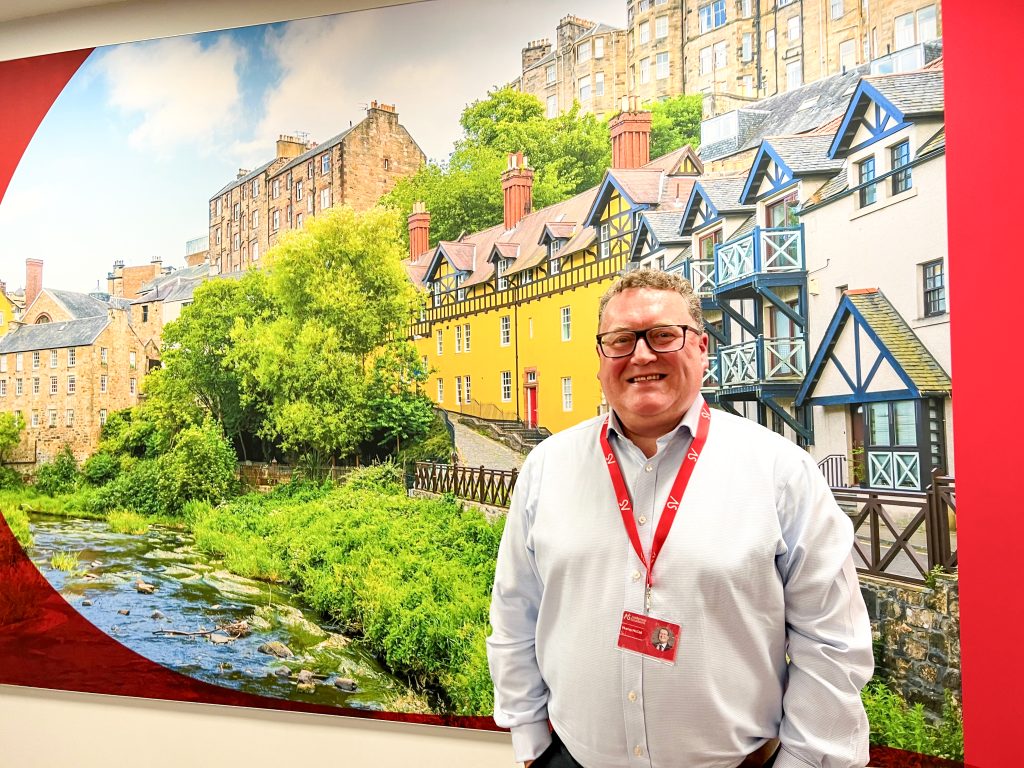
McCall’s arrival as a fully-fledged lawyer came before the reconvening of the Scottish Parliament in 1999 and the creation of the Supreme Court in the UK.
“We went through a lot of turmoil as a profession, and we have emerged with even more laws and regulations.”
But he has been a lifelong student after a host of major workplace changes. “For the whole of my career in employment law, I have been involved in TUPE. Across Scotland, there were lots of redundancies and restructuring going on. There would be bad behaviour going on in organisations. I would normally by instructed by the employer’s lawyers, and occasionally for individuals.”
In 2006, he was approached by Robert Carr, who had just become chair, to join Anderson Strathern with the delicious assignment of building the Glasgow office.
“I liked Robert’s style and vision. The managing partner was Robin Stimpson, and they had a young litigation partner called Andrew Lothian.
“Anderson Strathern was an Edinburgh firm with offices in Currie and Haddington, but they didn’t have a Glasgow presence. The opportunity I was given was to build the business in the West of Scotland.
“The excitement for me was setting up a proper law firm in Glasgow, as part of an established Edinburgh firm.”
Lothian was leading on the Glasgow project and McCall proved to be an excellent side-kick. He started in May 2006 with his first assistant, Chris McDowall. It was a team of three.
Over the next 20 years, McCall grew Anderson Strathern in the west of Scotland.
The latest figures, for the year ending March 2026, show a turnover of £38.7m, an increase of 7 per cent, and profits before tax of £11.4m, an increase of 18 per cent.
“I spent a lot of time in Edinburgh getting to know people and I got a lot of help and advice. Today there is a head count in Glasgow of 120. It’s been a collective effort.
“In the early days it was organic growth, then we started to look at acquiring small law firms, the first was Kerr & Co, with 30 people.
“It was like a reverse take-over in Glasgow but we were part of a much bigger firm. This worked successfully. Then we took over parts of other smaller firms.”
In 2014, Lothian who was by then managing partner, decided to stand down. McCall, then 42, who had built up a strong employment law service, put his name forward and was elected as managing partner. “I was very proud as a lawyer of 42, coming from Kilmarnock, taking on the role at one of the oldest law firms in Scotland,” he recalls.
While he concedes it was a career highlight, the hard yards of leadership had only just begun.
“I’m one of these few people who love both cities, Edinburgh and Glasgow, and both offices. I may have been in two or three other law firms before arriving here, but it is my absolute home. I’m devoted to the firm.
“I get the issues about the cultures being different but we are only 50 minutes on the train. We’ve more in common than separates us.”
In the days before hybrid working, he spent a great deal of time in Edinburgh working with clients and the legal teams.
“My view was I saw my job as a privilege. You are coming into a job, and you want to do well. I remain very, very ambitious. But I wanted to make sure we were a progressive law firm.
Times were achangin’ and he wanted to retain the best of the firm’s heritage and culture, yet gently transform it by making it more commercial, strengthening practice areas where they had been missing opportunities.
The company was strong in private client and rural and landed affairs, but McCall wanted to develop commercial work alongside his employment law.
“In 2014, it was tough because we’d come out of the property recession. It was the year of the referendum on independence and there was a lot of chaos and concern about what was going on. And, you know what, it has never stopped since.” The maelstrom of change goes on, with Brexit, Covid, war in Ukraine, a cost of living crisis, the Trump-Iran war, and now the arrival of AI and advanced machine learning threatens society and even the way legal advice is delivered.
“We are sitting here with tariff issues, and global politics have a more profound influence on us in Scotland more than ever. And we’re at the dawn of the AI revolution.”
How is he dealing with all of this change? “I’m quite good at putting things in perspective. So I look at what we can control and what we can’t. With civic society, there is certainly a lot we can do collectively, if we have the will and the ambition.”
He says he has changed Anderson Strathern by improving technology and IT infrastructure, and by refreshing the public image to reflect a more modern commercial outfit.
Training is paramount, in McCall’s eyes, and the firm takes on ten legal trainees a year, with the aim of trying to keep them in the firm. McCall and the firm’s chair Carole Tomlinson have spent a lot of time on business development, which he admits a lot of lawyers find tiresome.
“We’ve got to try and change that culture. Lawyers can’t just rest on their laurels and sit back, there has to be a pipeline of work,” he says.
When he was trying to get into the business mindset, he joined Vistage, the professional development organisation, that has helped him see the wood through the trees. “It has been tremendously helpful being part of that group, and I’ve learned a great deal about how to drive a business forward. It’s about how to build resilience,” he says.
The issues facing law firms are further consolidation of the market, the arrival of private equity to buy out law firms, and how to recompense partners who want to retire.
“These things are all of interest and you’ve got to know about them and be ready for it. But never forget about your core values as a legal business. You have a lot of things that are within your control collectively that will get you to where you want to be without the need for consolidation or private equity.”
This, for McCall, is about the ability to raise funds, win clients and improve the level of legal skill within the firm. It is about considering the prospects of a bad mergers or taking on PE that ends up destroying culture and credibility in a race for profits.
This then turns to the question of AI, where he says planning for its usage in a safe and secure environment is the best way to proceed.
AI is the single biggest challenge in terms of what the world is facing, not just law firms. It is important that voices are heard on this subject
“AI is the single biggest challenge in terms of what the world is facing, not just law firms. It is important that voices are heard on this subject. I don’t hesitate in saying there needs to be a national debate about AI.
“We’re a heavily regulated sector, and we need to hear more from the regulators. We need to hear more from both the UK and the Scottish Government. But we need a debate.”
This is more than arguments over where or whether hyperscale datacentres are placed in Scotland. This is a larger, more civic, discussion about how the human fits into the process of machine learning. “We need to find out now what AI is doing to the workforce. What is it doing to skills?”
Within Anderson Strathern, like many other legal firms, there are guardrails about experimenting with AI.
“Down the track, there are societal issues that are starting to come to the fore. Civic society needs to be engaged so that the introduction of AI does not cause public harm. We need an open discussion,” he says.
How does a busy managing partner manage to keep up?
“There are lots of podcasts and one I listen to is the author and researcher Dr Stephanie Hare, who spoke at our annual conference and she is one of the leading experts talking about the ethics and the control of AI.”
This all touches on McCall’s background of mooting, working for human rights and dealing with employment regulations. “There are beneficial aspects to regulation. There are good reasons for having strong and effective regulations in place, and health and safety is a good example. So allowing unbridled use of AI, without any kind of control, is not a sensible state going forward.” On the use of AI within the firm, what are the rules?
“We are not using it directly with clients at the moment, except in a few limited cases. If you are going to use this technology with clients, they should know what’s happening. They might want to experiment with it as well. That’s fine.
“For our own purposes, we have approved individuals experimenting with it, using Microsoft Co-Pilot. This is the foundation AI that we are using. Microsoft is a well-known organisation, its products are well-known and it’s a natural starting point. But we’ve put in rules about how it can be used. We’ve an AI accelerator programme that we are running for everyone in the firm.”
There are a welter of rules in place and an internal governance body is testing and experimenting with some specific generative legal AI tools, such as Harvey or Legora AI, which are now available for reviewing and drafting contracts and documents.
With our world still spinning rapidly, Murray McCall is observing the digital changes with keen interest, and trying to keep his historic Scottish firm on track and relevant in this modern age.
FROM KILMARNOCK TO THE TOP
Murray McCall was born in Ayrshire, and attended Kilmarnock Academy, before studying law at University of Glasgow. He took part in the hypothetical law student discussion of ‘mooting’ and enjoyed the intellectual challenge.
As part of his course, he was taken on a trip to the European Court of Human Rights where he worked on civil and human rights case, and he took an early interest in the US Supreme Court. “I enjoyed the mix of politics and jurisprudence,” he says.
He began his indentured career with Glasgow-firm Maxwell Waddell, a four-partner firm, specialising in commercial real estate. He became ‘enthused’ by litigation and in a small firm he was given opportunities working on corporate deals, adoption and family law.
In his first six months, he was asked to look at TUPE, the transfer of undertakings (protection of employment), which was just emerging.
“I had never studied employment law at university. It was a specialist subject and very few did it. TUPE was one of the most difficult concepts in employment law.”
He deciphered it for his four partners and soon became the in-house expert in a field that was about to mushroom.
“I was very happy in a small firm doing a bit of everything. Significantly out of my depth most of the time but willing to read lots, learn and watch people in action.”
He realised that litigation and employment law were the areas of most interest. He qualified as lawyer in 1996.
The firm merged with Tilston Maclaurin, with six partners, to become Maxwell Maclaurin, and McCall worked with partner and specialist employment lawyer Alistair Cockburn.
“He was one of the first experts in Scotland and a great person to work with,” he says.
McCall moved briefly to Wright, Johnston, Mackenzie before moving to MacRoberts [now MFMac], in 2000, where he worked with Raymond Williamson, a leading specialist, Emma Bell and John McMillan, the managing partner who was also from Kilmarnock.
“Raymond was top of his game and Emma was a great mentor. There was a good gang at the time.”
He was poached to work with McGrigor Donald, working with Stuart Neilson and Diane Nicol. McGrigors, then the biggest independent Scottish law firm at this stage, merged with Pinsent Masons in 2012. He worked there for three and half years, out of Glasgow, working with big London companies. He then joined Anderson Strathern.