

Scotland has a fabulous tradition of textiles. Now it has a new generation of innovators and designers
Just off Edinburgh’s bustling Royal Mile there is a small community of artisan shops. There is a bagpipe maker, a leather maker plying the ancient skills of the cordiner, a tattoo artist, and also a showcase for those interested in discovering more about home-grown Scottish textiles.
Kitty Bruce-Gardyne, a textile designer, set up the Scottish Textiles Showcase in the old Tron Kirk in Edinburgh before moving to a cluster of shops in St Mary’s Street to bring the craft and textiles from Scotland’s rural mills right into the heart of the city.
“We wanted to celebrate the wealth of the textile-making industry in Scotland, from the numerous mills scattered across our landscape through to the designers and artisans,” says Bruce-Gardyne
“There is a fabulous tradition of textiles in Scotland, and when visitors arrive and are looking for genuine Scottish garments, they are swamped with cheaper imports from abroad, which have no real resonance with Scotland.”
Bruce-Gardyne felt this was a travesty considering the number of Scottish premium makers who were producing high quality yarn, cloth and woollens.

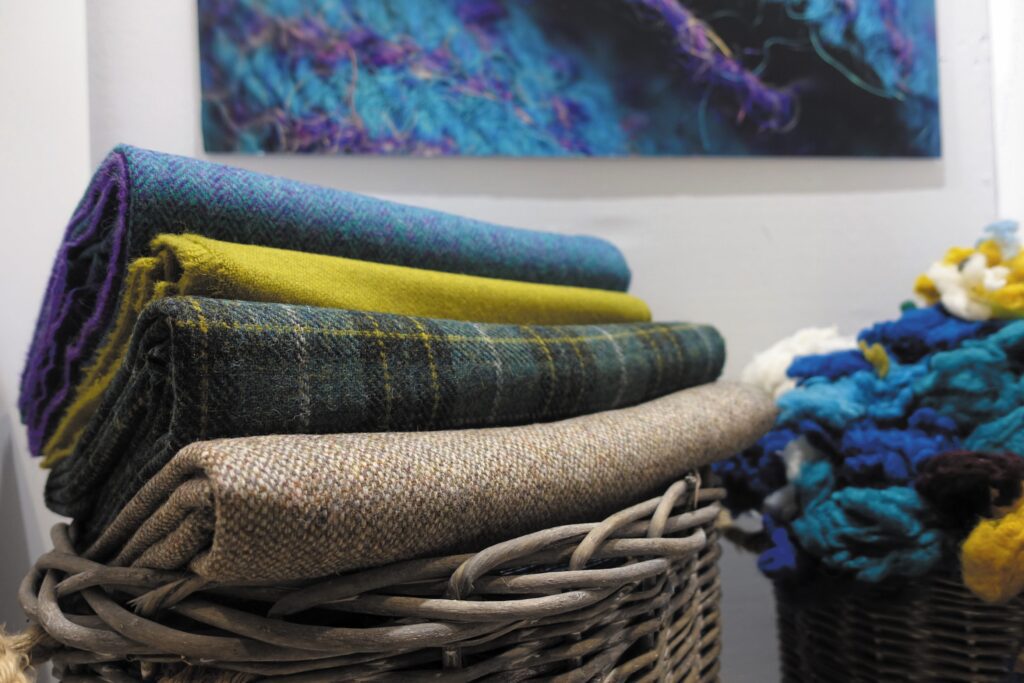
Perhaps the best known are Harris Tweed and the Harris Tweed Authority, alongside Johnstons of Elgin, renowned for its finely-spun cashmere, and Lochcarron of Scotland, a leading manufacturer of our tartan garments.
But there is now a vigorous culture of producers. These include the Birlinn Yarn Company from the Outer Hebrides, Robert Mackie of Scotland, founded in 1845 and based in Stewarton, in Ayrshire, famed for the Glengarry bonnets, and the Shetland Woollen Company, maker of the fisherman’s gansey sweater.
Then there are the designers, such as Rosie Sugden, Hilary Jane Keyes and Di Gilpin, whose handknitting design company is based in Pittenweem in Fife.
The Scottish Textiles Showcase, a commercial business with altruistic ideals, also promotes samples from Andrew Elliot, Anta, and the fine cashmeres of Kinalba, which is based in the Borders, which remains a heartland for textiles.
“More and more Scots understand that our nation has produced premium quality textiles which we can wear with pride, and are increasingly used in our homes with wonderful blankets, cushions and table-wear.
“Scotland would be a much poorer and less colourful place without its tartan, its tweeds and its cashmere. We need to ensure that people appreciate the level of quality and craft that goes into each element,” Bruce-Gardyne says.
Susan Anderson, another designer, and editor of Yarn magazine, believes there is much still to do to encourage Scots to appreciate what is on their doorstep.
“This is not fast fashion. Increasingly our Scottish designers are thinking more about the carbon footprint, using natural dyes to colour the textiles, and using locally sourced wools and yarns that are made in Scotland.
“There is a fabulous array of talent coming out of places such as Heriot-Watt University and and its School of Textiles and Design in Galashiels. We should do as much as we can to support this – and, of course, wear it with pride,” she says.
Another company bucking the fast fashion trend is based in Peterhead where the creation of knitted clothing to combat the chill from the North Sea has given way to the soft comfort and beauty of natural wool garments made by one of Scotland’s best home-grown brands.
Harley of Scotland, which is heading towards 100 years in business, has combined North-east of Scotland tradition with advanced textile technology to produce garments that are both beautiful and wonderful to wear.
The foundation of this family-run business goes back to 1929, the year of the Wall Street crash – perhaps not the best year to launch a business. Peter Harley Buchan, who had gained a postal diploma in woollen design four years previously, set up a factory in Queen Street, Peterhead, in what was a herring fish yard in one of Europe’s largest fishing ports.


The original products were the traditional fisherman’s woollen and worsted socks cherished by local trawlermen and fisher women. The company moved into knitwear, creating their own gansey sweaters.
Eventually Harley Buchan bought mechanical knitting machines, which led to the creation of the Glenugie Knitwear brand.
Peter’s son, Adam Harley Buchan, who studied textile manufacturing in Leicester, took over the company in 1973 and, at a time when the knitwear industry of Scotland was being battered by cheaper imports, he secured the company’s future through the application of innovation.
The North-east firm, with 25 employees, began exporting Glenugie Knitwear to Belgium and France. He and his wife Isabel took the company’s Shetland-style knitwear to Japan, where it was admired as an exclusive garment.
Today the company, under the ‘Harley of Scotland’ moniker, exports to a wide range of nations and regions including Japan, South Korea, the United States and Canada.
The use of textile innovation at Harley of Scotland included the arrival of programmable knitting machines for different sizes and patterns.
While the Buchan-based firm sells its products to online retailers and specialist retailers around the globe under its own brand, it also makes bespoke garments for some of the
finest fashion brand in the world.
Scotland would be a much poorer and less colourful place without its tartan, its tweeds and its cashmere. We need to ensure people appreciate the level of quality and craft that goes into each element
– Kitty Bruce-Gardyne
Today it makes seamless whole garments from the softest lambswool sourced in New Zealand and South Africa, and supplis specially spun yarns in England and at Todd & Duncan in Kinross.
Meanwhile, handwoven textiles mills or ‘micro-mills’ are supporting independent designers and artisans while making a contribution towards carbon-neutral clothing.
Slowing the pace of the ‘warp’ and ‘weft’, the literal threading of the yarn, ultimately produces fewer waste threads. To reduce textile waste, designers and artisans swapped and repurposed studio scraps for Studio Floor, a Creative Scotland project which culminated in an event at The Pyramid at Anderston in Glasow, in 2022 and 2023.
Various events and exhibitions across Scotland are also highlighting how technology can aid sustainability within the craft industry. A return to analogue technology, too, observed at an industry networking event by The Incorporation of Weavers of Glasgow, explored the intersection of textiles and technology.
The theme of tech and textiles goes as far as augmented reality, featured in the Hidden Seams exhibition at Johnstone Textile Space in Renfrewshire, which runs until 19 July.
In collaboration with Fashion Interrupted, it showcases ‘worse for wear’ garments from the archives of Paisley’s Sma’ Shot Cottages.
To consolidate sustainable fashion, it “explores the importance of conservation, mending, and the role of second-hand clothing from the late Victorian and Edwardian period”.