

With the Scottish Parliament election days away, five candidates gathered at the Hoxton in Edinburgh for The Business’s Hustings, which followed an all-women expert panel on The Fine Art of Negotiation.
The session, introduced by The Business Editor Kenny Kemp, brought together the representatives to address Scotland’s economic challenges and opportunities from a business viewpoint. A revealing portrait of competing visions for Scotland’s future — from tax policy and public services to Brexit’s legacy and the role of artificial intelligence – all came out in respectful discussion.
OPENING STATEMENTS

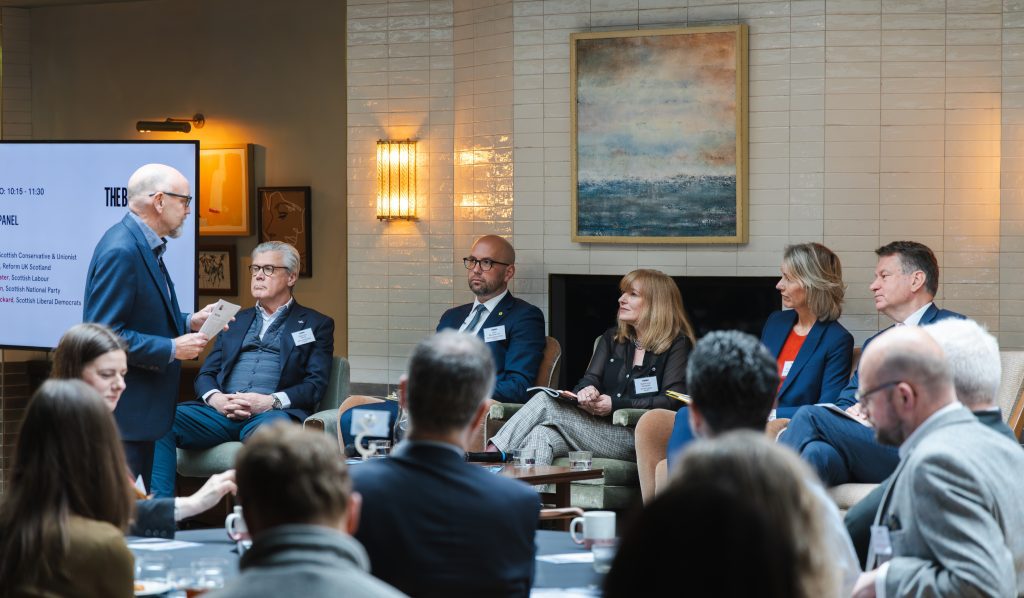
Kenny Kemp opened by explaining each candidate had three to four minutes to make their pitch to the room of business leaders and professionals. The order was selected by the drawing of lots.

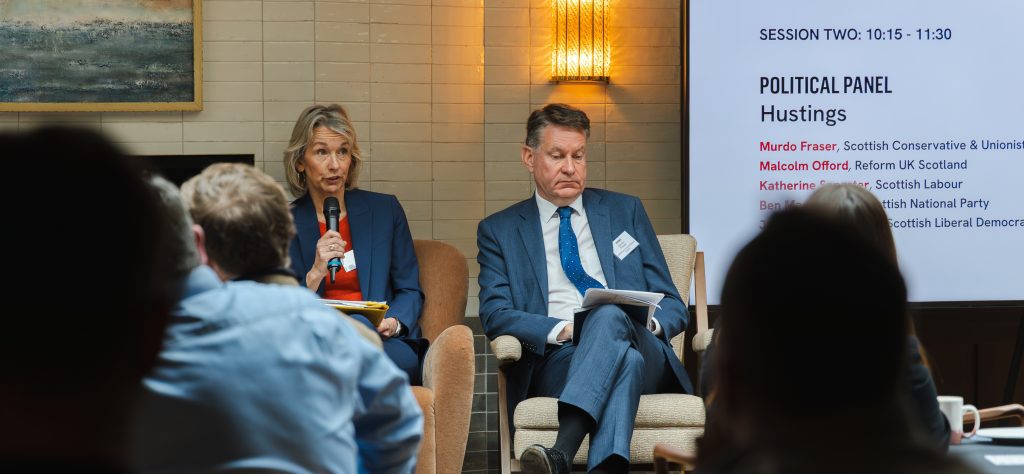
Jane Alliston Pickard of the Liberal Democrats set out her stall with immediate directness.
“As Liberals, we start with people,” she began. “We believe in intrinsic value and we are deeply optimistic about people. Our role and the role of government is to ensure individuals have both the power and freedom to thrive.”
She painted a sobering picture of Scotland’s challenges — an ageing population, a funding gap forecast to reach £5bn by the end of the decade, and 5,000 small businesses closed since 2020. Yet she emphasised Scotland’s strengths: world-class universities, globally recognised food and drink, and a reputation that continues to punch above its weight.
“Our offer to business is clear,” she stated. “Delivering on skills, speeding up planning, and a clear industrial strategy with business at the table.”
She pointed to concrete Lib Dem achievements including increased spending on further education colleges and mental health pathways secured through budget negotiations.
“More Lib Dems mean more voices on committees, willing to negotiate, willing to get Scotland going again.”

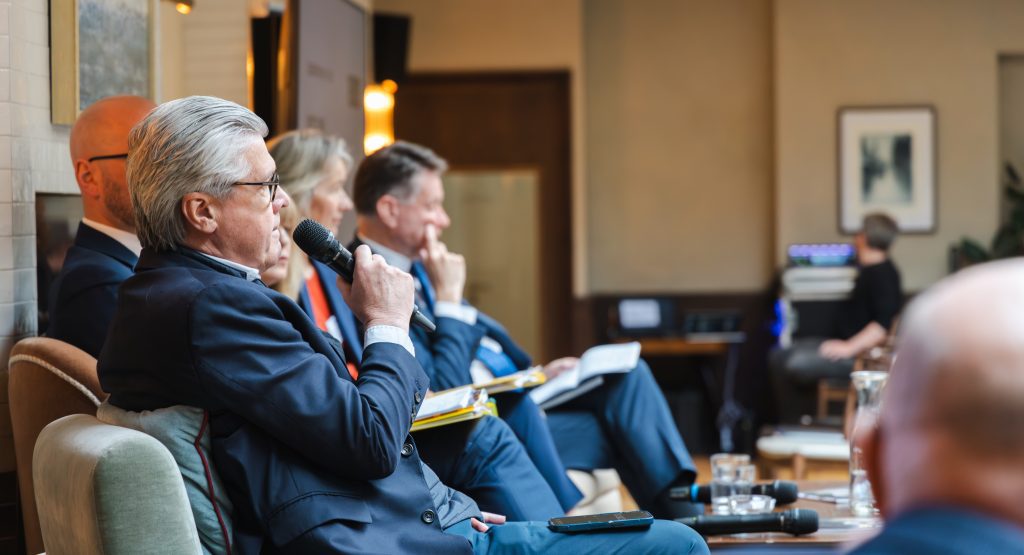
Malcolm Offord, the Scottish leader of Reform UK, took a more combative approach.
“Scotland’s underperforming. We’ve got all the natural resources, people, geography, science, money to be the most successful part of the UK. But we’re not exploiting that because we don’t have politicians who understand how business works.”
He delivered a statistical broadside against the status quo: when Holyrood started 25 years ago, Scottish state spending was 43 per cent of GDP; today it stands at 55 per cent.
“Compared to New Zealand, same size as the country, it’s 42 per cent. For all that extra money being spent, are our schools better? Are our hospitals better? Are our roads better?”
Offord outlined Reform’s tax proposals: aligning Scotland’s six tax bands with England’s three, then cutting by one percentage point below.
“That’s a £2bn investment in people who work. And where do we get it? That’s 3 per cent of the Holyrood budget. If I asked you overnight to cut your costs by 3 per cent without affecting your top line, could you do it?”
A show of hands suggested some business leaders thought they could.

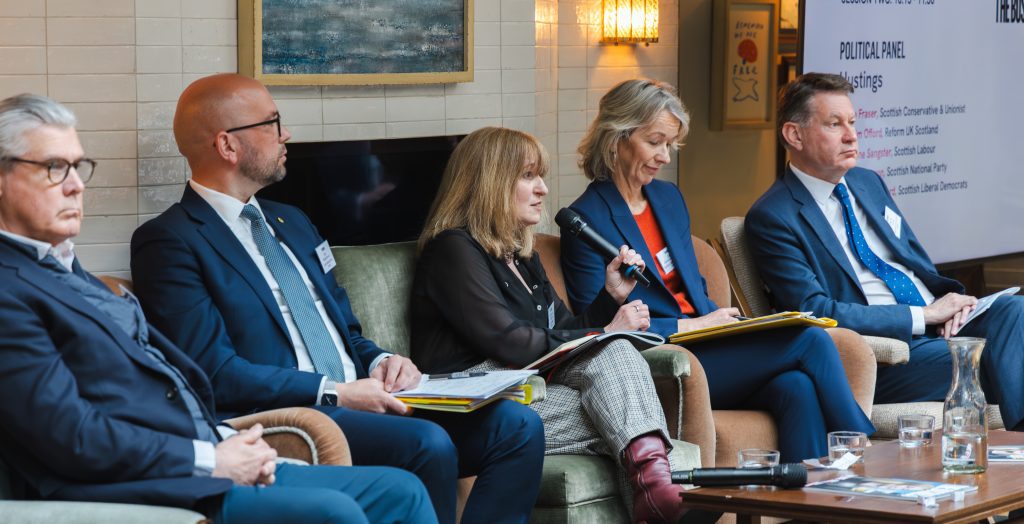
Katherine Sangster, of Scottish Labour, emphasised her party’s historic mission.
“We believe growing the economy is the only way to improve living standards and fight poverty. No Labour government in history has not had that mission.”
She outlined concrete policy commitments: lifting the ban on nuclear energy for energy security and job creation, no tax rises, and a single industrial strategy through a Scottish Board of Trade. Drawing on her canvassing experience, speaking to 6,000 people on the doorsteps, she identified key voter concerns: NHS waiting lists, antisocial behaviour, potholes, and safer schools.
“Scotland’s best days do lie ahead. We have fantastic businesses, great entrepreneurs, fantastic universities. But we need to work together. Everyone on our step is scunnered, and there’s good reason for that.”
She singled out the SNP’s failure to deliver and its obsession and focus on peripheral party political pet projects.

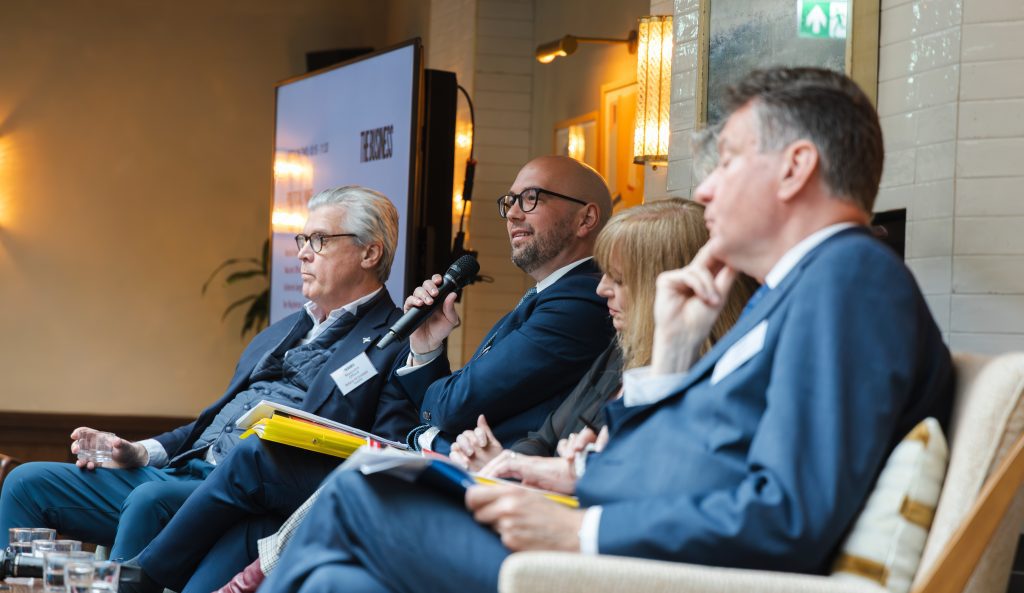
Ben Macpherson, of the SNP, offered a defence of his party’s record while acknowledging the external pressures caused by geo-political issues and turmoil in Westminster. Having served as an MSP for Edinburgh Northern and Leith since 2016, with five ministerial roles, he provided historical context for the SNP’s governance.
“Since I’ve been an MSP, we had the Brexit outcome that has cut UK GDP by 6 to 8 per cent. We had the COVID pandemic. We’ve had the Liz Truss government. We’ve had the Labour government’s hike in employers’ national insurance,”
Through these challenges, he argued, the SNP had sought to be “a government always on Scotland’s side.”
He pointed to achievements: lower unemployment than elsewhere in the UK, highest inward investment outside London, Edinburgh outperforming London economically. Looking forward, he promised an apprenticeship accelerator to reach 150,000 placements, a major projects office for faster planning, and a commitment not to increase income tax bands or rates.

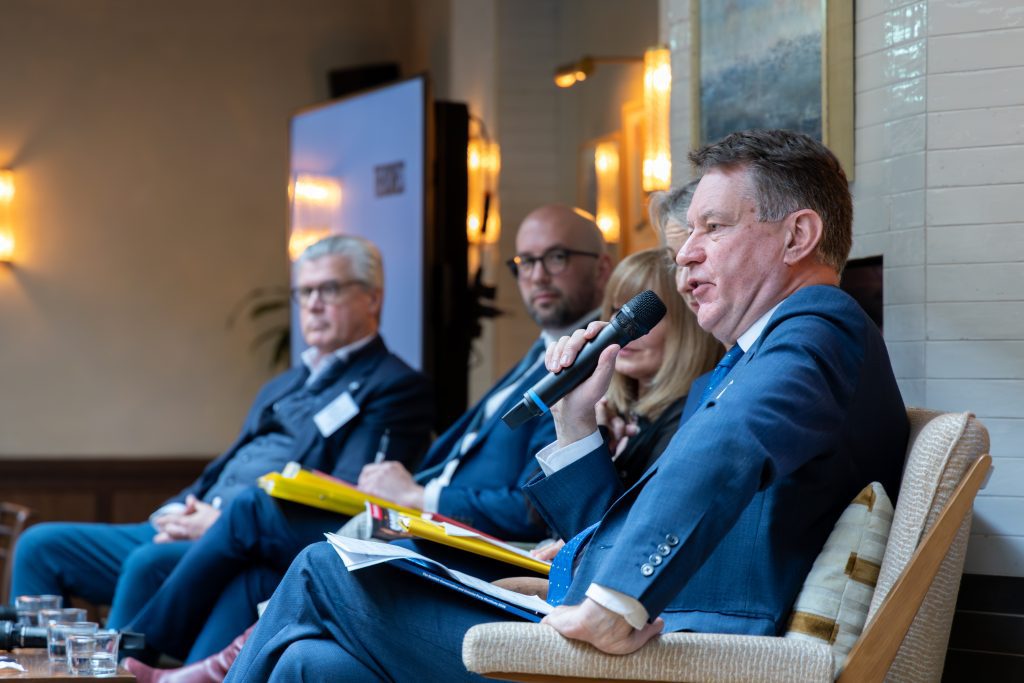
Murdo Fraser of the Scottish Conservatives was polite but pulled no punches.
“After 19 years of the SNP in power, it is time for a fresh start for Scotland, because everything has been getting worse.”
He listed a litany of failures: economic growth at half the UK rate, 800,000 working-age Scots economically inactive, NHS underperformance, Europe’s worst drug deaths, declining educational standards, housing crisis, infrastructure delays, inadequate policing, all while paying higher taxes than the rest of the UK.
“We’d focus on growth. If we get better growth, that creates more secure, well-paid jobs, generates the tax revenues we need.”
His party’s manifesto, Get Scotland Working, proposed tackling business costs, reforming business rates, a demand-led apprenticeship system, and creating Growth Scotland to rationalise the over 100 bodies currently providing business support.
He warned: “John Swinney has said if he wins a majority, he will take that as a mandate for another independence referendum. I can’t think of anything more damaging to Scotland.”
An opening question cut to the heart of Scottish politics: the Scottish Parliament was designed so no party would have an absolute majority, and that politicians would be encouraged to work together. How would each candidate work across party lines?
Murdo Fraser cited a recent example: the Community Wealth Building Bill.
“I was able to put forward amendments requiring public bodies to set targets for spending with local businesses. Initially, the SNP resisted. But I built an alliance – quite unusual for a Conservative – with the Greens, Labour, and Liberal Democrats. We forced it through.”
Jane Alliston Pickard pointed to budget negotiations: “We’ve been at the table, and where it counts, we’ve delivered. Our line in the sand: if the budget depends on our support, nothing is to be spent on independence.”
Katherine Sangster reflected on her transition from business to politics. “In business, you evaluate, reset, think about what’s working. What we’ve seen in Parliament is people don’t seem interested in what works, what will make the country better.”
Ben Macpherson acknowledged the problem of performative conflict. “Unfortunately, aspects of the media, party political machines, and a historic leaning towards combative interaction undermine collaborative work. We need a shift in consciousness – more discussion about solutions rather than amplification of unnecessary conflict.”
Malcolm Offord offered a different perspective as an outsider. “Eighty percent of our 73 candidates have never been professional politicians. We’re here to challenge the cosy consensus. On issues like education and skills, surely we can take the ideology out? Anyone who wants to talk about that, we’ll happily work with.”

THE SHADOW OF BREXIT
When asked about renegotiating European Union terms, the panel revealed deeper divisions.
Malcolm Offord defended his Leave vote on economic grounds.
“When my parents voted to join the Common Market, Europe accounted for one-third of global trade. When we left, it was 20 per cent, heading to 10 per cent by 2050.”
He pointed to trade deals with the Trans-Pacific Partnership and India which he said was “impossible while in the EU”. He argued Brexit hadn’t been properly delivered by politicians who never believed in it.
Jane Alliston Pickard offered a sharp rebuttal.
“In the past decade, our expected GDP has been 6–8 per cent less than it should be. We’re all fighting over a smaller amount of wealth.”
She called for restored relations with Europe and criticised the ‘horrible arrogance’ of Brexit’s underlying attitude.
Ben Macpherson, who had been a government minister in Brussels when the 2014 referendum votes was announced, emphasised Scotland’s democratic deficit.
“Scotland overwhelmingly voted to remain. Against our will, we were taken out. Scotland would be extremely well placed as an independent country to join the EU through an expedited process.”
He said the EU would have Scotland, as good Europeans, back within the EU in a ‘heartbeat’.
Murdo Fraser, who admitted voting to stay in Europe, despite his party’s decision to allow the Euro referendum, urged pragmatism.
“We should respect the result of the referendum: apply that to all referendums. I’d like a warm trading relationship with the EU, but talking about rejoining would just divide the country further.”
On question from the audience addressed technology’s transformative potential.
Ben Macpherson warned of disruption.
“By the end of this parliamentary term, the world will be quite a different place because of artificial intelligence. We don’t fully conceive yet how disruptive it’s going to be.”
He advocated for a scale-up office to support potential unicorn companies and emphasised getting ‘used to using AI as a tool’.
Jane Alliston Pickard called for a dedicated tech minister “at the heart of Scottish Government” to oversee values and coordinate with other governments. “The possibility of looking like an enormous company from your bedroom is now possible with AI. It’s something to be harnessed.”
Katherine Sangster focused on education: “We have to make sure young people have skills AI will never replace: creativity, leadership, managing people.”
She proposed digital skills passports and fact-checking education for all ages.
Murdo Fraser highlighted opportunities in AI data centres while warning about Scotland’s grid latency issues and ‘misguided’ opposition to nuclear power. He also flagged the university funding crisis threatening institutions at the core of technological development.
Malcolm Offord offered a libertarian perspective: “Government should get out of the way. Let business deal with how to deploy AI the right way.”
He redirected focus to ensuring young people enter well-paid technical jobs that won’t be displaced.
Late in the session, an audience member voiced frustration about political trustworthiness, specifying Chancellor Rachel Reeves’ shifting positions on taxation.
Katherine Sangster responded with some candour.
“These forums are slightly artificial. I’ve been campaigning for a year, spoken to hundreds of people. We build trust in face-to-face conversations. We are real people who live in our communities and use the same public services.”
Kenny Kemp concluded by acknowledging the civil debate between the participants.
“You’ve answered questions and spoken politely to each other. Hopefully that sense of camaraderie can continue into the mechanics of the next Parliament.”
For the business leaders in attendance, the challenge remains: translating political promises into the certainty and stability which their business operations require.
As one questioner noted, trust is built not through manifestos but through consistent delivery: something politicians of all stripes will need to demonstrate in the years ahead.
A full report on the Fine Art of Negotiation panel discussion will follow in the next Business magazine in June.