
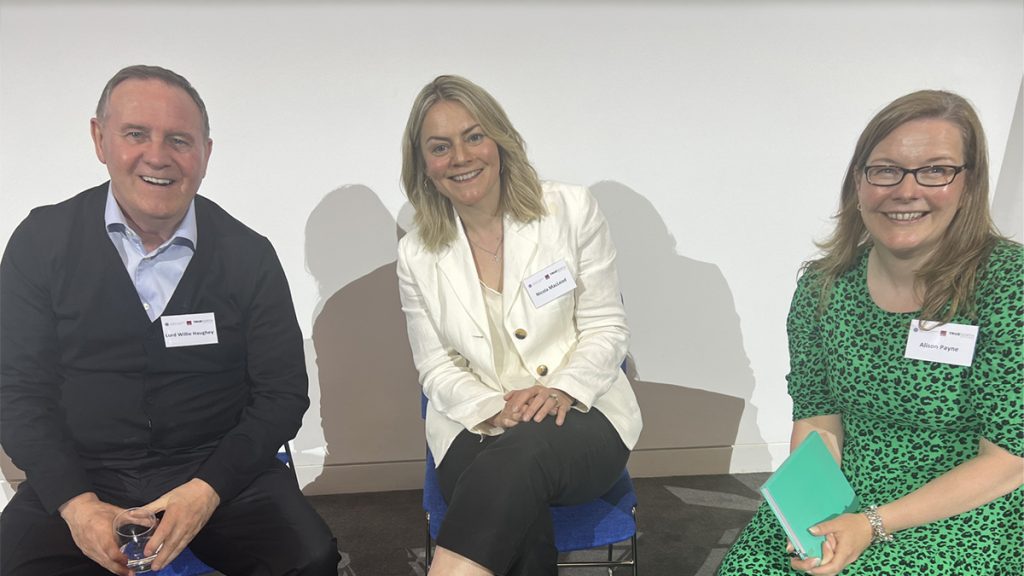
Scotland’s £4.7bn fiscal deficit is so large that if the nation was a business, it would already be in administration. This was the blunt verdict of Lord Willie Haughey, chair of City Facilities Management Holdings, speaking at a post-election panel discussion in University of Edinburgh Business School.
The Glasgow entrepreneur, who has been a life-long Labour Party supporter, was reflecting on the Scottish Parliament results in a panel with Aberdeen-based Nicola MacLeod, general counsel and director of corporate affairs for energy investment platform D2Zero, a renewable energy investment platform representing six companies, and Alison Payne, research director of Enlighten Scotland.
The business session, part of the Elections 2026 – Looking Back and Looking Forward, was chaired by Gavin Jack, the Dean of the Business School, and supported by the Fabian Society and True North Advisors. The other three sessions, chaired by Andrew Liddle, Catriona Stewart, of The Scotsman, and Professor Chris Carter, featured several Labour MSPs, Paul Sweeney and Jenny Young, and Scottish Labour MPs, Melanie Ward and Chris Murray, and David Green, a new Scottish Liberal Democrat MSP, who dissected Labour’s failure to break the SNP stranglehold in the Scottish Parliamentary election, and address the unpopularity of Prime Minister Keir Starmer.
However, Haughey who, with his wife Susan, built his refrigeration services company from four employees to a workforce of more than 14,000 over the past 40 years, fired a warning to the new government of John Swinney, saying the £4.7bn deficit was the central issue facing the new Scottish Government, yet it had been inadequately debated during the election campaign.
John Swinney’s new slimmed-down cabinet has now been sworn-in, but it has spent time debating an independence vote instead of tackling the critical matter of how to pay for vital services such as the National Health Service, education or the justice and care system. While there is widespread criticism of the SNP’s handling of the Peter Murrell case, the long-running scandal failed to damage the party at the election ballot box. Murrell, who was married to First Minister Nicola Sturgeon, admitted guilt in embezzling more than £400,00 of party funds, after the May election vote.
Haughey argues that some politicians were actively making the deficit issue worse by promising additional free services without identifying how to pay for them.
“To have a deficit of £4.7bn in a country this size, if Scotland was a business it would be bankrupt. We would have the administrators in just now. So if that is not the number one priority for the people running the country, then I do not know where we will be.”
He said he was astounded that during the elections the SNP leader John Swinney was uninterested in hearing about the misery caused by the business rates revaluations, which resulted in massive hikes for thousands of businesses.
At a business hustings, Swinney simply shrugged when pressed on the cost of business rates relief, saying that if the money was not taken from one place it would have to be cut from another.
Haughey’s warned that if the current political culture continues with departments competing to offer more benefits without confronting the costs, Scotland could be facing a deficit approaching £8.7bn by the next election.
“There is nothing that is given away free, someone pays for it. I think if that continues, then the next time an election comes round, we will probably be sitting at about £8.7bn of deficit.”
He traced the under-performance of the Scottish economy back more than 25 years to the Labour administration of Jack McConnell and through every government since. He said the growth of the Scottish economy relative to the rest of the UK had consistently lagged, and the deficit was the accumulated consequence of that under-performance combined by a failure to placed enterprise at the centre of an economic strategy.
He cited the NEST programme, a ten-year growth plan developed under Kate Forbes as Deputy First Minister, which Haughey helped to write and launch in Dundee. Within a week of that launch, he recalled, the value of the document had been publicly undermined.
“I watched Nicola Sturgeon a week later standing alongside Patrick Harvie, then leader of the Green Party in Scotland, and Nicola says, this is what we are going to do, this is how we are going to grow the economy. And all the journalists turned to Patrick Harvie and said but you are in partnership with the government and you are anti-growth. And Harvie’s answer was ‘Yes, that is correct. We’re anti-growth probably like most green parties in Europe’. So for me, that was why we wasted more time here.”
The Scottish National Party has 58 seats in the Scottish Parliament, while the pro-independence Greens have 15 seats, which will be vital for John Swinney to push through his agenda. Scottish Labour has a rump of only 17 seats, three of which are constituency seats, while Reform has the same number, all 17 gained through the regional vote system. The Scottish Liberal Democrats have three seats, and the Conservatives have 8 seats, with four constituency MSP representing the southern upland areas of Scotland.
Haughey is clear that the deficit can only be tackled through economic growth driven by enterprise and lower taxation, and not in further rounds of spending reduction. The hollowing out of Scotland’s 32 councils by years of Scottish Government budget cuts has had a massive impact, because it is the councils which deliver the education, social care and infrastructure services, not the Scottish Ministers. The councils are also responsible for the business rates.
He pointed to the existing infrastructure of business support in Scotland, naming Entrepreneurial Spark, Entrepreneurial Exchange and Scale Up, and the personal investment of Sir Tom Hunter in driving business formation, as evidence that the raw material for growth was present. What was missing was political will and a funding route.
“We have a fantastic conveyor belt for startup businesses in Scotland, probably one of the best in Europe. We have a lot of clever people in Scotland. I think we just need to find a route of how we can fund them. If I can set up a business 40 years ago with four people and grow into a business with 14,500 people, then I think there is hope. If we can get hundreds of businesses that can get to employ 100 people, that would be phenomenal.”
With the newly appointed MSP Stephen Flynn, the former Westminster SNP leader, in charge of the economy in the cabinet, it will interesting to see how entrepreneurship is brought to the fore and how the government intends to support it.
The imposition of damaging business rates will be Flynn’s early test on whether the new administration is serious about economic growth, says Haughey.
He offered one specific reason for mild optimism. The campaign to have the business rates revaluation reviewed had eventually produced a result, with the Government moving from apparent indifference to a commitment to an urgent review after sustained pressure from the business community and a meeting between Sir Tom Hunter and the First Minister.
“If the FM does something about that, then there are definitely green shoots, because that is the number one thing that people are talking about, apart from the cost of living crisis … they would not have changed their mind about rates if it was not being kept at the top of the agenda. So if we hadn’t keep that fight going for weeks and weeks and weeks, [on the Go Radio show] it would just have been swept under the carpet.”
Council tax collection mechanism, particularly by Glasgow City Council, added a further layer of complexity that the Scottish Government had been too slow to acknowledge.
When asked whether any Scottish government had genuinely understood and embraced partnership with the business community, Haughey’s answer was unequivocal.
“I have never seen an example of where partnership has worked in all my years. I am talking about the last 26 years. For me, that is the number one thing. Partnership would be at the heart of turning a country round.”
He was delighted that Sir Jim McDonald, the retired Principal of the University of Strathclyde, has been made chair of Scottish Enterprise.
Nicola MacLeod, who works in Aberdeen, addressed the discussion from the perspective of a company operating across the full energy transition spectrum, from conventional oil and gas to renewables, hydrogen, battery storage, carbon capture and fuel cell systems.
D2Zero, the platform she represents, is backed by US private equity and makes investment decisions on 10 to 15 year cycles. Her concern was with the damage that political instability and mixed messaging were doing to investor confidence.
She said energy had become a political football, with oil and gas development being stigmatised on one side and wind farm investors being warned by the UK Reform party that their projects would be shut down if Reform comes to power. Neither position served Scotland’s long-term interests, and both were being noticed by the international investor community.
Her example of Score Energy, the Peterhead-based engineering and manufacturing company employing 3,000 people across 70 global locations and training three hundred apprentices, was used to make a point about skills. The engineers working on offshore oil and gas platforms carried exactly the skill set that would be needed for data centres, hydrogen processing and the wider infrastructure of the energy transition.
Demonising the industry and the North Sea engineers made it harder to recruit and train the next generation, which is need to build the transition to a green economy.
In a stark point which demonstrated the UK’s energy policy, she pointed to Norway’s current drilling activity on the UK-Norway median line, where Norwegian operators were extracting oil and gas from reservoirs that crossed the boundary into UK waters, with no active UK licensing in those areas, and then selling the product back to British consumers.
Scotland was importing energy it could be producing itself, at significant cost to both the economy and, she argued, the climate, given that imported energy carried a carbon footprint several times larger than domestically produced hydrocarbons.
On transparency, she cited Denmark as a country that had been honest with its citizens about the volatility that comes with a renewable energy mix, including price swings that could see the cost of charging an electric car shift from zero to a £100 in a single session depending on weather conditions. Denmark had extended its oil and gas sector as a result of that honest discussion. Scotland had yet to have this conversation.
Alison Payne’s contribution focused on the specific mechanics of Scotland’s fiscal position and on two structural issues: skills and decentralisation that she believed were not being adequately addressed in the political debate.
She noted that in the current financial year Scotland needed to find £1.5bn in savings simply to balance its existing budget, before any discussion of new investment or development. That figure was the baseline. Against that backdrop, the election campaign’s competitive offers of additional free services were, in her assessment, detached from reality.
She welcomed Kenny Gibson’s [the new Presiding Officer of the Parliament] initiative in organising a fiscal literacy day for new MSPs as a recognition that the parliament needed to start from an honest understanding of the numbers.
She said the campaign had been characterised by most parties, including Scottish Labour, committing to maintain taxpayer-funded benefits, with no credible explanation of how those commitments would be funded given a shrinking working age population and a budget that was already out of balance. She was cautiously optimistic about some of the new cabinet appointments, suggesting that there might be more voices willing to advocate for a pro-business, pro-growth approach than had previously been the case, but she was clear that this remained to be demonstrated.
On skills, she argued that the challenge was not simply about apprenticeships and youth employment. Scotland had an ageing population and significant numbers of people falling out of the workforce through caring responsibilities and redundancy. Lifelong learning and reskilling were as important as initial training, and the policy framework for both needed to improve.
Haughey later addressed the specific question of climate targets and the management of the energy transition.
“No one wants to get to net carbon zero more than me. No one, and I am trying it in every single thing I do. To think for one minute that we could wean ourselves off of oil and gas in that short time period and get to 100 per cent clean energy was crazy. What happened was at the COP26 in Glasgow, people came and said we are going to do this by 2030. The politicians came out waving a piece of paper and put the whole burden onto us. Everybody who is building a new house just now has got £30,000 of new cost for a heat pump and solar panels. And they are saying, ‘I am not paying that’.”
He gave the example of his social housing development in Glasgow where he asked future residents about their appetite for electric vehicle charging points and green infrastructure, expecting to find enthusiasm and finding instead widespread reluctance. The political targets had not been matched by the financial support or the infrastructure investment that would have made compliance affordable.
He argued for a 20 year transition period as a realistic alternative to the compressed timelines that had been set. The North Sea, he noted, was expected to require decommissioning activity for another 50 years.
MacLeod pointed to her involvement in the GB Energy business task force in Aberdeen as a sign that some appetite existed for rebuilding public-private partnership structures. Payne noted the possibility that new cabinet appointments might bring a more commercially literate approach to economic policy. Haughey acknowledged that Swinney’s movement on business rates was a concrete, if belated, example of government responding to sustained pressure from the business community. It was also felt that Ivan McKee, the newly-appointed Cabinet Secretary for Public Service Reform, has a ‘poisoned chalice’ in trying to cut back the size of the public sector on Scotland.
Haughey made clear that he would be watching the new administration’s approach to entrepreneurship and growth as his primary measures.
“I want the best for Scotland. I live here. I would be delighted and I would be the first guy to applaud if the SNP government turned things round, if they start to do things in a way that makes us think enterprise is going to be at the heart of how we can grow the economy. But I have not seen signs of that, and I go way back. In the last 26 or 27 years, the growth across the UK has not been growing in Scotland.”
He made one final point saying that Scotland’s should request from the UK Government a ten year period of complete fiscal autonomy, running all of its public finances from Edinburgh, and then going to the electorate with a national referendum. Then it would be a matter of asking the voters: you’ve seen the reality of what we can spend on services, do you want to remain within the structures of the UK, or do you want independence?