

An urban safari wending through the streets of Edinburgh, selected parts of leafy Glasgow, and along Golf Place in St Andrews can provoke the twin emotions of admiration and envy. When you wander around exclusive Scottish postcodes with their prevalence of million pound-plus homes you can spy an interesting phenomenon.
While there are pockets of stillness, regal sycamores in late bloom, afternoon sun glinting on the silver in the sandstone, ripe purple plums in baskets on pavements inviting locals to ‘help themselves’, and iron gates, well-pointed walls and slabbed driveways, there are fleets of white Transit vans and flat-bed trucks parked nearby.
This phenomenon is accompanied by the burr of power tools, hammering, drilling, sawing and matey banter as building work goes on. For purchasing a million pound plus home is seldom the end of the matter: it is the start of another splash of cash on upgrading, improving and regenerating venerable stone-built buildings.
The postcode has become a defining element of life in Britain today. It was invented by the General Post Office purely to sort out mail to each home and business address, but now it defines so much more.
John Boyle, head of research at Rettie, the leading Scottish property firm, has been charting million pound home sales in Scottish postcodes for more than a decade. The Business’ chart on the opposite page shows the growing number of Scottish postcodes and the changing league table since 2019.
Edinburgh is the economic driver with a shortage of high-end homes pushing up demand
“There were over 500 £1m sales per annum in 2022-24 but, for the first half of 2025, fewer than 200 have registered, so the market is running behind a little,” says Boyle. “This may recover in the second half of the year but the top end market has been affected by market uncertainty and economic headwinds just like the general sales market. The size of the tax bill on these purchases, a minimum of £78,350, is also a factor.”
The first Scottish million-pound home was in Cramond in the 1970s in Gamekeeper’s Road (EH4). Even the Georgian townhouses in central Edinburgh’s New Town (EH3) were short of this bracket in the 1970s through to the early 1990s.
Edinburgh is the economic driver with a shortage of high-end homes pushing up demand. Since 2015, the average UK increase in a house value has been 25 per cent. In the Capital, growth in value in this same period has been 50 to 55 per cent.
Homes that were selling for £660,000 in 2014 are valued at over a million based on 51 per cent growth.
This has created significant underlying wealth for Edinburgh homeowners in the last decade. And anyone buying a £500,000 home in the Capital, if present trends of between 4-6 per cent per annum continue, will have a home in a millionaire postcode between 2037, 12 years from now, or by 2043.
Of course, this is only realised when a home is bought or sold, but it often allows owners to remortgage to spend money on home improvements – which in turn brings the Transit vans and skips to the postcodes.
“The market remains focused on Edinburgh and hinterland areas such as East Lothian. Comparing the figures for the year H2 2024 to H1 2025 with 2019, there are no ‘up and coming’ areas as such, just more areas with some £1m+ sales but no real clustering.”

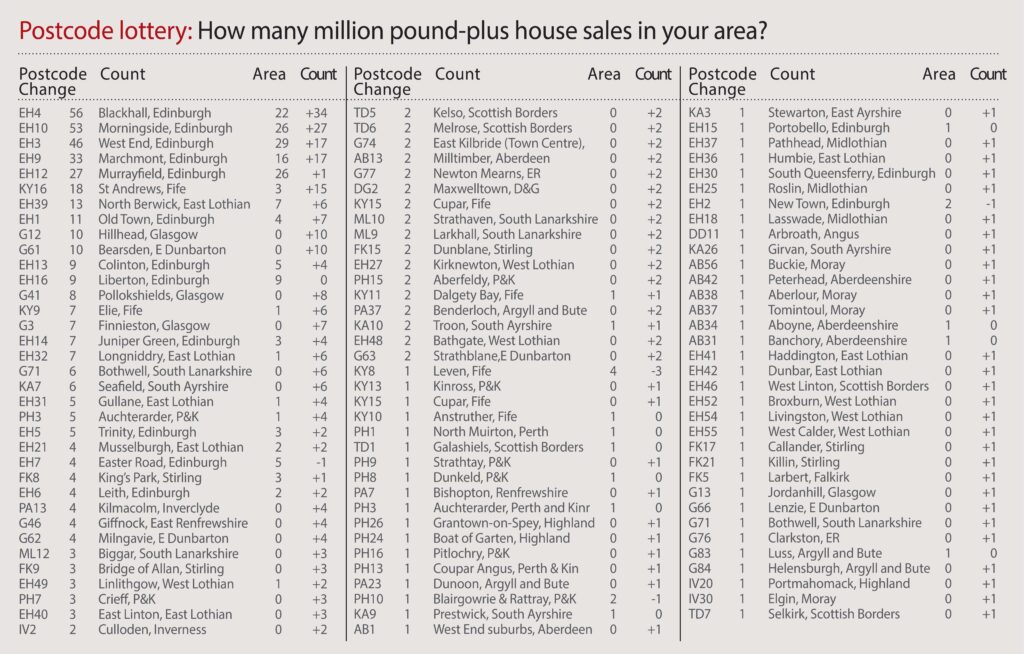
One factor has been the demise of the million-pound sales in Aberdeenshire, as the energy sector goes through its bumpy transition from oil and gas to renewables.
“I think you probably could say that the West End of Glasgow (G12), Bearsden (G61) and St Andrews (KY16) are now much more prominent areas for such sales in the last five years,” says Boyle.
The Rettie economist says the Southside of Glasgow, such as G41 (including Pollokshields and Shawlands) and G46 (including Giffnock) now also have a small number of £1m+ sales each year, whereas these areas were not registering in the table in 2019.
While each million pound home will offer something unique, there are common denominators: period features, entrance lobby, Victorian tile flooring, cornices and central rose plasterwork, wood panelling and sweeping staircases up to large drawing rooms and master bedrooms with balcony windows.
The estate agents talk about ‘well-proportioned’, but it means ceilings where you can stretch up your arms and there’s still three more feet to the ceiling. Then there’s the garden, which doesn’t have to be massive in the million-plus postcode, but enough to build a new architect-designed extended living space with folding doors leading down into a seating area and a decent square of lawn and mature trees for the de rigueur children’s tree-house. If you’ve room for a new pod gym at the bottom of the garden path, that’s another bonus.
Of course, there are houses all across Scotland that fit this bill and are substantially less than a million pounds. But the difference is location, location, location.
Boyle says: “The £1m+ market in Scotland is very small – only around 0.5 per cent of sales – but the £2m+ market is tiny: 0.04 per cent of sales. There were around 40 sales per annum in 2022-24 but numbers are running below this in 2025 to date (just 10 sales registered).”
New build sales were accounting for 20 per cent of the market in the pre-pandemic years but this has dropped back since to 15 per cent on average and only 10 per cent so far this year. New build has been harder hit generally across the housing market in Scotland as it was impacted by demand-side drivers such as higher mortgage rates and the cost-of-living crisis and supply side factors such as cost of finance and cost of construction.