
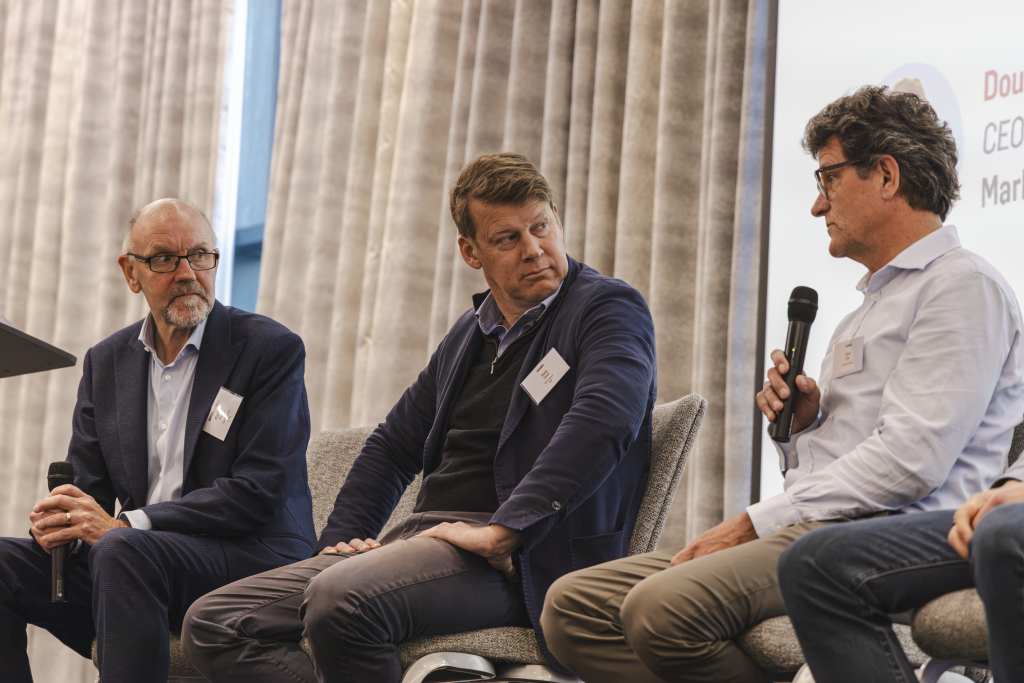
In central Edinburgh, looking out towards the Usher Hall and the Castle, a satellite communication technology is prepared and ready for take-off.
David Wither, the chief executive of Sofant Technologies, a company spun-out from the University of Edinburgh in 2013, says it has been a long and challenging journey to the launchpad.
But the stars look to be in alignment for his company’s technological development with the increasing demand for lighter telecommunications across a range of industries. This gives Sofant an amazing window of opportunity.
However, the most frightening aspect is that companies, such as Sofant, are still into the middle of what is termed ‘the valley of death’: where a start-up with massive potential has gone from proof of concept all the way along the pathway to first commercial revenues and profits.
“Our core technology is based on a semi-conductor process which is a micro-electro mechanical system. When you speak over a microphone, you are using such a system.
“The process has some unique capabilities for our specific niche which we are now focus on,” he explained at The Business Dealmakers’ Breakfast in Edinburgh.
Sofant is developing a phased-array antennae, which will be capable of operating within 6G bandwidths and beyond.
“If you are familiar with Starlink, which is very topical in the news for its share valuation, then the type of antenna system on the ground it uses to communicate with satellites is essentially what Sofant is developing.”
Elon Musk recognised that a lower-earth satellite system with a network of hundreds of high-bandwidth, low latency communications closer to the ground would be able to cover the globe more effectively.
This led him to develop the launch capability for commercial rockets which SpaceX now dominates. Here the important ratios are size, weight and power. Sofant Technologies products are substantial smaller and lighter than existing radio antennae.
“We are 15 times better than our closest competitor. That’s a pretty big deal in our industry. So we are seeing a lot of pull for the technology, especially in the commercial aerospace industry.”
We are now seeing revenues on the horizon and customer contracts and demand
He says that Europe is now investing heavily in sovereign communications technology.
“A few weeks ago we saw a $300m deal done by a company called Open Cosmos, which is developing K-Band satellites in the UK. Our technology fits perfectly with their needs. If we go out to Europe, it is developing a satellite-communication system called IRIS². This is a perfect fit for one of our technologies.”
American-born Wither, who began his professional career in the wireless communication business, has been CEO for ten years.
He says the Sofant journey to develop new technology has been brutal. He knows because he has already spent over 20 years in the wireless industry, having built a successful company from scratch to major sale. He wants Sofant to become another major success but based in Edinburgh.
“You can only imagine the journey our investors have been on. This ‘are-we-going-to-make-it’ journey, is something all early-stage businesses go through.
“What has enabled us to sustain ourselves through this is consistent support from Scottish Enterprise. They have been really brilliant. Kelvin Capital in Glasgow have been great too.”
He applauds the EIS (Enterprise Investment Scheme) investors who have continued to support the Sofant project.
“We are now at a stage where we are looking for institutional capital. We are now seeing revenues on the horizon and customer contracts and demand because of the geopolitical situation right now.”
While Wither is optimistic and sees light at the end of the tunnel, he is cautious.
“It ain’t over, until you are there. We still have lot of work to do, and I spend an overwhelmingly amount of my time looking for capital. It’s not easy.
“It is hard to fund the gap in the so-called valley of death, especially a company in the sphere of semi-conductors where you have to literally spend millions of pounds just to build the supply chain to deliver products.
“But if you want to stay afloat, you’ve got to keep getting out and trying to convince investors, that you are determined to deliver.”
This article is featured in the Winter 2026 Edition of The Business magazine published with The Sunday Times Scotland.
Continue reading coverage of the event here. [link to p.42]