
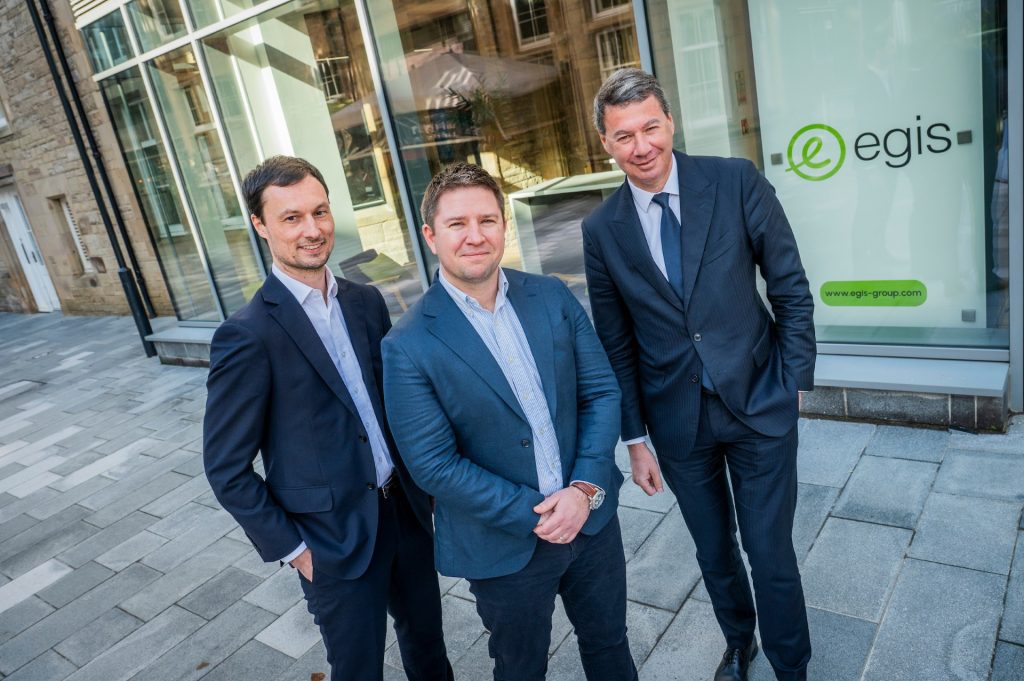
Laurent Germain, the CEO of Egis, the global engineering company based in Paris with a footprint in Canada, United States, Saudi Arabia and the UAE, has been on a major spree of buying complementary companies.
The €3bn annual turnover global architectural, construction and engineering group has just rebranded its offices in Lister Square, Quartermile, in Scotland, after its takeover last year of Thomas & Adamson, the venerable consultant quantity surveyors. So Egis, which also owns 10Design in Edinburgh, has a connection to many prestige projects across Scotland such as the refurbishment of the Royal Commonwealth Pool, the Assembly Rooms, and the building of Virgin Hotels and several whisky distilleries.
It was suggested that Germain might be able to introduce his [relatively unknown in Scotland] company to his Murrayfield hosts, by saying his company was also responsible for project work on the Oriam, the Heriot-Watt University facility where the Scottish rugby team have their training headquarters.
Speaking exclusively to The Business, he said: “Since July 2020, when I became CEO, we have made 47 acquisitions. We are focusing these acquisitions in the areas where we want to deepen our platforms of growth.”
Egis, a leader in the French domestic market, has several regions where it has been increasing its presence, including Canada and the United States, and has a major platform in the Middle East. In all, the firm has 22,000 employees in over 70 countries, working on around 10,000 international projects.
“We have grown significantly in the Middle East with five acquisitions. And we are now in the top three engineering company in Saudi Arabia, and top five in the UAE,” said Germain, who was accompanied by the UK managing director Francois Basselot.
Germain expressed his admiration at the massive infrastructure investment and engineering projects in the desert Kingdom, and he is the co-chairman of the France-Saudi Arabia Council.
A FOCUS ON EUROPEAN OPERATIONS
“The third platform for growth is Europe, including France, UK and Ireland. We have undertaken several acquisitions in the UK and Ireland because we saw – and we still believe deeply – that this market is growing in many sectors.”
He says it is in Egis’s DNA to have a presence in the geographical places where it operates which is why the firm decided on the acquisition of Thomas & Adamson, the quantity surveyors, set up in 1935.
“We decided to increase our footprint in the UK and Ireland with offices throughout the regions, which led us to look in Scotland including Edinburgh and Glasgow,” he said.
The company now has 150 staff in Scotland, including its work as the control centre for Transport Scotland.
“It is important for our clients to be able to come to the office and interact with the people who will deliver the jobs. Yes, it has a cost for the company to have so many offices, but it has a lot of advantages.”
While Egis is already in the built-environment and transport sector, it is increasingly focused on energy transmission and distribution in Scotland because, says Germain, globally around 40 to 50 per cent more electricity has to be produced and redistributed to meet net zero targets.
“The amount of investment from every country to achieve that is enormous, this is the case in France and in the UK. We have acquired Omnia Projects in the UK who are dedicated to the transmission and distribution space, primarily in England at this stage.”
“We will be using Omnia to support our investment in Scotland as well,” added Francois Basselot.
ENERGY, INCLUDING NUCLEAR, AND WATER
“We also see water and future water needs as a key sector of growth. We have expertise elsewhere in the UK and Ireland and we want to leverage this with Scottish Water.”
Egis’ international contracts are impressive and complex including designing the iconic aqueduct of the Seine-Nord Canal, linking two major river basins, and working with the European Space Agency on Higher Aerospace Operations.
Egis sees an opportunity to increase investment by Scottish Water.
“It’s timely to invest in water in Scotland. We want to complement the energy sector with the water sector.”
Where does he see the opportunity and could it include building a connection between the water-rich north of Scotland, to the drought-prone south of England?
Francois Basselot smiles at such an idea, suggesting that this kind of major thinking is also a part of Egis’s DNA.
“If you look across England, Wales and Scotland, the big themes are around how do you share more resources, and we are seeing water transfer as part of this. Clearly it is down to the regulator and the water companies to discuss that, but already we can see this trend in England between water companies. That’s something we should welcome and look at,” he said.
The company is also involved in the British nuclear industry at both Sizewell and Hinkley Point C, the UK’s first third generation nuclear power plant. So how does Germain feel about the Scottish Government continuing to resist nuclear power upgrades and developments?
“In France for decades we had a lot of controversy, it was either you were pro-nuclear or pro-renewables. FTE, an independent company, produced a report which showed that if we wanted to reach the net zero targets, then 100 per cent renewables would not do, and 100 per cent nuclear either would not work. The best scenario would be to have a mix of both.”
President Macron made the announcement which “solved the controversy” ordering the construction of six new nuclear plants in France.
“We need to leave the political debate and look at the proper facts and the best way, the experts say, for the different sources of energy, so we reach carbon neutrality by 2045. Nuclear power is carbon friendly, so for me that is the right mix of technology.”
The French CEO is also looking at the skills gap and is urging the Scottish Government to keep investing in producing young graduates with engineering skills.
ON THE LOOKOUT FOR RECRUITS
“We need to recruit. We have an apprenticeship programme here in Scotland. This is attractive for young graduates to join because they can get an internal diploma and gain the practical experience in the engineering business. The capacity to be trained internally and become professionally recognised is attractive for Scottish students wanting to join Egis,” he said.
Egis has a strong reputation in retaining its best staff, and there is a share scheme with 21 per cent stake in the company owned by the employees and managers.
“This is a big strength of our company,” he said.
Germain himself is not an engineer but was a top French civil servant working in the department of economy, and became chief financial officer of the national space agency, before moving into the private sector. He joined Egis as CEO in 2000, and grown the business substantially in the last five years.
“Once you grow and reach a certain size the contractors want to work with you. Your competitors want to work with you on some big bids because nobody alone can deliver these complex engineering work, and so partnerships are built. The more resources you can provide, the more attractive you become,” he says.