
As the Edinburgh Tram network continues to be disrupted in the aftermath of the fire in Princes Street, there are questions over how fixed rail public transport can overcome incidents that are beyond its control. The traffic chaos in the Capital, mobbed with visitors at the start of the festival session, verges on a national embarrassment.
But Scotland’s investment-starved railway in the Highlands and the Far North is reaching a far more critical point where it needs substantial investment and a proper long-term commitment for its electrification of the tracks from Inverness to Wick and Thurso. It is hard to see where such infrastructure funding might come from given the precarious state of the nation’s purse.
Switzerland made the sensible decision to electrify its entire world-class railway system by 1960. This has encouraged rail tourism opening up massive economic benefits in rural settlements across the Alps. Such a bonanza could be achieved in Caithness and Sutherland if the rail network received massive improvement, upgrade and then international marketing as a unique attraction.
It is time policymakers took a proper long-term look north at the railway, investing in a sustainable future scheme to get rid of polluting diesel railway trains.
It is shocking that it is quicker to get from Edinburgh to Paris by train than from Edinburgh to Wick. The train time between Edinburgh and Perth is the same time as it was in 1895, and the average speed of a Far North train is just 37 miles per hour.
Back in 2016, a Far North Line Review Group was set up by the Scottish Government to co-ordinate activities and look at opportunities to improve performance on the route from Inverness to Wick and Thurso. Then Cabinet Secretary Fergus Ewing Ewing said the Scottish Government was determined to improve overall performance on the longest rural railway line.
“It is essential we make the most of this important asset for passengers, for sustainable freight transport, and for the communities and businesses along the whole route,” he said at the time.
He asked the Director of Rail at Transport Scotland to lead a review to identify timetable improvements and works, such as the level crossings at Lairg, Brora and Rovie, and look at infrastructure options for up to 2024. Not a lot has changed apart from some cosmetic improvements to stations, yet the greenhouse gases from transport continues to rise, with road traffic north during the summer nose to tail with NE500 campervans and tourers.
Transport accounted for 33.2 per cent of Scotland’s total greenhouse gas emissions in 2023, one percent more than in 2019 and in 2022 (both 32.2 per cent), while the number of motor vehicles registered in Scotland (3.2 million) is at an all-time high. Motor traffic also rose in 2024. The distance driven by motor vehicles on Scotland’s roads increased by 2 per cent to 49.3bn vehicle kilometres in 2024. This is slightly above the 2019 figure of 48.7bn vehicle kilometres.
Of course, it virtually impossible to live in the Highlands of Scotland and rely on public transport, a private motor car remains essential, rather than a luxury. But moving more people and freight by rail will help free room on the busy A9.
There were 84.7 million passenger journeys on ScotRail services in 2024/25, an increase of 4 per cent compared with 2023/24, but 12 per cent lower than the 96 million passenger journeys in 2019/20. By comparison, passenger footfall using the Far North Line totalled 406,016 in 2015, dropping to 397,688 in 2019/2020, dipping to 241,124 during the covid year of 2021, and has only returned to 332,766 in 2023/24. With only 64,000 passengers making the trip to Thurso and Wick. The line’s sustainability and future depends on more people stepping onto the trains at the 25 rural stations. Free bus passes for the elderly and those of school years has also made rail less popular as an option.
A DELIVERY PLAN FOR ELECTRIFICATION
Early this year Transport Scotland published its fifth delivery plan with a commitment to £1.2bn in renewing the rail fleet in Scotland, and investing £519m to deliver electrification in Fife and the Borders. Transport Scotland in the Central Belt has done a remarkable job since 2005 by increasing the electrification of the rail network to meet net zero targets. Scotland had benefited from this. Yet the rush to rid the networks of diesel traction trains by 2045 has led to the abandonment of full Intercity electrification in Scotland, including to Inverness, and the advent of something called Discontinuous Electrification (DE). It looks like a good solution because it does not require the full installation of expensive overhead line equipment. Instead, there are long intervals between overhead lines where the trains switch to on-board battery stored electricity.
But railway insiders says DE stand for ‘Disingenuous Electrification’, because it is only a partial solution and hides the true costs, and has no practical use on mainlines or for freight, because battery-electric locomotives do not have suitable range or speed. Experts says that full electrification is cheaper in all cases. Yet it appears that Transport Scotland advocates DE for its northern routes.
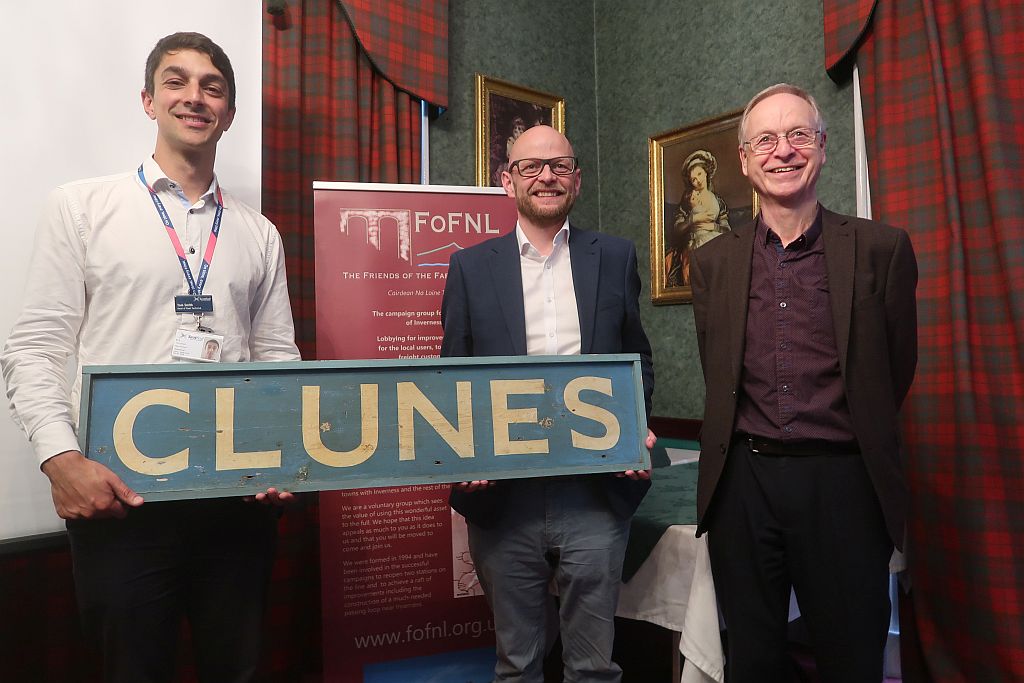
“There seems to be two reasons for this – firstly the Scottish Government has very limited borrowing powers for capital investment, thanks to the devolution settlement, and secondly its own policy of Net Zero prevents extending the use of diesel power beyond 2045, even although rail’s contribution to harmful emissions is microscopic [around one per cent in Scotland]. The trouble with DE is that it is not easy to justify conversion to full electrification once it is in place and the trains have been built,” says Ian Budd, convener of the Friends of the Far North Line, set up in 1994 by Frank Roach, partnership manager at HITRANS.
Ian Walmsley, a veteran columnist in Modern Railways magazine says DE is a matter of stealing from the next generation. “Time to stop pretending that discontinuous electrification is a clever innovation when it is actually a milestone around the neck of the next generation,” he says.
Transport Scotland’s recent document, Rail Recharged, says: “Where there is no freight market, or as a transitional on InterCity routes, the operation of battery-electric trains can deliver the same carbon [Co2] benefits as a fully electric train while significantly reducing the capital investment required in the short to medium term.”
On the Far North line, freight has dwindled away. Nuclear flasks from Thurso are still sent by rail for reprocessing, while a proposed timber loading facility at Altnabreac for a new terminal at Dalcross would be good news.
Ian Budd says: “Is it too much to hope that common sense will be allowed to prevail in Scotland? We need the Highland Main Line to be fully electrified soon, and for diesel traction to be permitted until full electricification is done. Some say that you can never electrify the scenic routes in Scotland, but given Switzerland’s topography this seems unlikely to be true.”
LOOPS ARE NEEDED TO IMPROVE TIMETABLE
But there are other pressing issues. From Perth to Wick there are 279 miles of track, 243 miles of this is single track, and 36 miles of double track. Only 20 passing loops remain. The average distance between loops is 13 miles. The priority for the North Line is to have a passing loop built between Inverness and Muir of Ord, on the busiest section of the Far North railway which is shares with the Kyle of Lochalsh line.
Southbound trains can arrive in Inverness an hour late, having arrived at Muir of Ord a few minutes behind schedule and held for two northbound departures to pass, before proceeding to Inverness. The lack of passing loops is the result of British Rail ‘rationalisation’ to save money between the 1960s and the 1980s when it was thought that railways were in terminal decline.
The Far North Line needs at least two new passing loops, just to make the current timetable more reliable. It is understood that the cost of a loop would be around £20m.
The freight requirement for the construction of the Spittal-Beauly overhead power line will need more than that for the line to cope. This is something which the Scottish Government seems slow to understand.
The long-term fragility of the line is only too clear. In June, ScotRail’s Caithness Transport Forum update stated that the class 158 units, which serve the Far North Line, and are now over 35 years old and based in Inverness, are a part of a much-needed rolling stock maintenance programme. Network Rail has been carrying out major engineering work worth £6m on the Far North Line during the summer to help improve journeys. Upgrades took place at several locations including between Evanton (near Alness), Tain, and Lairg, and on sections north of Tain towards Wick and Thurso. Engineers renewed more than 4 km of track, carried out repairs to a railway bridge, improved drainage, and maintained the level crossing at Rogart.
To complete these operations safely, trains between Dingwall and Wick were halted from the 7 June to 29 June. The replacement buses were used during this summer peak of travel. Those who use this vital public service for the North are being short-changed. While the tram in Edinburgh has shown the future of rapid urban transport, and the success of the re-opening Borders railway has brought massive economic benefit, the Far North is reaching a critical point where it requires seriously levels of funding – or else it will simply be allowed to wither away to more delay and possible closure. That would be travesty for all of Scotland.