
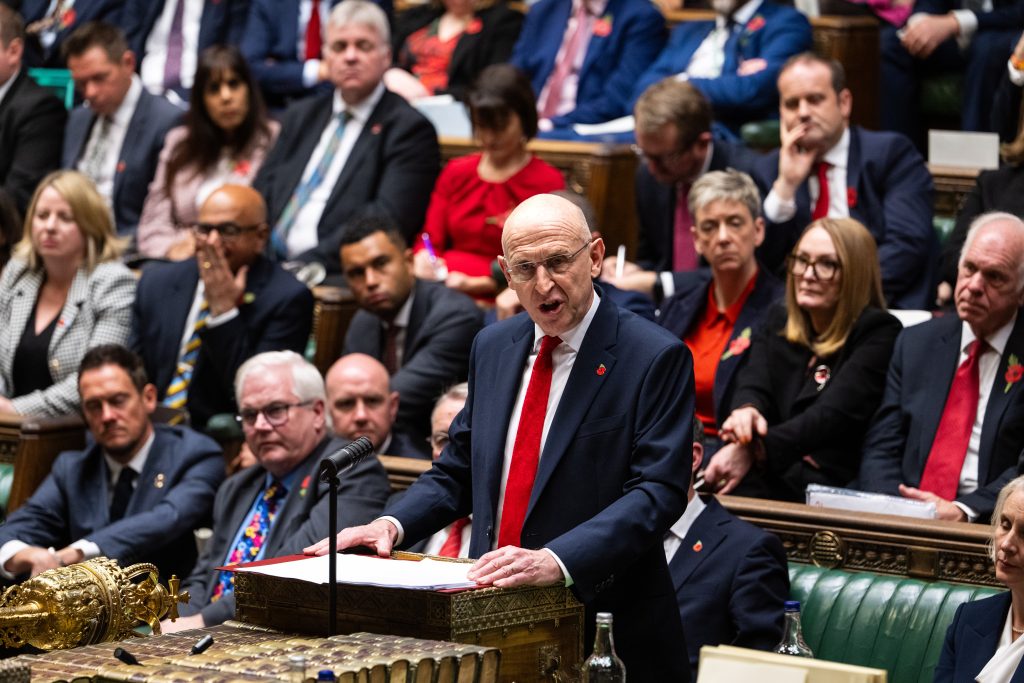
The Chancellor of Exchequer John Healey in his first Budget fired off a list of economic tinkering as he stated that the UK government’s priority “is first and foremost cheaper energy”.
Whether the tokenism of £100 in the bank accounts of householders in Band A to D homes towards domestic electricity bills will make any real impact, remains to be seen with UK energy bills expected to rise by around £300. It will be up to the Scottish Government to hand out the £100 to Scottish home owners who qualify.
While the introduction of a number of minor fiscal changes have been welcomed by entrepreneurs and business scale-ups, a wider view is that the Chancellor, in repeating his ‘breathing space’ mantra, has missed the opportunity to tackle the UK’s increasing levels of debts – especially in the rising bill for social care.
He made a series of tax ‘tweaks’ which will amount to increases for savers and property owners.
CUT TO BUSINESS ASSET DISPOSAL RELIEF
Ritchie Whyte, partner and head of corporate and business advisory, at Aberdein Considine, said: “There are two stand-out changes in this Budget for business owners, and they pull in different directions.
“The first is a cut to Business Asset Disposal Relief (BADR). From 6 April 2027, the lifetime limit on gains qualifying for the reduced rate falls from £1 million to £500,000. For someone selling a business with a gain of £1million or more, that means £30,000 in additional tax. It continues a long squeeze on the relief, which not so long ago applied to £10million of gains.
“The second is the new Founders’ Relief, which on the face of it is very positive. It is targeted at founders and early investors who have made a long-term, high-value contribution, and it marks a clear change of tack: rather than broad relief for all business owners, the government is focusing support on the key risk takers who are in it for the long haul, creating jobs and economic activity. The aim is plainly to keep wealth creators in the UK. As always, the devil is in the detail, and the qualifying conditions will determine how many founders actually benefit.
“There is also welcome support for female founders, with the British Business Bank doubling its funding for female-led businesses to £200m. Women still face a much tougher route to investment than their male counterparts, so this is a positive step towards ensuring the next generation of wealth creators is drawn from a wider pool of talent.
“Equally welcome is what the Budget did not do. After years of speculation about aligning Capital Gains Tax with income tax rates, the main rates are unchanged. Many business owners had been rushing to act in anticipation of a rise, so this is a positive message. But they should not be lulled into a false sense of security. This is the moment to take stock of their position, get their house in order and plan ahead, particularly with the changes to BADR coming in April 2027.”
David Ovens, joint managing director at Archangels, said: “This is a nuanced Budget for entrepreneurs. Halving Business Asset Disposal Relief to £500,000 is disappointing, but the new founder allowance, offering a 10 per cent CGT rate on gains up to £10m, is a positive step that rewards the people who take the biggest risks. More funding for the British Business Bank and new support for young and female founders also help widen the pipeline of ambitious companies.
MORE FUNDING FOR FEMALE ENTREPRENEURS
“After more than 30 years backing Scottish tech and life sciences businesses, we know that founders need patient support over multiple rounds in order to succeed. The measures are, on balance, positive and the real test will be whether government builds on them to give founders and investors across the UK the long-term confidence to start, scale and stay.”
Gail Boag, ICAS CEO, said: “The real test of this Budget is what comes next. Targeted measures to ease energy bills, freeze business rates and encourage investment may provide much-needed relief to households and small businesses, but short-term measures are no substitute for a credible, detailed, long-term plan for growth.
“Rather than continuing with piecemeal changes, the Government must commit to fundamental structural reform of the tax system to strengthen the UK’s economic resilience and help businesses weather global economic storms. That means moving beyond short-term fixes to establish a simpler, more coherent framework that reduces complexity, provides long-term certainty and confidence to invest, innovate and create jobs.
“Businesses can’t invest with confidence when the tax system is a moving target and ICAS should not have to make the case for a simpler, more predictable tax system at every Budget. Fiscal discipline matters, but balancing the books can’t be the only measure of success. The Government’s forthcoming 10-year plan and spending review must break the cycle of annual tax tinkering and set out a credible roadmap for reform, investment and growth.”
CANCELLING CASH ISA CUT IS POSITIVE
Sandy Begbie, the CEO of Scottish Financial Enterprise, said: “For businesses in Scotland and across the UK, most budget measures can be broken down into those that help drive economic growth, and those that do not. Given economic growth is the government’s central mission, the Chancellor did disappointingly little to apply that lens to this budget, and avoiding tackling the long term government addition to high public spending.
“Cancelling the planned cut to the cash ISA limit is a positive move for savers and the framework for data centres is a welcome recognition of the need for a strategic approach that the Scottish government would do well to look closely at.
“Elsewhere, raising levies on the banking sector is politically expedient, but the truth is increasing taxes on a sector that plays such a key role in driving growth is symptomatic of a desire to prioritise short term popularity over long term economic priorities. It sends the wrong message to investors and risks giving the impression that when a business or sector becomes too successful, it automatically becomes a target for the treasury. While the time limitation on the increase is a welcome ambition, governments tend to find it harder to wean themselves off such revenue streams once they are introduced and the government should set out a clear path to equalising bank tax to that of other businesses.
“As the Scottish government approaches its own budget in the coming weeks, it is now more essential than ever that it resists the temptation to go down a similar path.”
APPROVAL OF JACKDAW IS GOOD NEWS
Rod Hutchison, partner and energy sector lead, Aberdein Considine, said: “For the energy sector, this Budget sends a welcome signal on both security of supply and the transition.
“The approval of Jackdaw is an important step for UK energy security and a vote of confidence in the North Sea. Alongside it, the new £2bn energy wealth fund to back clean energy and start-ups, linked to the future of the North Sea, is a recognition that the skills, businesses and expertise built up over decades have a central role to play in what comes next. With the government reaffirming its commitment to net zero by 2050, the message is that oil and gas and the transition are not either/or.
“The focus on data centres is equally significant. Grid connection has been one of the biggest barriers to new projects, so a stronger offer of support on energy connectivity, and new powers to accelerate connections before 2030, could unlock investment and create jobs in a fast-growing sector. The new Data Centre Covenant makes clear that support will go to projects which deliver for local communities and the wider economy.
“For businesses across the energy supply chain, these are real opportunities. The detail on how the fund will operate, and who can access it, will determine how quickly they can be taken up.”
SCOTLAND NEEDS MORE INVESTMENT
Fraser Gillies, managing partner of Scottish legal firm Wright, Johnston & Mackenzie (WJM), reflected on the clean energy comments.
“The focus on clean energy in the Budget undoubtedly creates opportunities for Scotland. The country already punches above its weight when it comes to clean energy innovation thanks to our vast renewable energy resources, putting us in a strong position to potentially attract a share of the recently announced £2bn Energy Wealth Fund.
“However, Scotland needs more than investment alone if it is to realise its true potential and this is what our firm will be focusing on when we and Irwin Mitchell hold our annual Renewable Energy Seminar in Glasgow next week.
“Driving renewables forward effectively will depend heavily on NESO’s capacity allocations and its Strategic Spatial Energy Plan which will help determine where grid investment is needed and crucially help provide clarity for developers and investors, though that clarity may not come until well into 2027.”
TURBINE BOOST FOR ROLLS-ROYCE
Meanwhile The Scottish Government is still resisting the development of new nuclear technology which will have an impact on the Chancellor’s decision on turbine energy technology.
“I can announce that Rolls-Royce will develop their next generation of turbine engine technology here in the UK, in partnership with this government,” he said.
Healey said the measure represented a £2.5bn that will support “thousands of jobs across the Midlands, Bristol and the UK”
“Our country is one of the most innovative in the world,” said the chancellor.
Rolls-Royce is also working with the government on the deliver of its small modular reactor (SMR) plans.
DISAPPOINTMENT OVER ACORN PROJECT
The Acorn CCS project at St Fergus, near Peterhead, was dealt a major blow in the Budget, with the UK Government cutting £200m from carbon capture capital grants to help fund increased defence spending.
While projects in Teesside, Merseyside and North Wales were prioritised, and grant funding for the Viking project protected, Acorn has been left without a confirmed funding commitment.
The move also casts doubts on the Peterhead Carbon Capture Plant, a joint venture between SSE and Equinor, which received planning permission just hours before Healey pulled the rug from the region’s CCS plans.
The decision raises serious questions about the future of the Acorn scheme, which was promised government support by former energy secretary Ed Miliband in June 2025, when he declared that ministers were “putting their money where their mouth is”.
Russell Borthwick, chief executive of Aberdeen and Grampian Chamber of Commerce (AGCC), said: “This is yet another hammer blow for the north-east Scotland economy and comes only a year since Former Energy Secretary Ed Miliband said the UK Government would put ‘its money where its mouth is’ and back the Acorn Project, protecting 15,000 North Sea jobs. All talk, no action, like so much of the transition we were promised by this government.
“This is an abject betrayal of that commitment and, yet again, communities across our region, which has powered the UK’s energy and economic security for decades, are left to face the consequences of inaction and indifference from our political class.
David Whitehouse, chief executive of OEUK, which represents the oil and gas industry, said:
This Budget recognised the significant contribution of the North Sea to the UK economy but missed the bigger opportunity to unlock the investment needed to secure its future contribution to jobs, growth and energy security.”
“Legislating for a successor to the damaging Energy Profits Levy is welcome, but 2030 is too late. Bringing that date forward to 2027 would unlock billions of pounds of additional investment ultimately generating £15bn more tax revenue for the Exchequer.
“This is about more than oil and gas. It is about Britain’s resilience. Reindustrialisation starts at home, attracting investment into UK energy, supply chains and industrial communities. We must back North Sea oil and gas, not imports”
In OEUK’s submission to the Treasury ahead of the budget OEUK analysis listed more than 100 North Sea oil and gas projects awaiting development.